
Congress adopts the Stars and Stripes | June 14, 1777

By: HISTORY

 S E E D E D C O N T E N T

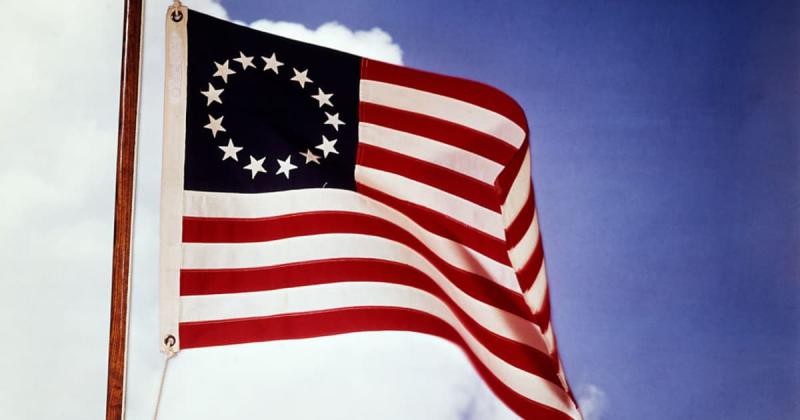
June 14, 1777: During the American Revolution, the Continental Congress adopts a resolution stating that "the flag of the United States be thirteen alternate stripes red and white" and that "the Union be thirteen stars, white in a blue field, representing a new Constellation." The national flag, which became known as the "Stars and Stripes," was based on the "Grand Union" flag, a banner carried by the Continental Army in 1776 that also consisted of 13 red and white stripes. According to legend, Philadelphia seamstress Betsy Ross designed the new canton for the Stars and Stripes, which consisted of a circle of 13 stars and a blue background, at the request of General George Washington. Historians have been unable to conclusively prove or disprove this legend.
The History of the American Flag
Why does the American flag have 13 stripes? Get all the facts and figures on "Old Glory."
2:07m watch
With the entrance of new states into the United States after independence, new stripes and stars were added to represent new additions to the Union. In 1818, however, Congress enacted a law stipulating that the 13 original stripes be restored and that only stars be added to represent new states.
On June 14, 1877, the first Flag Day observance was held on the 100th anniversary of the adoption of the Stars and Stripes. As instructed by Congress, the U.S. flag was flown from all public buildings across the country. In the years after the first Flag Day, several states continued to observe the anniversary, and in 1949 Congress officially designated June 14 as Flag Day, a national day of observance.
Also on This Day in History
Discover more of the major events, famous births, notable deaths and everything else history-making that happened on June 14th
1775 -- U.S. Army founded
On June 14, 1775, the Continental Congress authorizes the enlistment of expert riflemen to serve the United Colonies for one year. This launches the U.S. Army as America's first national institution, more than a year before the Declaration of Independence is published on July 4, 1776. "Resolved, that six companies of expert riflemen, be immediately […]
1789 -- Bounty mutiny survivors reach Timor
English Captain William Bligh and 18 others, cast adrift from the HMS Bounty seven weeks before, reach Timor in the East Indies after traveling nearly 4,000 miles in a small, open boat. On April 28, Fletcher Christian, the master's mate on the Bounty, led a successful mutiny against Captain Bligh and his supporters. The British […]
1811 -- Writer and abolitionist Harriet Beecher Stowe is born
Harriet Beecher Stowe, author of Uncle Tom's Cabin, is born on June 14, 1811 in Litchfield, Connecticut, the seventh child of Congregationalist minister Lyman Beecher. Stowe studied at private schools in Connecticut and worked as a teacher in Hartford for five years until her father moved to Cincinnati in 1832. She accompanied him and continued […]
1846 -- California's Bear Flag Revolt begins
Anticipating the outbreak of war with Mexico, American settlers in California rebel against the Mexican government and proclaim the short-lived California Republic during the Bear Flag Revolt of 1846. The political situation in California was tense in 1846. Though nominally controlled by Mexico, California was home to only a relatively small number of Mexican settlers. […]
1877 -- First African American graduate of West Point
Henry Ossian Flipper, born into slavery in Thomasville, Georgia, in 1856, becomes the first African American cadet to graduate from the United States Military Academy at West Point, New York on June 14, 1877. The United States Military Academy—the first military school in America—was founded by Congress in 1802 for the purpose of educating and […]
1917 -- U.S. President Woodrow Wilson gives Flag Day address
On June 14, 1917, as the soldiers of the American Expeditionary Force (AEF) travel to join the Allies on the battlefields of World War I in France, United States President Woodrow Wilson addresses the nation's public on the annual celebration of Flag Day. Just the year before, on May 30, 1916, Wilson had officially proclaimed […]
1940 -- Germany invades Paris
On June 14, 1940, Parisians awaken to the sound of a German-accented voice announcing via loudspeakers that a curfew was being imposed for 8 p.m. that evening as German troops enter and occupy Paris. British Prime Minister Winston Churchill had tried for days to convince the French government to hang on, not to sue for […]
1946 -- The United States presents the Baruch Plan
The United States presents the Baruch Plan for the international control of atomic weapons to the United Nations. The failure of the plan to gain acceptance resulted in a dangerous nuclear arms race between the United States and the Soviet Union during the Cold War. In August 1945, the United States dropped two atomic bombs […]
1951 -- UNIVAC, the first commercially produced digital computer in the U.S, is dedicated
On June 14, 1951, the U.S. Census Bureau dedicates UNIVAC, the first commercially produced electronic digital computer in the United States. UNIVAC, which stood for Universal Automatic Computer, was developed by a team of engineers led by J. Presper Eckert and John Mauchly, makers of ENIAC, the first general-purpose electronic digital computer. These giant computers, […]
1968 -- Dr. Spock convicted for aiding draft resisters
A Federal District Court jury in Boston convicts Dr. Benjamin Spock and three others, including Yale University Chaplain William Sloane Coffin, Jr., of conspiring to aid, abet and counsel draft registrants to violate the Selective Service Act. During the Johnson administration, Spock, a physician and the famous author of The Common Sense Book of Baby […]
1982 -- Falklands War ends
After suffering through six weeks of military defeats against Britain's armed forces, Argentina surrenders to Great Britain, ending the Falklands War. The Falkland Islands, located about 300 miles off the southern tip of Argentina, had long been claimed by the British. British navigator John Davis may have sighted the islands in 1592, and in 1690 […]
1985 -- TWA flight 847 is hijacked by terrorists
TWA Flight 847 from Athens to Rome is hijacked by Shiite Hezbollah terrorists who immediately demand to know the identity of "those with Jewish-sounding names." Two of the Lebanese terrorists, armed with grenades and a 9-mm. pistol, then forced the plane to land in Beirut, Lebanon. Once on the ground, the hijackers called for passengers […]
2015 -- Gypsy Rose Blanchard's mother, Dee Dee, found stabbed to death
On June 14, 2015, sheriff's deputies in Missouri discover a grisly scene: the bloody body of Claudine "Dee Dee" Blanchard, who had been stabbed to death a few days before. The murder of Blanchard, lying face down in bed in a pool of blood, becomes a highly publicized case about Munchausen Syndrome by Proxy, a […]
2017 -- Grenfell Tower fire kills 72 in London
Shortly before 1:00 A.M. on June 14, 2017, a fire tears through West London's 24-story Grenfell tower. Seventy-two people died in the blaze, scores were injured and hundreds were left homeless in Britain's deadliest fire in more than a century. The fire started in a Hotpoint brand fridge-freezer in a fourth-floor apartment. The flames traveled […]
2017 -- Gunman shoots four people, including GOP congressman, at baseball practice
On June 14, 2017, a gunman walked onto a baseball field at Eugene Simpson Park in Alexandria, Virginia, opening fire on politicians and wounding House GOP Whip Steve Scalise of Louisiana and four others. The representatives had been practicing for the annual Congressional Baseball Game for Charity. James Hodgkinson, a 66-year-old man, asked a passing […]
Be a good human. Grossly derogatory comments, blatantly inflammatory comments, excessive trolling, mean-spirited taunting and insults, scamming, spamming, and off topic comments may be removed in compliance with the site's Terms of Service and the Code of Conduct. The moderators have the final word.

Tags
Who is online
117 visitors
Something to consider when people claim it's only a rag.