
Daylight Saving Map Shows New Sunset, Sunrise Times in US if Bill Passes

By: Alice Gibbs and Amanda Castro (Newsweek)


Hey, let's double down on stupid. We can call the new standard the Donald J. Trump American Time - or - Trump Time.
 S E E D E D C O N T E N T
July 14, 2026 -- Americans in most states will see their winter clocks stay one hour later than usual if Congress passes a proposal to make daylight saving time permanent, ending the twice-yearly ritual of changing clocks.
The Sunshine Protection Act of 2025, sponsored by Rep. Vern Buchanan, a Florida Republican, would make daylight saving time permanent nationwide by repealing the temporary daylight saving period and effectively advancing standard time by one hour.
The House Rules Committee voted 6-4 on Monday to advance consideration of the Sunshine Protection Act, teeing up a House-wide vote as early as this week. The measure has backing from President Donald Trump, who has repeatedly called for an end to the twice-yearly clock changes.
Trump has previously called daylight savings time "inconvenient," and "very costly to our nation." In 2025 he told reporters: "It's something I can do. But a lot of people like it one way, a lot of people like it the other way. It's very even. And usually, I find when that's the case, what else do we have to do?"
If the measure ultimately passes both chambers and is signed by President Donald Trump, and if it takes effect on December 1, most Americans would not "fall back" into standard time during the winter months. Instead, Eastern states would remain on the equivalent of Eastern Daylight Time, Central states on Central Daylight Time, Mountain states on Mountain Daylight Time and Pacific states on Pacific Daylight Time.
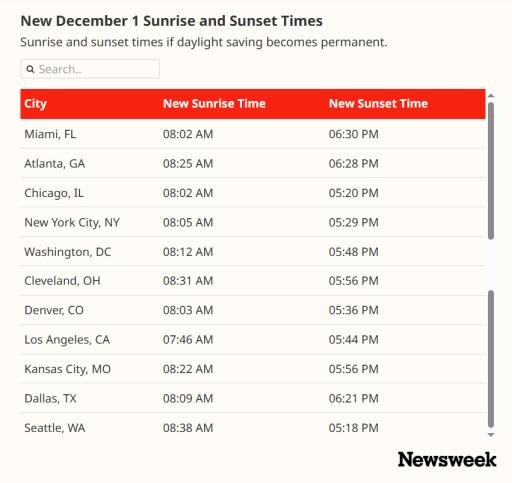
Under permanent daylight saving time, some cities would not see the sun rise until well after 8 a.m. in winter. Seattle's Dec. 1 sunrise would be 8:38 a.m., Cleveland's 8:31 a.m. and Atlanta's 8:25 a.m.
What the Proposal Would Mean
The change would not create extra daylight, but it would shift the clock so that daylight comes later in the morning and lasts later into the evening during winter.
Supporters of permanent daylight saving time argue that ending the clock change would reduce disruption and give Americans more usable daylight in the evening. Buchanan said in May that Americans are "tired of the biannual time change" and argued that permanent daylight saving time could improve public health, reduce traffic accidents, lower crime and encourage more outdoor activity.
While the proposal enjoys bipartisan support, lawmakers do remain divided over whether permanent daylight saving time is the best solution.
Some House Democrats raised concerns this week about darker winter mornings. Rep. Debbie Wasserman Schultz of Florida raised concerns about child safety, while Rep. Nanette Barragan of California pointed to medical research that a change could be harmful to sleep patterns.
A 2025 Stanford Medicine analysis found that both permanent standard time and permanent daylight saving time would be healthier than changing clocks twice a year, because seasonal clock changes disrupt circadian rhythms.
But the debate has long been complicated by concerns over darker winter mornings, particularly for schoolchildren and commuters. The United States previously tried year-round daylight saving time during the 1970s energy crisis, but the experiment was cut short amid public concern over dark mornings.
Under current rules, daylight saving time begins on the second Sunday in March and ends on the first Sunday in November, when clocks move back one hour to standard time. The National Institute of Standards and Technology (NIST) describes daylight saving time as the period when clocks are moved one hour ahead, shifting daylight from the morning to the evening.
That means the most noticeable effect would come between November and March. In New York and Washington, D.C., winter time would move from Eastern Standard Time, or UTC-5, to Eastern Daylight Time, or UTC-4.
In Chicago, Dallas and much of the Midwest and South, winter time would move from Central Standard Time, or UTC-6, to Central Daylight Time, or UTC-5. In Denver and Salt Lake City, it would move from Mountain Standard Time, or UTC-7, to Mountain Daylight Time, or UTC-6.
In Los Angeles, Seattle and most of the West Coast, it would move from Pacific Standard Time, or UTC-8, to Pacific Daylight Time, or UTC-7.
How Every State's Time Would Change
Most states would be one hour later in winter than they are under current standard time. The main statewide exceptions are Hawaii and most of Arizona, which already do not observe daylight saving time. NIST says daylight saving time is not observed in Hawaii, American Samoa, Guam, Puerto Rico, the Virgin Islands and Arizona, except for the Navajo Indian Reservation.
In practice, that means Hawaii would remain on Hawaii Standard Time, or UTC-10. Most of Arizona would remain on Mountain Standard Time, or UTC-7, although the Navajo Nation observes daylight saving time and would need to be treated separately in localized reporting.
Which States Already Back Permanent Daylight Saving Time?
The proposal would also interact with years of state-level efforts to stop clock changes. The National Conference of State Legislatures says 19 states have enacted measures to provide for year-round daylight saving time if Congress allows it: Alabama, Colorado, Delaware, Florida, Georgia, Idaho, Louisiana, Maine, Minnesota, Mississippi, Montana, Oklahoma, Oregon, South Carolina, Tennessee, Texas, Utah, Washington and Wyoming.
Federal law currently allows states to opt out of daylight saving time and remain on standard time, as Arizona and Hawaii do, but it does not allow states to adopt permanent daylight saving time on their own. That is why congressional action is needed before those state laws can take effect.
A Competing Proposal Would Make Standard Time Permanent
The Sunshine Protection Act is not the only proposal before Congress. A separate bipartisan bill introduced this month, known as the Sunshine for Our Kids Act of 2026, would make standard time permanent instead of daylight saving time. Under that approach, Americans would keep the winter clock setting year-round, resulting in earlier sunrises and earlier sunsets.
The competing measure reflects a broader debate over what should happen if the country eventually abandons twice-yearly clock changes. While supporters of permanent daylight saving time argue that later sunsets encourage outdoor activity and provide more usable daylight after work, supporters of permanent standard time say it is better aligned with the body's natural circadian rhythm and avoids darker winter mornings.
What's Next for the Bill
The bill still faces several steps before it could become law. Even if the House approves it, the Senate would also need to pass the measure before it could be sent to Trump for his signature. A similar version of the Sunshine Protection Act passed the Senate in 2022 but did not become law.
For now, the practical effect is straightforward: if permanent daylight saving time becomes federal law by December, most Americans would keep the later clock setting through winter, while Hawaii and most of Arizona would remain unchanged.
Be a good human. Grossly derogatory comments, blatantly inflammatory comments, excessive trolling, mean-spirited taunting and insults, scamming, spamming, and off topic comments may be removed in compliance with the site's Terms of Service and the Code of Conduct. The moderators have the final word.

Tags
Who is online

309 visitors
What exactly is Trump American Time supposed to accomplish? The street lamps will be lit the same number of hours. Stores will be open the same number of hours. Flight schedules won't change.
Naturally the supporters of Trump Time tout the money making opportunities. But is that really so? What does an extra hour of daylight in the evening really allow?
Why can’t we just have standard time, but change when we do stuff if we need to?
We should go the other way in the winter
I love listening to people bitch about this. I think that it's perfect as is.
I hate changing all those time pieces twice a year. I like the extra daylight at the end of the day. I don't like coming home in the dark. I already go to work in the dark even during summer so it's no big deal to me
i make up my own time, it's easier to schedule things