
25 Great Ways to Use Vinegar Around Your Home

By: Debbie Koenig (AARP)


 S E E D E D C O N T E N T
Key takeaways
- In the kitchen : Vinegar loosens buildup, cleans surfaces and removes residue when mixed with water and given time to work. It can also extend the freshness of foods, curdle milk to make buttermilk and improve texture in recipes.
- In the bathroom : The acid in vinegar breaks down soap scum and mineral deposits on glass, tile, fixtures and toilets.
- Personal uses : Diluted vinegar solutions help manage odors and buildup in items like clothing and humidifiers.
- Garage and backyard : Vinegar tackles rust, outdoor grime and buildup in equipment and feeders, but use care with certain materials.
If you’re only using vinegar in salad dressings, you’re missing out: Inexpensive distilled white vinegar can help in just about every room of your home. The key is to understand how it works.
“Some folks think everything else is toxic, so ‘let’s use vinegar everywhere,’ ” says Birnur Aral, a chemical engineer and cofounder of Best of the Year, an independent, expert-led awards program for consumer products and services. “But where it really shines in the household is descaling — when you have mineral deposits inside your teakettle or showerhead.”
White distilled vinegar contains 4 to 7 percent acetic acid. In your store’s cleaning aisle you’ll find “cleaning vinegar,” which contains up to 10 percent. Both are strong enough to dissolve stuff like limescale and rust. But vinegar is not a sanitizer or disinfectant, and it won’t cut through heavy grease. It can damage some surfaces, too. (See the box “7 Ways You Shouldn’t Use Vinegar” at the bottom of this story for details.)
Here are 25 ways to safely use vinegar in your home:
IN THE KITCHEN
1. De-gunk your water bottles and pitchers
Water often contains hard minerals that can build up over time — and that’s not the only issue. “In the summertime, you may start seeing some black film there,” Aral says. “People think it’s mildew, but it’s what we call a biofilm, where there’s bacteria, maybe fungi, and it turns black. Vinegar can help loosen this biofilm.”
Instructions vary by manufacturer, so double-check to be safe, but it may be as simple as this: Fill your bottle or carafe with a 1:1 combination of distilled white vinegar and very warm water, shake with the cap on, and let it soak for 15 minutes or longer. Scrub, then rinse well.
2. Clean (some) counters
Vinegar damages countertops made from stone, but for laminates, stainless steel or butcher blocks, it’s a great everyday cleaner, provided you don’t let it sit on surfaces for too long. Use a spray bottle filled with a 1:1 mix of vinegar and water, wipe, then use a clean, water-dampened cloth to remove any residue.
“You’ve got to remove the organic matter off of the surface before you can spray disinfectant on it and have it actually kill the viruses, the bacteria, what have you,” says Ashley Matuska Kidder, founder of Dashing Maids in Denver. “Vinegar is my starting point. I don’t have stone countertops, so I’ll clean daily with the vinegar-water mixture, and once a week I’ll go in with a disinfectant.”
3. Remove dried-on food from your microwave
That spaghetti sauce splatter you forgot to wipe off has now glued itself to the walls of your microwave. Check with the manufacturer to be sure, but the basic play is: Put 1 cup of water and 1 tablespoon of vinegar into a microwave-safe bowl, then run the microwave for 3 to 4 minutes. The acidic steam it creates will loosen whatever muck has accumulated; you can then use a damp cloth and a little dish soap to remove it.
4. Keep your drain clean
When combined, vinegar and baking soda create a furious bubbling foam (think science fair volcano). Their chemical reaction yields carbon dioxide gas, which makes those bubbles. But the two substances neutralize each other; any residual cleaning power comes courtesy of elbow grease. So skip it for oven cleaning, but use it where pressure can help: in your drain. While it won’t clear a fully clogged pipe, it can wash away the debris that’s slowing things down.
Start by pouring boiling water down the drain. Then add 1 cup of baking soda, followed by a solution of 1 cup each of vinegar and water. Plug up the drain to force the bubbles downward, then wait 5 to 10 minutes before rinsing with more boiling water.
Vinegar plus a little dishwashing liquid creates a trap for fruit flies. Sam Island

5. Catch fruit flies
The scent of overripe, fermenting fruit and vegetables attracts fruit flies in search of food. Since vinegar is made from fermented food, it makes excellent bait for a trap. Put it in a small bowl or jar to lure the flies, and add a drop or two of dishwashing liquid. Cover with plastic wrap, secure with a rubber band, poke tiny holes in the plastic to let the flies in, and leave your DIY trap on the counter. The vinegar’s aroma attracts flies, while the dishwashing liquid breaks the surface tension, allowing them to fall in and drown. Distilled white vinegar works, but apple cider vinegar’s fruitier scent is even better.
6. Descale appliances
You may already run distilled white vinegar through your coffee maker from time to time (manufacturers like Keurig and Cuisinart provide instructions). Vinegar’s ability to break down mineral buildup works on other water-adjacent appliances, too, like your refrigerator’s ice and water dispensers, says Lisa Yakas, a senior account manager for product certification at the National Sanitation Foundation. Be sure to check the instructions for your make and model, and rinse afterward to remove any remaining scent or taste.
7. Make DIY buttermilk
You’re well into a recipe when you notice it calls for buttermilk. No need for a grocery run — all you need is regular milk and some white vinegar. For each cup of buttermilk, put 1 tablespoon of vinegar into a liquid measuring cup, and add enough milk to measure 1 cup. Stir, and let it sit for 5 minutes. It will curdle the milk and create the acidic, tangy flavor your recipe needs.
8. Extend berries’ shelf life
Those juicy berries were just too appealing, so you bought way more than you can eat in one sitting. Soaking them for about 5 minutes in a bowl with 1 cup of vinegar to 3 cups of cold water may prolong their freshness. Rinse well to remove any hint of vinegar, and be sure to dry them thoroughly before refrigerating. “Vinegar contains acetic acid, which can help reduce surface bacteria, yeast and mold spores that may contribute to spoilage,” Yakas says. “The bigger factor, though, is drying and storage. If berries are washed and then stored damp, that moisture can accelerate spoilage.” She recommends drying them thoroughly before storing them in a breathable container lined with paper towels. A vinegar wash can do more than keep your berries fresh: Research published in 2021 showed that a 1:3 vinegar-to-water solution was effective at killing certain parasites that can cause foodborne illness.
9. Make perfect poached eggs
10. Leaven a cake
IN THE BATHROOM
A vinegar-and-water solution can remove soap scum in your shower. Sam Island
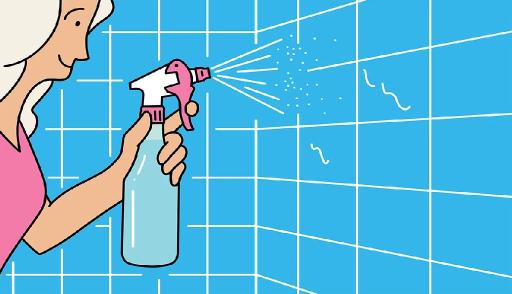
11. Shine up your tile
12. Uncloud your glass shower door
13. Clear your showerhead
Especially if you live in an area with mineral-rich hard water, the individual nozzles of your showerhead can get a little crusty over time. If your water pressure seems weaker than it used to be, clearing those nozzles may do the trick. When you know how to remove the showerhead, the process is easy: Submerge it in a container of vinegar and let it sit between 30 minutes and 2 hours. Rinse thoroughly and reattach it. No idea how to remove the showerhead? You can still do the job, but it’s a little trickier, says Lisa Fogarty, who covers home issues for Consumer Reports: Fill a plastic bag with vinegar and wrap it around the showerhead. Secure with rubber bands and let it soak for up to 2 hours.
14. Erase that ring in your toilet bowl
Hard-water deposits can include iron, which can leave a brownish-red ring at the waterline of your toilet bowl. To remove that stubborn stain, spray it well with undiluted vinegar and let it sit for at least half an hour, or better yet, overnight. Grab a non-scratch scouring pad and scrub the stain, and it should come off. Always check with your toilet’s manufacturer before starting.
15. Make your medicine cabinet mirror sparkle
Don’t waste your money buying glass cleaners. For a streak-free mirror, use your spray bottle of 1:1 vinegar and water. Apply the mixture to a microfiber cloth until it’s just damp — no need to saturate it. Rub the mirror surface from the top down, and spray more solution onto the cloth as needed. This same tip works for any glass surface in your home, including windows.
PERSONAL USES
Soak your feet in a 1:2 vinegar-to-water solution each week to kill funky odors. Sam Island

16. Deodorize smelly feet
That stink can come from bacteria attracted to sweat or from fungi, and sometimes washing alone doesn’t cut it. The Cleveland Clinic recommends a weekly vinegar foot soak: Put 1 part vinegar to 2 parts water in a basin, and dunk your tootsies. Read a book for 15 to 20 minutes, then rinse and dry thoroughly. That vinegar will make your feet inhospitable to the malodorous crud. Don’t try this remedy if your feet have open sores, cuts or scratches, or if it irritates your skin.
17. Decalcify your clothes steamer
Just like other appliances with water reservoirs, minerals can build up and block your steamer, too. The how-to varies by manufacturer, so be sure to check your instructions, but many can be cleaned with a 1:1 solution. Depending on the make and model, it might mean only soaking the reservoir or running the solution through the steamer itself.
18. Clean your humidifier
Humidifiers use a water tank, so mineral buildup is an issue here — but mold may be even more of a concern, especially if you’re allergic to it. Vinegar comes to the rescue, Fogarty says. “Remove the tank and add half a cup of distilled white vinegar and water to the base well. Use a cleaning tool [or a cotton swab and toothpick] to clear scale from crevices. Fill the tank with 1 cup each of vinegar and water, let it soak for 20 minutes and swish occasionally. Drain and rinse both the well and tank until the vinegar smell is gone.”
19. Get the funk out of workout clothes
Afraid to get near your laundry hamper because of the stink? The experts at Peloton, who know a thing or two about sweat, recommend filling a basin with 1 part distilled white vinegar to 4 parts cold water, then soaking your gym clothes for 15 to 30 minutes before washing according to the label instructions.
20. Deep-clean your mouth guard
Anyone who sleeps with a guard against grinding or clenching knows how gross they can get. Christian is himself a teeth-grinder, and he uses distilled white vinegar to deep-clean his mouth guard weekly. “It gets that kind of white calcium buildup on it, and vinegar will dissolve it,” he says. “I can’t call it a disinfectant, but it does a pretty good job of killing the germs and helping with odor.” Check with your dentist for specific instructions.
GARAGE AND BACKYARD
Soak your bird feeder in a 1:1 vinegar-to-water solution monthly to keep it clean and its visitors healthy. Sam Island

21. Clean your birdbath and feeder
You’ve set out the key things your feathered friends need to thrive: food and water. But that can backfire and make them sick if you don’t keep up maintenance. The National Audubon Society recommends regularly cleaning your birdbath and feeder with vinegar. At least every other week, empty the feeder and soak it in a 1:1 vinegar-to-water solution, then rinse and dry thoroughly before refilling. For the birdbath, rinse and scrub it with a weaker solution: 1 part vinegar to 9 parts water.
22. Spruce up your car, inside and out
Whether we’re talking streaky windshields, grimy mirrors, dusty dashboards or dried-on bird droppings, vinegar and a microfiber cloth may be all you need to spot-clean places in and on your vehicle. “I keep a little bottle of vinegar diluted with water in my car, just one-to-one,” Kidder says. “I use it to clean the steering wheel and dashboard.”
Diluted vinegar can remove smashed-on bugs from the outside of your windshield, as well as the haze that coats the inside. And when it comes to hardened bird poop on the exterior, it’s hard to beat — apply some 1:1 vinegar-to-water solution, wipe clean with a microfiber cloth and rinse. The acid dissolves the solids, so you can just wash them away. But because it can strip wax and sealants and potentially damage the paint, the folks at Kelley Blue Book, the automotive pricing guide, recommend testing a small patch first and using this method infrequently.
23. Remove rust
A vinegar soak can help remove rust from metal outdoor objects such as patio furniture. “Acid is really good at removing rust,” Christian says. “Anything from rusty tools to any type of metal corrosion, the way you clean rust is [with] acid. You’re trying to dissolve the mineral buildup.” He says to use caution if you’re working on a concrete patio, though, since vinegar can dissolve the minerals that make up the material.
If a rusted item is submergible, like a cast-iron pan, put it into a bath of 1:1 vinegar solution and check every few minutes. When you can flake off the rust, remove it and scrub. Don’t leave cast iron in vinegar any longer than necessary — if the vinegar seeps past the rust and into the iron, your pan may be damaged. (See the box 7 Ways You Shouldn’t Use Vinegar for details.)
24. Clean your grill grates
When was the last time you gave your grates, and grill accessories like roasting baskets, a deep clean? Leave them too long, and things get pretty gnarly. Vinegar can help. Always check your specific model’s cleaning instructions first, but in general, applying a paste of baking soda and vinegar should remove stuck-on food debris. The fizzing produced by combining the two substances loosens those bits of incinerated steak or barbecue sauce that have been there so long, they feel like part of the grates.
25. Descale your washing machine drum
As with other appliances, water deposits can muck up the inside of your washing machine, too. But the acid in vinegar can erode its rubber gaskets, seals and hoses. The solution is to fill up the drum with hot water, pour in a couple of cups of vinegar and run the machine through its longest wash cycle.
7 Ways You Shouldn’t Use Vinegar
While vinegar can do a lot around your home, don’t consider it an all-purpose cleaner. Used incorrectly, it can damage items, and when mixed with other common cleaners, it could harm your health.
1. Don’t mix with other household chemicals
This can get truly dangerous. Mixing vinegar with bleach produces chlorine gas, while combining it with hydrogen peroxide makes peracetic acid, also known as peroxyacetic acid. “When you have these types of mixtures, it can cause or pose very serious safety hazards, including possible toxic inhalation and potentially some chemical burns,” says Lisa Yakas, a senior account manager for product certification at the National Sanitation Foundation.
2. Don’t expect it to disinfect
The acid in vinegar is great for breaking down minerals, and it does kill some bacteria — but to be really effective, you’d need to use a higher concentration of acetic acid than you’ll find in vinegar, even types marketed specifically for cleaning.
3. Don’t spray stone countertops
Using vinegar to clean stone countertops made from materials like granite, marble, quartz and limestone erodes the protective sealer and etches or dulls the surface.
4. Don’t mop wood floors
Vinegar can break down the finish over time, leaving the wood susceptible to staining or water damage.
5. Don’t clean cast-iron pots and pans
If you find a rusty skillet at a tag sale, diluted vinegar can help dissolve the buildup (see tip No. 23 above). Soak one that’s not rusty, though, and the acid can pit the iron and strip away the built-up residue of a well-seasoned skillet.
6. Don’t wipe down screens
“You should never use vinegar to clean electronic screens, such as on computers, smartphones and televisions,” says Lisa Fogarty, who covers home issues for Consumer Reports. “It can damage the screen’s anti-glare properties and make a touchscreen less responsive.”
7. Don’t let it sit on rubber
Yup, vinegar erodes rubber, too. That makes a risky proposition for things like your washing machine and dishwasher, where it may damage gaskets and hoses. (See tip No. 25 above for a smart way to use vinegar in the washing machine.) “When in doubt, leave it out,” Yakas says. “If you’re ever concerned about vinegar breaking down a material, either don’t use it or just test a small patch.”
Debbie Koenig is a New York-based writer whose work has appeared in The New York Times , Eating Well , WebMD , and dozens of other publications.
Remember the Golden Rule, be a good human. We're here to relax and chat, so let's keep it civil and fun. Please, remember to quote the person(s) you are replying to as a courtesy so everyone can follow the conversation. Grossly derogatory comments, blatantly inflammatory comments, excessive trolling, mean-spirited taunting and insults, scamming, spamming, and off topic comments may be removed in compliance with the site's Terms of Service and the Code of Conduct. The moderators have the final word and may remove comments at their judgement (or lack thereof).
Past performance does not guarantee future results. Comment at your own discretion. The owners of the site, the owner of this group, and the moderators are not responsible or liable for any stupid thing you do. You break it, you buy it. No shirt, no shoes, no service. Don't poke the bear. Mind the gap.

Tags
Who is online
68 visitors
Old fashioned household tips that are still quite useful.