
Costa Rica's recently discovered "coffee frogs" sing in plantations, but pesticides threaten them

By: CBS News


 S E E D E D C O N T E N T
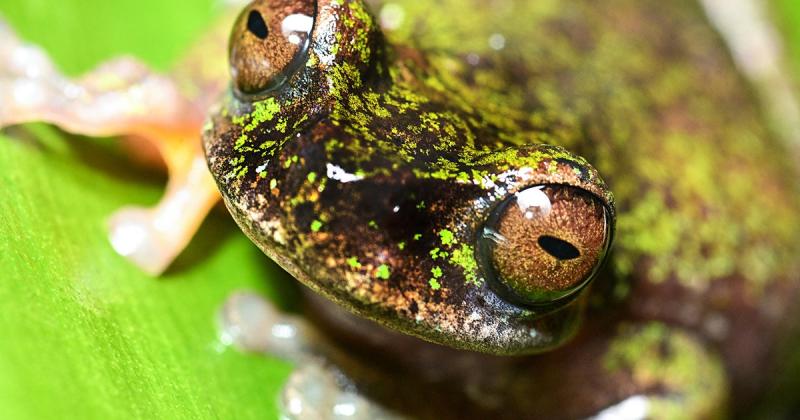
August 8, 2026 -- A tiny greenish, nocturnal frog that thrives in coffee plantations was discovered in Costa Rica's central Pacific region, where it also faces risks from agrochemicals used in farming.
Measuring less than 4 centimeters and known as the "spring frog," AFP reporters observed the dark green-spotted amphibians in San Lorenzo de Tarrazu.
"It's a new species of tree frog for science and endemic to Costa Rica," researcher Wagner Chaves-Acuna told AFP, per the findings of colleagues from the University of Costa Rica and Argentina's National Council for Scientific and Technical Research.
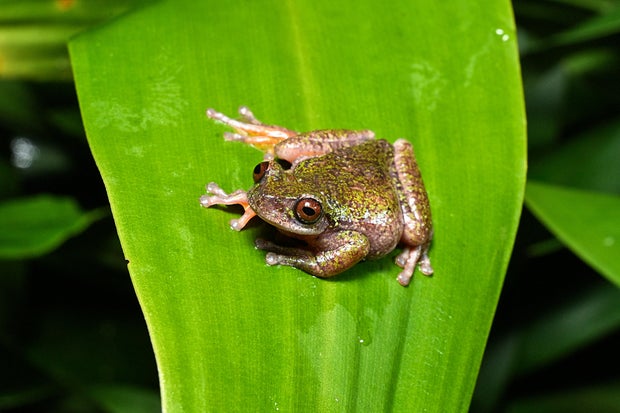
View of a "Rana de las nacientes" (Isthmohyla nacientes), a newly discovered frog species, in San Jose, Costa Rica, on Aug. 6, 2026. Ezequiel BECERRA /AFP via Getty Images
The tiny frog was first observed in the 1960s, but it was incorrectly identified as another species, according to Costa Rica's National Alliance for the Conservation of Amphibians and Reptiles (ANCAR). It was rediscovered and confirmed in 2021 through genetic and morphological studies, the organization said.
Also nicknamed the "coffee frog," the species has another distinctive trait: males have a translucent throat that inflates with their short, high-pitched call.
"At night, when they are most active, you can hear them singing and perched on coffee shrubs," Chaves-Acuna said.
Generally, frogs seek out shade, moisture and food in the crops — but they are not after the coffee berries, feeding instead on the small insects in the habitat.

Costa Rican scientists from the International Institute for Wildlife Conservation and Management at the National University of Costa Rica photograph a newly discovered frog species, "Rana de las nacientes" (Isthmohyla naciente). Ezequiel BECERRA /AFP via Getty Images
Chaves-Acuna warns that pesticide use on coffee plantations could potentially pose a risk to these tiny amphibians.
"These poisons travel through the air ... they seep through the soil and that's where they enter the aquatic systems where the tadpoles develop," Chaves-Acuna said.
The species also faces other threats, including waste dumping, increased tourism and the loss of vegetation due to the invasion of protected areas, according to ANCAR.
Remember the Golden Rule, be a good human. We're here to relax and chat, so let's keep it civil and fun. Please, remember to quote the person(s) you are replying to as a courtesy so everyone can follow the conversation. Grossly derogatory comments, blatantly inflammatory comments, excessive trolling, mean-spirited taunting and insults, scamming, spamming, and off topic comments may be removed in compliance with the site's Terms of Service and the Code of Conduct. The moderators have the final word and may remove comments at their judgement (or lack thereof).
Past performance does not guarantee future results. Comment at your own discretion. The owners of the site, the owner of this group, and the moderators are not responsible or liable for any stupid thing you do. You break it, you buy it. No shirt, no shoes, no service. Don't poke the bear. Mind the gap.

Tags
Who is online

123 visitors
It's the 21st century and we're still discovering new species.
Maybe someday we will find an honest politician species. Maybe after we find unicorns really do exist.