
Four potential positives from higher bond yields

By: Ian Harnett (Financial Times)



A narrative is emerging that the massive investments and corporate capital expenditures on developing AI has created a strong economy. But this pie-eyed optimism glosses over the risk of a dot.com repeat. At some point it becomes too difficult to paper over the real economy with financial fantasies of monetizing AI.
 S E E D E D C O N T E N T
The alarm over the rise in the benchmark US bond yield above the 5 per cent threshold has been dominating financial markets in recent weeks and not without reason.
US 10-year Treasury yields have jumped more than 0.5 percentage points in the past month and 1.3 points since the start of the Iran conflict to levels not seen since 2007. Indeed, today’s levels of US Treasury yields have only been higher since 1900 during the inflationary mid-1960s to mid-2000s, and at the end of the first world war. And importantly, yields on inflation-linked bonds have been rising around the world.
But the move in bond yields has not been without potential positives for investors.
First, we suspect that stronger growth is driving yields higher rather than increased inflation risk or policy uncertainty. For us, real yields — those adjusted for inflation — simply reflect the true cost of capital. Accelerating AI-related capital expenditure is both boosting economic growth and, likely, pushing real yields higher. Increased government spending on areas such as defence and infrastructure may also be boosting real growth and real rates — especially as some of this economic growth is coming from falling household sector savings across the G7 group of nations.
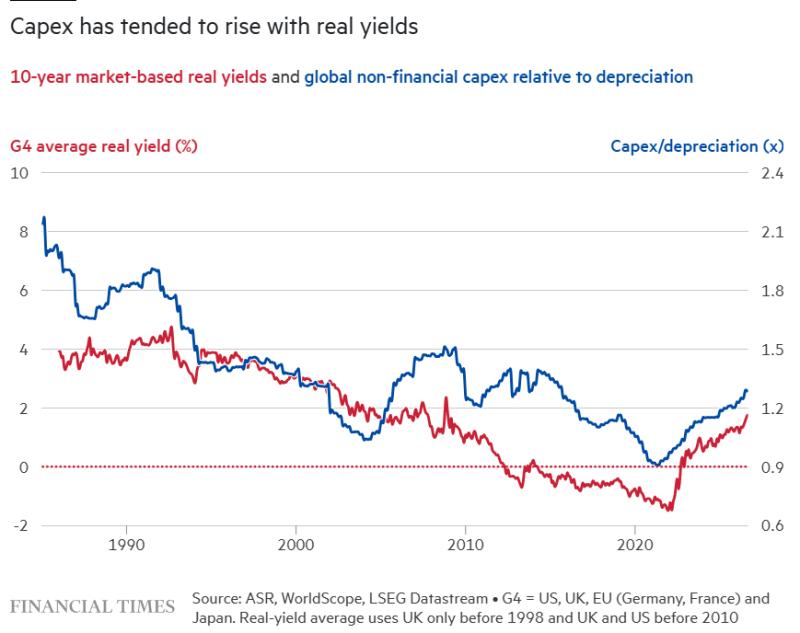
Second, investors should welcome the fact that higher real yields are a source of capital discipline on both governments and corporates. Moreover, this additional discipline need not necessarily constrain the level of capex. Despite what economic theory would suggest, real yields and corporate capex have tended to broadly rise and fall together over the past 40 years. More importantly, these higher real yields are also likely to lead to more productive capex. One of my gripes about the impact of central bank bond-buying programmes known as quantitative easing was always that the resulting low rates didn’t boost capex but reduced it. Companies were rewarded by investors for providing yield via dividends and buybacks, rather than investing in new capacity and processes.
Third, higher real yields will probably see less financial engineering driving markets, which should boost investor and policymaker confidence in the longer-term stability of the financial system. Non-bank financial institutions such as private capital firms were key beneficiaries of the QE period, in part because cheap funding facilitated increased financial engineering. This helped NBFIs to displace the more regulated, traditional bank lending.
We are already seeing a reversal in the fortunes of listed US non-bank stocks compared with US bank stocks, as real rates have normalised. While this may be a coincidence, we suspect that if real yields continue to rise, the business models of some of these new NBFIs, which have been based on low rates, plentiful liquidity and a dose of financial engineering, could be challenged.
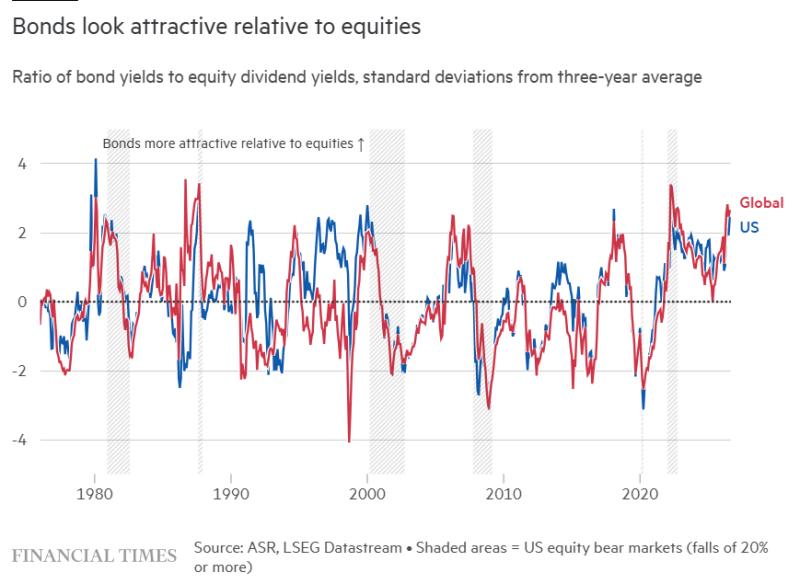
Finally, higher bond yields may create more options for long-run asset allocators. The AI bubble has meant that, for many, investing in US equities has been the “only game in town”. This could be changing. Rapidly rising bond yields have often been a precursor to market corrections, as they expose the extent to which the gains in the stock market have been driven by higher valuation multiples, rather than the growth in earnings, or dividends.
Take a look at the gap between US Treasuries and US markets earnings yield — the earnings per share of companies divided by the share price. While the US 10-year yield is up to more than 5 per cent, the equity market has an earnings yield of only 3.9 per cent, and the dividend yield is back to its 2000 lows at 1.1 per cent. Even if you include buybacks alongside dividend income, the total equity yield is just 2.6 per cent — again, close to the 2000 lows.
But it is also this divergence in relative valuations where the investment opportunities arise for longer-term investors with patient capital. While bondholders can now get a 5 per cent return if they hold their 10-year Treasuries to maturity, the kind of returns that equity holders might expect over the same 10-year period is close to zero, based on historic precedent as indicated by the cyclically adjusted price-earnings model developed by economist Robert Shiller.
While this still may not be enough of a return premium for some investors, given the excitement surrounding the prospects for AI-related stocks, it does create more optionality for long-run asset allocators to invest in something other than equities.
Be a good human. Grossly derogatory comments, blatantly inflammatory comments, excessive trolling, mean-spirited taunting and insults, scamming, spamming, and off topic comments may be removed in compliance with the site's Terms of Service and the Code of Conduct. The moderators have the final word.

Tags
Who is online

158 visitors
The rising bond yields are also a result of self-regulating mechanisms within a financialized economy. The perpetual need to collect interest and rent still needs to protect real value from a rapidly debasing fiat currency. The AI boom has distorted the financial measures but has not eliminated the consequences of a bust. Ian Harnett seems to suggest investors think about how to take advantage of those consequences.