
Challenges to the CO2 Global Warming Hypothesis: (1) A New Take on the Carbon Cycle

By: Ralph B. Alexander (Science Under Attack)


Yes, it's a blog. Dr. Alexander has expressed concern that the empirical evidence and logic of science is being abused and rejected in favor of technocentric pseudoscience. ( About Dr. Ralph Alexander. )
The study by Dr. Ed Berry, that is the subject of the blog post, doesn't deny climate change. Dr. Berry is challenging assumptions made by the IPCC. In a backhanded manner, Dr. Berry is using physics to show that the IPCC is engaged in pseudoscience by selectively ignoring the physics of the earth system and relying on oversimplified assumptions that defy logic.
Dr. Berry's study suggests that the observed increases in atmospheric CO 2 concentration should be attributed to both human and natural sources. Climate change isn't being caused by humans, alone. Dr. Berry is making the case that understanding climate change requires understanding the complete carbon cycle. Humans are a part of nature and not separate from nature.
No doubt, those vested in the political pseudoscientific narrative of climate change (mostly for technological and economic reasons) will attempt to slander Dr. Berry. But true science and logic suggests that the technocentric pseudoscience used by political bodies, such as the IPCC, are promoting solutions directed toward deployment of technology and manipulating economic geopolitics. The political pseudoscience isn't really directly addressing climate change.
Dr. Berry is actually making the case that addressing climate change will require far more than elimination of fossil fuels. A warming planet will accelerate the natural carbon cycle. The earth climate does not distinguish between carbon emitted by human sources and natural sources. Political bodies focusing attention on only the human source of carbon are engaged in something other than mitigating climate change.
 S E E D E D C O N T E N T
Central to the dubious belief that humans make a substantial contribution to climate change is the CO2 global warming hypothesis. The hypothesis is that observed global warming – currently about 1 degree Celsius (1.8 degrees Fahrenheit) since the preindustrial era – has been caused primarily by human emissions of CO2 and other greenhouse gases into the atmosphere. The CO2 hypothesis is based on the apparent correlation between rising worldwide temperatures and the CO2 level in the lower atmosphere, which has gone up by approximately 47% over the same period.
In this series of blog posts, I’ll review several recent research papers that challenge the hypothesis. The first is a 2020 preprint by U.S. physicist and research meteorologist Ed Berry, who has a PhD in atmospheric physics. Berry disputes the claim of the IPCC (Intergovernmental Panel on Climate Change) that human emissions have caused all of the CO2 increase above its preindustrial level in 1750 of 280 ppm (parts per million), which is one way of expressing the hypothesis.
The IPCC’s CO2 model maintains that natural emissions of CO2 since 1750 have remained constant, keeping the level of natural CO2 in the atmosphere at 280 ppm, even as the world has warmed. But Berry’s alternative model concludes that only 25% of the current increase in atmospheric CO2 is due to humans and that the other 75% comes from natural sources. Both Berry and the IPCC agree that the preindustrial CO 2 level of 280 ppm had natural origins. If Berry is correct, however, the CO 2 global warming hypothesis must be discarded and another explanation found for global warming.
Natural CO2 emissions are part of the carbon cycle that accounts for the exchange of carbon between the earth’s land masses, atmosphere and oceans; it includes fauna and flora, as well as soil and sedimentary rocks. Human CO2 from burning fossil fuels constitutes less than 5% of total CO2 emissions into the atmosphere, the remaining emissions being natural. Atmospheric CO2 is absorbed by vegetation during photosynthesis, and by the oceans through precipitation. The oceans also release CO2 as the temperature climbs.
Berry argues that the IPCC treats human and natural carbon differently, instead of deriving the human carbon cycle from the natural carbon cycle. This, he says, is unphysical and violates the Equivalence Principle of physics. Mother Nature can't tell the difference between fossil fuel CO2 and natural CO2. Berry uses physics to create a carbon cycle model that simulates the IPCC’s natural carbon cycle, and then utilizes his model to calculate what the IPCC human carbon cycle should be.
Berry’s physics model computes the flow or exchange of carbon between land, atmosphere, surface ocean and deep ocean reservoirs, based on the hypothesis that outflow of carbon from a particular reservoir is equal to its level or mass in that reservoir divided by its residence time. The following figure shows the distribution of human carbon among the four reservoirs in 2005, when the atmospheric CO2 level was 393 ppm, as calculated by the IPCC (left panel) and Berry (right panel).
A striking difference can be seen between the two models. The IPCC claims that approximately 61% of all carbon from human emissions remained in the atmosphere in 2005, and no human carbon had flowed to land or surface ocean. In contrast, Berry’s alternative model reveals appreciable amounts of human carbon in all reservoirs that year, but only 16% left in the atmosphere. The IPCC’s numbers result from assuming in its human carbon cycle that human emissions caused all the CO2 increase above its 1750 level.
The problem is that the sum total of all human CO2 emitted since 1750 is more than enough to raise the atmospheric level from 280 ppm to its present 411 ppm, if the CO2 residence time in the atmosphere is as long as the IPCC claims – hundreds of years, much longer than Berry’s 5 to 10 years. The IPCC’s unphysical solution to this dilemma, Berry points out, is to have the excess human carbon absorbed by the deep ocean alone without any carbon remaining at the ocean surface.
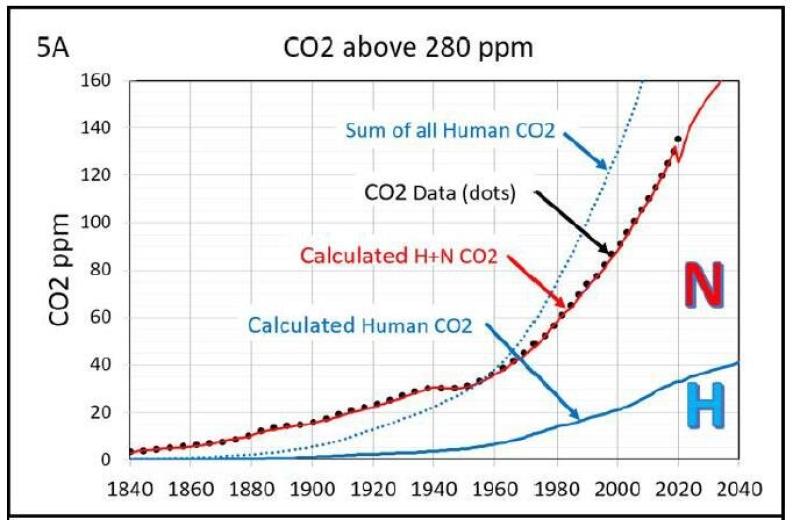
Contrary to the IPCC’s claim, Berry says that human emissions don’t continually add CO2 to the atmosphere, but rather generate a flow of CO2 through the atmosphere. In his model, the human component of the current 131 (= 411-280) ppm of added atmospheric CO2 is only 33 ppm, and the other 98 ppm is natural.
The next figure illustrates Berry’s calculations, showing the atmospheric CO2 level above 280 ppm for the period from 1840 to 2020, including both human and natural contributions. It’s clear that natural emissions, represented by the area between the blue and red solid lines, have not stayed at the same 280 ppm level over time, but have risen as global temperatures have increased. Furthermore, the figure also demonstrates that nature has always dominated the human contribution and that the increase in atmospheric CO2 is more natural than human.
Other researchers (see, for example, here and here) have come to much the same conclusions as Berry, using different arguments.
Tags
Who is online
110 visitors
The study conducted by Dr. Ed Berry actually suggests that climate change is worse than we are being told by political institutions. There isn't a human carbon cycle and a natural carbon cycle. There is only one carbon cycle; both natural and human sources contribute to that one carbon cycle. If we are going to turn back the clock, according to political advocacy, then pseudoscientific technocentric and economic solutions won't be adequate.
As with the pandemic, deploying technology and imposing restrictions will only be an attempt to flatten the curve. An easy political response won't stop climate change any better than it has stopped the pandemic. Nature has the final word in the debate.
That is a fact that climate scientists have never refuted.
I don't think I've ever heard a climate scientist claim that just eliminating fossil fuels will reverse global climate change. It's a start, a measure that would allow us to "flatten the curve" but it certainly hasn't been seen as some cure all vaccine to stop global climate change.
Even if the IPCC's general understanding about how much CO2 gathers and is stored in the atmosphere is not 100% accurate, their desire to slow the amount of CO2 that Dr. Barry says "flows" through the atmosphere is still warranted. Perhaps it's less like a large septic tank rapidly filling up and more like a sewer system, it can still fill up and get overloaded causing the many symptoms of global climate change we are already experiencing and are already impacting millions of humans lives.
The fact remains, global climate change is already a serious threat to humanity and it will only get worse, but if humans choose to change some of their worst habits they could "flatten the curve" and limit the impact it will eventually have on billions of humans or at minimum gives us more time to adapt.
The implication is that climate change is less like a sewer and more like a watershed. While humans can affect a watershed, that human impact only contributes to what occurs within the watershed. Nature also plays an important role in changing what occurs within a watershed. Watershed management requires an understanding of both human and natural impacts.
Whether or not climate change affects human lives is a 'good' or 'bad' thing is beyond the purview of science. If humans are the principal cause of climate change then the problem of climate change is self correcting. As a changing climate adversely affects the human population then human activities affecting the climate will decline. Fewer humans results in less harmful impact on climate. The size of the global human population for 1800 has been estimated at about 1 billion. Returning to preindustrial conditions will occur naturally by reducing the size of the human population. Science cannot determine if that outcome would be 'good' or 'bad'; science can only predict cause and effect.
Which is why the current age is being called the Anthropocene. That's also a problem with the IPCC's emphasis on anthropogenic sources of carbon. Humans are part of nature; humans are not separate from nature. And humans are not the center of the universe.