
Drones dropping "Dragon Eggs" are Colorado's latest aerial assault weapon for wildfires

By: Jason Blevins (The Colorado Sun)
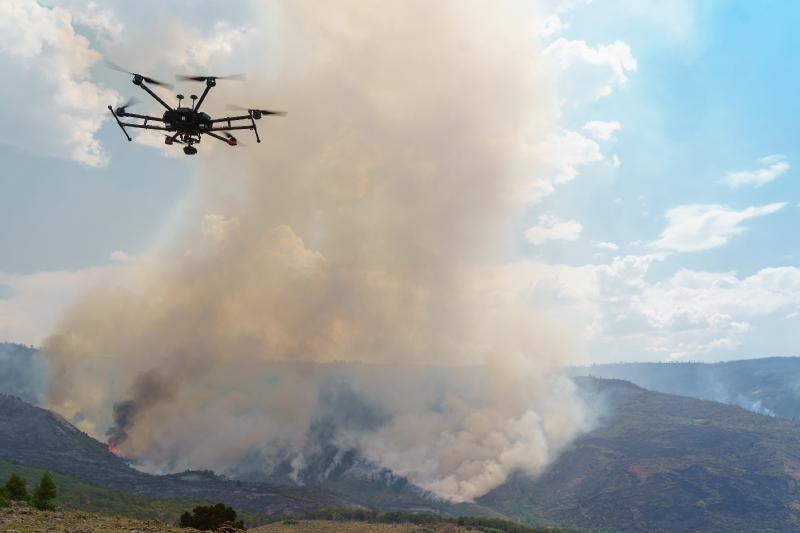


Drones aren't just for scaring airline pilots. Unmanned aircraft are an emerging innovation for firefighting.
 S E E D E D C O N T E N T
Flames erupt on the hillside as plumes of smoke billow into the hazy sky above the Colorado River.
"It's beautiful right now. This is a really good burn going right now," says John Kennedy, the director of one of three branches of firefighters battling the Grizzly Creek wildfire.
Kelly Boyd, standing next to Kennedy on a bluff overlooking the blazing basin, smiles. He started that fire.
A box of "Dragon Eggs" are dropped from a helicopter or drone to help spark controlled fires that create containment lines.
Boyd piloted a drone that dropped balls of fiery chemicals, called Dragon Eggs, that ignited the sprawling bowl of scrub oak, pinon and sage in what firefighters call a "burnout operation." The flames crawled down the basin, charring dry timber and foliage along the southeast edge of the 32,000-acre Grizzly Creek fire. That burned barrier connected two other containment lines, creating a barrier on the fire's southern edge that prevented it from spreading any farther south. By Wednesday, thanks in part to the burnout on that southern flank, firefighters were able to increase their containment of the wildfire to 61%.
Aerial ignition used to be done by helicopters that imprecisely dribbled those ping-pong ball-sized bombs onto fire lines. Now, as part of an increasingly progressive firefighting strategy honed by the Bureau of Land Management and adopted by the Forest Service and National Interagency Fire Center, drones are handling airborne firebombing and more.
"I think more of this is the future," says Mike Ferris, the spokesman for the Type 1 team tackling the Grizzly Creek Fire.
Drones did more than surgically strafe the cliffside with Dragon Eggs, which contain 3 grams of potassium permanganate and drop from a gizmo bolted to the drone that injects them with glycol to create a chemical reaction that causes them to burn for about a minute after hitting the ground. The Unmanned Aircraft Systems also scan the edge of fires with an infrared camera to identify hotspots where crews can bury or douse rogue embers that hop containment lines.
Kelly Boyd, with the Bureau of Land Management's Unaweep Wildland Fire Module based in the Grand Junction field office, pilots a UAS set up to survey for hot spots around the burn in the distance, using an infrared camera. (Steve Peterson, Special to The Colorado Sun)
Most importantly, drones reduce the need for helicopters. That's important in a pandemic fire season when aerial attacks are a critical tool in knocking down fires before large camps of ground crews are needed to defend lives, property and resources.
On Monday, when Boyd's team dropped those flammable Dragon Eggs, things got rowdy as afternoon winds swept through the basin above Bair Ranch, where a team of 60 hotshot firefighters are camped at a rest stop along the edge of the river.
The goal of the three-day mission — which stretched to five days — was to light fires on top of the ridge and let the flames slowly creep down the bowl through the timber toward the hotshots, who are soaking a road with fire hoses to create a damp barrier for flames. That type of controlled burn is easier to contain than wind-driven, unchecked flames reaching the bottom of the basin and climbing up and over the ridge. The burnout operation was planned to create a southern barrier to block the wildfire.
Drone video of the Grizzly Creek Fire shows some of the rough terrain the drones can reach that ground firefighters can't. (Note: some footage sped up for brevity). (Kelly Boyd, Bureau of Land Management)
But an afternoon thunderstorm on Monday pushed into the bowl and "we had winds swirling 360 degrees," says Derek Sams, a division group supervisor trainee from the Larkspur Fire Department.
"We had a fire pushed in all directions and it was a real firefight in here yesterday," Sams says. "That's why we got the infrared out this morning to check for hotspots."
Derek Sams, Division Group Supervisor Trainee, discusses the strategy of the controlled burnout in the southeast corner of the Grizzly Creek Fire containment line. (Steve Peterson, Special to The Colorado Sun)
The scrub oak and pinon is dense and tall in the valley and basin, making it impossible for ground crews to search for flames that might have escaped the fire line.
"One of our guys described it as 'maneater brush,'" says Sams as Boyd's crew readies the six-rotor drone for another heat-seeking flight. "To do this operation we would have had to put multiple people in an aircraft to light fires and ID hotspots. With this tool we don't have to put people out like that."
And that's the real benefit of fighting fires with drones, which with a rotating stock of batteries and an infrared camera costs upward of $25,000.
That could maybe pay for a few hours of helicopter time and, more importantly, it's a small cost to reduce the risk for pilots captaining aircraft over burning terrain, fire officials say. And it's been an exceptionally bad year for firefighting pilots. Two single-engine air tankers collided over the Bishop Fire in Nevada last month, killing two pilots. Three helicopter pilots died in crashes while fighting fires in Arizona, California and Oregon in July and August. Three American firefighters were killed in an airtanker crash in Australia in January.
Drones are part of the firefighting strategy at the Grizzly Creek Fire. The unmanned aircrafts survey for hot spots using an infrared camera and can also drop "Dragon Eggs" to ignite controlled burns. (Steve Peterson, Special to The Colorado Sun)
Granted, the drones are not actually dousing flames. But they are much more efficient than helicopters and able to do things manned aircrafts cannot, including very precise remote ignition and hovering inside smoke plumes while scanning for flames and embers that escape containment.
Firefighters use an infrared camera mounted to a drone to scan for hot spots beyond containment lines. The screen displays color-coded hot regions, providing firefighters a way to locate embers that may have hopped containment lines. (Steve Peterson, Special to The Colorado Sun)
That's what Boyd was doing Tuesday: He is glued to the tablet screen positioned above the drone flight controller. His thumbs deftly toggle the control sticks. The drone, flying at about 1,400 feet above the ground, relays high-definition imagery showing the smoky terrain: a jumble of steep rocks and thick foliage. He aligns side-by-side images of both live video and infrared imagery. A red dot on the screen automatically reveals the hottest spot in the camera's viewfinder.
"When you go IR, you can see right through that smoke," Boyd says, switching his screen over to show flickering red stains spilling across the slope but contained to the fiery side of the freshly bulldozed road tumbling down the ridge. "We are looking for any of that heat on the backside of that road."
That spot that's 110 degrees? Just a rock baking in the afternoon sun. That spot that's 304 degrees? Fire. Luckily the flame is where it's supposed to be, inside the bulldozed perimeter. If it wasn't, Boyd would be able to drop a GPS pin and share it with the hotshot crew on the road below and even direct them to the rogue embers in real time using the drone's video.
After several minutes, Boyd has scanned the southern edge of the fire and the entire ridge above the flames. The drone emerges from the thickening plume and heads back to Boyd and the bluff overlooking the fire.
"Line looks good, boss," he says.
"Copy," answers Sams. "Good news."

Tags
Who is online

97 visitors
There be dragons here.
Drones have almost limitless possibilities. I can see armies of mass-produced drones operating in unison to accomplish good (and, unfortunately, bad) acts. It is similar to what is accomplished by the coordinated actions of millions of mass-produced CPUs ... we call that the internet.
Imagine a future mass-supply of inexpensive drones, thousands of them, capable of carrying payloads sufficient to surgically fight wildfires based on coordinated instruction by powerful servers monitoring the fire progress and taking appropriate corrective action. The drones provide the information on the fire (intensity, direction, etc.) and respond to real-time instructions from the coordinating computers.
I have often wondered if some kind or mortar rounds containing retardant instead of explosives could be launched into the fires. But I think this drone thing is awesome.
Problems with a mortar round as you suggest is it would have to be sturdy enough to take the shock of firing , yet fragile enough to reliably break open and disperse the retardant where directed on the other end and be large enough to cover an effective area 10 to 20 meters at a pop isnt all that effective .
. I dont think its undoable , but then i have watched avalanche crews use howitzers to trigger slides on teton pass , and their biggest concern isnt the use of the gun , but some back country enthusiast ignoring or not getting the warning or just not caring and going into the target area anyway .
You make good points. It was just a random thought of mine.
Amazing stuff. I can see in a short time that the drones will be doing a lot more than dropping egg clusters to help fight fires.
This is a great advancement...
Kudos