
'Cannot do business in the state of California': Gas prices could hit $8/gallon as two refineries shut down

By: Yahoo Finance


 S E E D E D C O N T E N T
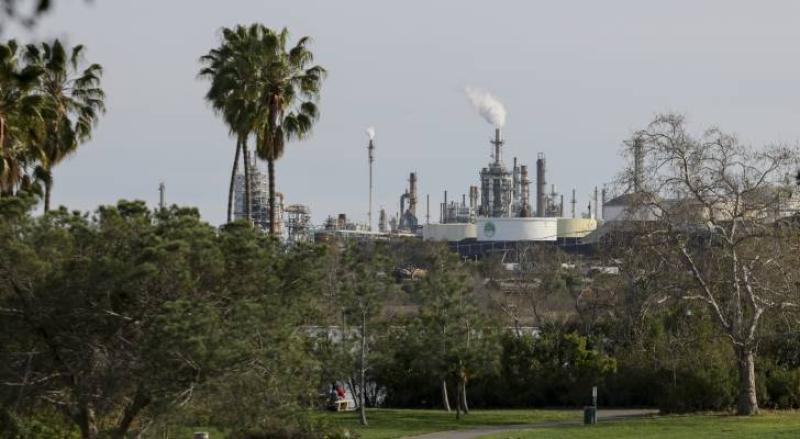
The Phillips 66 Los Angeles Refinery is seen from Ken Malloy Harbor Regional Park on Sunday, Feb. 16, 2025 in Harbor City, CA. Emma Caplan-Fisher Mon, Jun 23, 2025, 6:31 AM 4 min read
In This Article:
Two large California oil refineries are shutting down, triggering mounting concerns from state legislators, industry groups and many others.
Assemblymember Mike A. Gipson of the Gardena district bluntly described his concern during a recent Sacramento hearing.
"This is a tremendous loss," Gipson told NBC Los Angeles, referring to the looming closure of the Phillips 66 plant near L.A. "The jobs that it holds, the individuals… working each and every day, those individuals live in my district, they shop in my district, they add to the economy in my district."
Shutting down refinery powerhouses
The Phillips 66 and Valero's Benicia sites are set to close in 2026. Together, the shutdowns will eliminate nearly 300,000 barrels-per‑day of refining capacity — roughly 20% of the total used in the state.
Valero attributed its decision to "years of regulatory pressure (and) significant fines for air quality violations," including an $82 million penalty levied in 2024. Phillips 66 similarly cited business challenges stemming from California's strict environmental regulations.
"They have said that they cannot do business in the state of California," Gipson reiterated. "The regulatory agencies have imposed on the refiners of California very stringent regulation that makes it very difficult for them to remain in the state of California."
The way Gipson sees it, the state should do everything it can to ensure that its remaining refineries stay in California.
"These companies have been working to make sure they meet these standards, these goals and objectives that the regulatory agencies and legislature have set."
What's at stake
With California processing about 24% of its own crude oil needs but consuming a far greater share — some 13.1 million gallons daily — the impact of these closures is significant:
Less supply and higher gas prices
California drivers already pay the highest gas prices in the nation — around $4.85 per gallon, significantly greater than the $3.16 national average.
With less local supply, experts warn of a potential impact that could range from modest spikes (less than $1 per gallon) to more dramatic spikes if supply disruptions occur. One particular analysis forecasts prices could even soar over $8 per gallon by late 2026.
"California can ill afford the loss of one refinery, let alone two," said USC Professor Michael Mische in a May 2025 report.
Import dependency and emissions
With fewer local refineries, the state will rely heavily on imported fuel — both from other U.S. regions and overseas — which would escalate shipping costs and increase emissions from tanker vessels at the ports as well as possibly the other refineries where the imported oil originates (they themselves may not be meeting sufficiently stringent environmental or quality standards).
Job losses and tax impacts
Each closure risks the loss of hundreds of direct and indirect jobs. The Benicia refinery supports about 400 employees, while Phillips 66 has around 900 workers and contractors. Layoffs will ripple through communities, hurting local economies and tax revenue.
The risks and rewards
As California's refineries close, the state stands to gain and lose in different areas. For example, while local air will potentially be cleaner, pollution will increase at ports from tankers bringing in imported fuel.
There may be a boost to clean-energy infrastructure and jobs, along with potential federal or state transition aid. However, the current industry will see large job losses and communities reliant on incomes related to local refinery work may suffer economically.
The state will also rely on foreign markets and supply chains, making it more vulnerable to disruptions beyond its control.
Trolling, taunting, spamming, and off-topic comments may be removed at the discretion of group mods. NT members that vote up their own comments, repeat comments, respond to themselves, or continue to disrupt the conversation risk having all their comments deleted. Please remember to quote the person(s) you are replying to preserve the continuity of this seed. Posting debunked lies will be subject to deletion

Tags
Who is online



126 visitors
S'ok. Electric is the way to go anyway.............or not.
Rolling black and brown outs are in their future, plus what are they going to do when the utility companies turn the power off during the Santa Ana's?
Yeah, probably. Eventually. Gasoline engines create types of pollution in California that you just don’t see in most of the rest of the country. That’s why we burn specialized fuel formulas and are allowed by law to make stronger air quality regulations. Those special fuels combine with federal regulations on shipping gasoline and a lack of a pipeline to make California kind of a fuel island. So, when refineries close it can be jarring to fuel prices. We can’t easily make up the difference.
And so the state is trying harder than other places to transition to mostly electric vehicles. Currently, something like a quarter of new car sales in California are electric, or at least hybrid. So since we’re seeing a decline in demand, that is another reason why a refinery might close. Long term, we’d probably want to see all of them close, but not right away. The transition is going to take some time.
The Governor of California seemed to be taking a moderate course, at least briefly. He was probably considering a Presidential run. Once the LA riots began, he must have said to himself: I'm part of an insane political party, I better get back to the far left. Yes, all of California's problems from fires to high tax rates to failing schools are self-inflicted. They became a left-wing state and have suffered ever since.
We are talking about a dysfunctional state that started the year $76 billion in debt.
What is the state's far left officials doing about it?
They are promoting rights for transgender athletes, the state spent about $100-200 billion on a high-speed rail debacle, the governor blew up 4 dams on the Klamath River then spent a $ billion to build reservoirs three ended up being cancelled. Those reservoirs would have held enough water, in a year of amble rainfall which California had, to control the wildfires of the past summer. The state has the highest tax rate (13.3) in the nation. CA has one of the highest gas taxes at 70 cents per gallon, they also have some of the highest sales taxes and property taxes. Half the people in the state are covered by Medi-Cal. CA has spent about $11 billion on indigent aid, mostly for people who entered the country illegally. Newsom is now seeking to borrow $3.4 billion from the state's general fund to continue paying that aid.
Nearly 20% of all the people who are Pacific Gas & Electric users have not paid their bills. The CA school system now is among the worst in the nation.
So, I guess you could say the left has destroyed the state of California.