╌>

What a U.S.-Canada Spat Could Mean for American Security and Wallets

  
Via:  Buzz of the Orient  •  3 months ago  •  2 comments

By:   Oliver Knox - USNews & World Report

 What a U.S.-Canada Spat Could Mean for American Security and Wallets
 

Leave a comment to auto-join group Variety Is the Spice of Life

Variety Is the Spice of Life


S E E D E D   C O N T E N T


What a U.S.-Canada Spat Could Mean for American Security and Wallets

gettyimages-2242716096.jpg

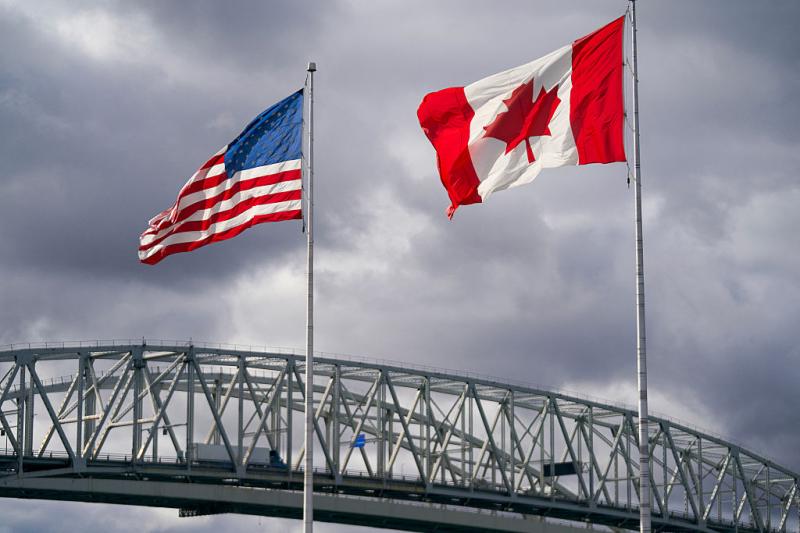
The U.S. and Canadian flags flutter next to a border crossing in Point Edward, Ontario.  (GEOFF ROBINS/AFP/Getty Images)

The United States and Canada appear to be hurtling toward an all-out trade war that will make many products more expensive on both sides of the longest undefended border in the world.

It may also have long-term repercussions for American access to energy. And allies. And maybe for Lake Ontario’s name – at least on the U.S. side. 

On Tuesday morning, President Donald Trump  posted  on social media that he was “giving serious consideration” to renaming it Lake America “in that we don’t expect to be doing much business with Ontario any longer.”

That’s just presidential trolling.

But the overall commercial feud – reciprocal threats to impose tens of billions of dollars in new tariffs – could have deep practical impacts on wallets and entire sectors of the two economies.

What Tariffs Do

Let’s pause here to recall what tariffs are. They are taxes on imported goods. They are initially paid by the “importer of record,” but costs are generally passed on to consumers in the form of higher prices. They are not typically paid by the country whose products are targeted.

Then why do countries get upset when their goods are targeted? The import duty increases the price for American consumers. A higher price will lead those consumers to buy less of the import. That hits the foreign company’s bottom line.

That can mean fewer jobs or even – at scale – a broader economic slowdown.

Canada Strikes Back

On Tuesday, Canada  announced  that it would impose tariffs of 15% to 50% on about $20 billion of American goods – about 7% of total exports to our northern neighbor. The duties, a response to the U.S. decision last week to impose  50% tariffs  on about $20 billion in Canadian goods, will kick in Sept. 8.

“Among the products targeted by Canada are U.S. steel, aluminum, motorcycles, washers and dryers, chain saws, processed cheese, clams and frozen octopus,” The Wall Street Journal noted.

(Also on the list?  Lobsters in myriad forms , a sign Canada may have struck strategically, knowing how important the Maine Senate election could be, come November.)

Bottom line: It’s not just cars and major appliances that will get more expensive but daily consumables – everything from aluminum foil to seafood.


Canada’s Nuclear Option?

Canada’s economy is less than 10% the size of the U.S. economy, so it’s definitely the underdog in this fight. Its main hope rests on exacting political pain in the U.S. Already, some Republican senators have  criticized  this trade war.

And Canada is not entirely defenseless. Ontario Premier Doug Ford has  called  for Canada to consider cutting off exports of electricity, critical minerals, oil and fertilizer. Notably, petroleum and potash are exempt from Trump’s latest tariffs, a nod to their importance to the United States.

That would certainly increase the pressure on the American economy, but it would be a massive escalation.

How Do You Solve a Problem Like America?

The standoff is a test for Canadian Prime Minister Mark Carney’s decision to choose confrontation over concessions to Washington. He has previously warned that “middle powers” must sometimes  resist  major powers like the U.S. and China even if it causes economic pain.

On Saturday, after the U.S. announced its tariffs, Carney bluntly described the world as he sees it, where close ties to the United States can be a liability and where Washington cannot be trusted.

“Our government understood, before many, that America would transform all its commercial relationships. That it would put a series of tariffs on its closest allies and use economic integration as a weapon,” he  said . Constantly shifting U.S. policy means Washington’s signature is “written in pencil.”

Complaints from American allies are nothing new. But they’ve acquired new meaning over the last decade or so. Why?

  • U.S. voters elected Trump, saw his confrontational approach to allies, and ultimately reelected him. The message to the world is that his 2016 victory wasn’t a historic aberration.
  • President Joe Biden did not meaningfully roll back tariffs Trump imposed on China in his first term.
  • Biden at times also angered traditional allies like France (which accused him of being Trump “ without the tweets ”).
  • And the Democrats’ Inflation Reduction Act and CHIPS law provided major incentives to move industrial capacity to the U.S. and away from, say, Europe. French President Emmanuel Macron  warned  those policies might “fragment the West.”

For traditional allies, the U.S. may have become reliably unreliable.


Red Box Rules

The administrator of this group reserves the right, along with the site moderators, to moderate all and any postings to this group, including the right to enforce the ToS, the CoC, and also including anything that the administrator deems within his sole discretion to be offensive, including and not limited to off topic or 'no value' comments, with the power to delete in exercising those rights. 

It would be best, therefore, to be civil in posting on this group.

By now it should be well known that I am unable to open certain sources, videos and pictures.  If I cannot, I will ask that they be described and explained.  If the poster refuses to comply, their comment will be deleted. Instagrams are banned.


Tags

jrGroupDiscuss - desc
[]
 
Buzz of the Orient
Professor Expert
1  seeder  Buzz of the Orient    3 months ago

Take note that this is an AMERICAN source.


Nerm_L
Professor Expert
2  Nerm_L    3 months ago

Mark Carney could consider weaponizing immigration.  Lowering restrictions could exacerbate 'brain drain' and might encourage more immigrants entering the US to get to Canada (essentially flooding the zone).  That would turn one of Trump's political strengths into a weakness.  


Who is online


87 visitors