
The Story Behind "In Flanders Fields" - One Of The Most Famous War Poems Of History

By: By Colin Fraser for War History Online

 S E E D E D C O N T E N T

The Story Behind "In Flanders Fields" - One Of The Most Famous War Poems Of History ,
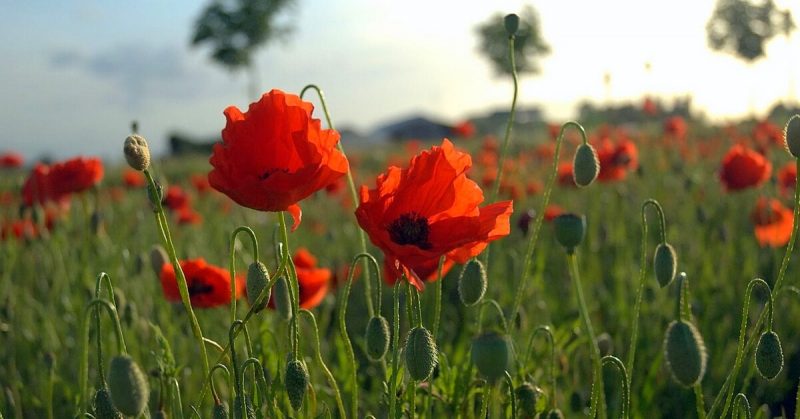
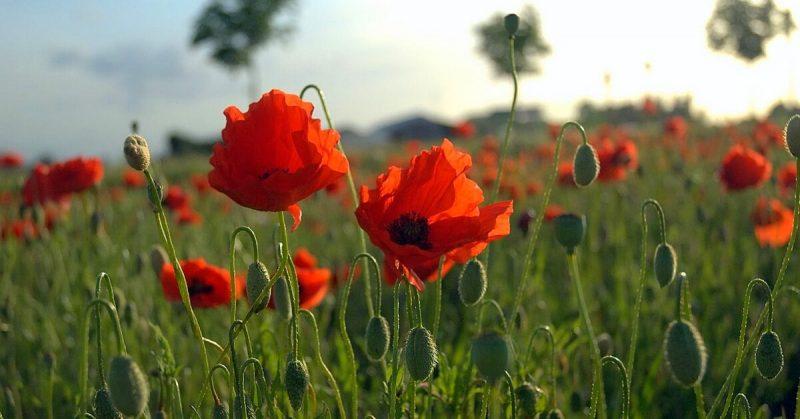
Red Poppies in Flanders Fields. Tijl Vercaemer - CC BY 2.0
More so than any other modern war and certainly more than any war fought before it, The First World War was the age of the "war poet". For the first time, droves of books were shipped from Britain and France to their front lines in Northern France and Belgium (as well as other countries where the War was fought) to be read by a mostly literate army. Many Commonwealth Nations had war propaganda posters asking people to donate books for the soldiers.
Inspired by the horrors of war and rarely without literary influence in the down times away from the front trenches, many soldiers began writing poetry. The resulting collection of poetry written by soldiers on the Western Front is huge and ranges in tone from staunch patriotism to utter fatigue at the madness and mass destruction of 20th-century warfare.
By far one of the most famous World War I poems in the English Language is "In Flanders Fields" by John McCrae, a Canadian doctor who wrote the piece after a friend died while they both served at the Second Battle of Ypres.
In Flanders fields the poppies blow
Between the crosses, row on row,
That mark our place; and in the sky
The larks, still bravely singing, fly
Scarce heard amid the guns below.
We are the Dead. Short days ago
We lived, felt dawn, saw sunset glow,
Loved and were loved, and now we lie
In Flanders fields.
Take up our quarrel with the foe:
To you from failing hands we throw
The torch; be yours to hold it high.
If ye break faith with us who die
We shall not sleep, though poppies grow
In Flanders fields.
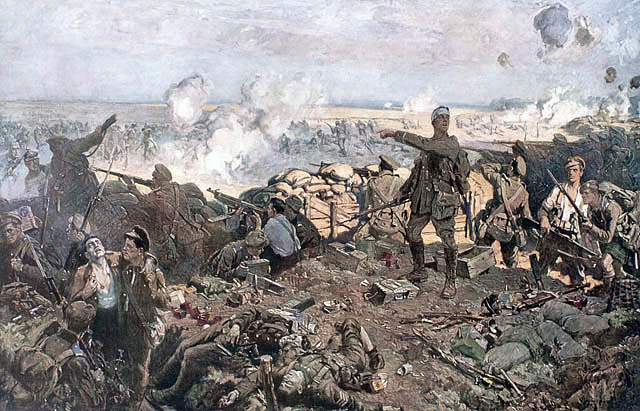
Painting of the Second Battle of Ypres by Richard Jack.
The Second Battle of Ypres, lasting from April 22 nd until May 25 th 1915, in which the Western Entente forces suffered over 87,000 casualties and the Germans at least 35,000, set new precedents in the War. Firstly, it was the first time formerly-colonial forces defeated a European empire in major engagements in Europe. At the battles of St. Julien and Kitcheners' Wood, Canadian forces defeated German forces.
The difficult loss of so many comrades (Canadian battalions lost over 80% of their men in several engagements) mixed with the desire to honor their sacrifice with the duty to fight is seen clearly in McCrae's work.
Perhaps it was too difficult, too much a brand new and fresh horror to confront, but absent from the poem is any reference like that epitomized by Wilfred Owen's "Dulce Et Decorum Est" to chemical warfare. Less than two weeks before McCrae wrote "In Flanders Fields" the German Army released the first mass attack of chlorine gas. French and then Canadian troops were the first to confront it.
McCrae was not a frontline man, but rather a Major and Medical Officer for the First Brigade Canadian Field Artillery. He would have seen some of the first ever medically advanced dressing station scenes of men coming back from the battle suffering from the effects of the poison gas.
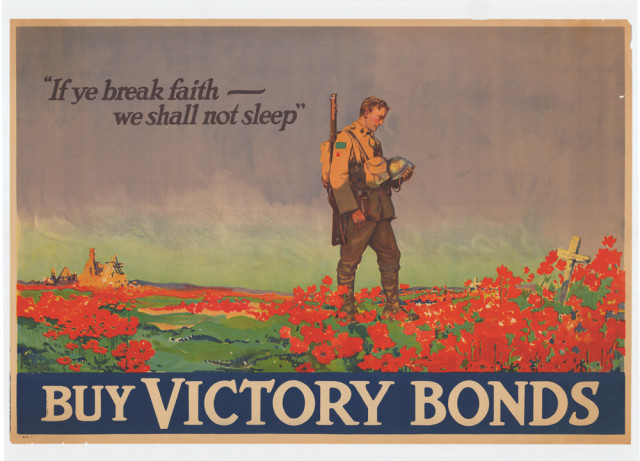
Propaganda poster featuring a line from McCrae's poem, a soldier, a grave, and red poppies.
McCrae, a very well educated and respected doctor born in Guelph, Ontario in 1872, had volunteered to serve when the Dominion of Canada was thrust into the war. He had fought for the British Empire as an artillery officer in the Second Boer War, in the middle of a very prestigious medical career that included service as expedition physician on a canoe trip to Hudson Bay with Lord Grey, the Governor General of Canada in 1910.
He worked and taught at hospitals in Canada and the United States.
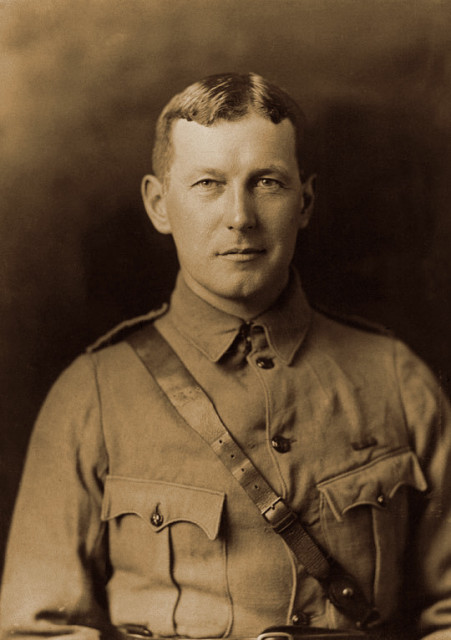
John McCrae in 1914.
Lieutenant Alexis Helmer was killed on the front lines outside the Flemish town of Ypres at the beginning of May 1915. He was the friend of McCrae whose death is cited as the inspiration for the famous poem. The chaplain who normally would have presided over Helmer's funeral was occupied with other duties, so it fell to McCrae to lead the service for his fallen comrade on May 2nd.
Though several stories of how McCrae wrote "In Flanders Fields" arose in the years after its publication, there is one that stands out. On the day after Helmer's service, McCrae sat on the back of an open field ambulance and wrote in his notebook. Sergeant Major Cyril Allinson recalls seeing McCrae write the poem, occasionally glancing over to his friend's grave. On the hollowed ground many poppies were growing, fertilized by the dead, a common occurrence in the region and written about in descriptions of recent burial grounds from wars past.
It is said that McCrae was unhappy with the poem and threw it out after he wrote it, only for it to be rescued from the rubbish by friends who later convinced him to publish it. "In Flanders Fields" was published anonymously in Punch magazine in Britain on December 8 th , 1915, to great acclaim. Before long, McCrae was revealed as the author and showered with praise.
The poem was used as propaganda to recruit volunteers and sell war bonds. After the war, the poem, as well as the poppy flower, became symbols for remembrance, honoring those who served and especially those who gave their lives.
McCrae would become one of the honored dead on January 28 th , 1918. On January 18 th , he was promoted to Colonel and Consulting Physician to the British Armies in France and immediately contracted pneumonia. The sickness was severe, and he developed cerebral meningitis, which proved fatal.
To a nation that lost three-quarters of one percent of its entire population with an all-volunteer Army in Word War I, McCrae is memorialized as one of its greatest poets and officers.
By Colin Fraser for War History Online
The administrator of this group reserves the right, along with the site moderators, to moderate all and any postings to this group, including the right to enforce the ToS, the CoC, and also including anything that the administrator deems within his sole discretion to be offensive, including and not limited to off topic or 'no value' comments, with the power to delete in exercising those rights.
It would be best, therefore, to be civil in posting on this group.
By now it should be well known that the administrator is unable to open certain sources, videos and pictures. If he cannot, he will ask that they be described and explained. If the poster refuses to comply, their comment will be deleted. Instagrams are banned.

Tags
Who is online
382 visitors
Today, November 11, was Remembrance Day in Canada, when Canadians think of their soldiers who died and were wounded during the 2 World Wars. Veterans sell cloth poppies to fund their organizations. Any recent photos of Canadians will see them wearing their poppies. When I was in Canada I bought and wore my poppie every year. One extended family member, a cousin who was at least 25 years older than me at the time was a bomber navigator for the Royal Canadian Air Force who was shot down by the Nazis and is buried "over there".
Unsurprisingly, young and new Canadians don't really wear poppies.
I guess I haven't seen any photos of young and new Canadians. I suppose the feelings are the same among new and young Americans.
Don Cherry is probably right. I''ve not been back to Canada for almost 2 decades so I guess The Great Wars are not remembered or even thought of at all by most people now.
When we were in Shanghai I was surprised to see poppies growing there, so I took this photo.
Where Have All the Flowers Gone?
Song by
Long time passing
Where have all the flowers gone
Long time ago
Where have all the flowers gone
The girls have picked them every one
Oh when will you ever learn
Long time passing
Where have all the young girls gone
Long time ago
Where have all the young girls gone
They've taken husbands every one
Oh when will you ever learn
Long time passing
Long time ago
Where have all the young men gone
They're all in uniform
Oh when will we ever learn
Well, Americans were involved in wars here and there around that time, were they not?
Arvo...
Lest We Forget..
The Sydney Opera house is lit up every year for Remembrance Day...
November 11th, 2026..
Fantastic.