
What literature can teach us about the climate crisis

By: By ELLIOT HELLER, IN COLLABORATION WITH BEN-GURION UNIVERSITY OF THE NEGEV VIA The Jerusalem Post JPost. com

 S E E D E D C O N T E N T

What literature can teach us about the climate crisis
Prof. Itay Marienberg-Milikowsky of Ben-Gurion University argues that the books that matter most for the environment may not be about the environment at all
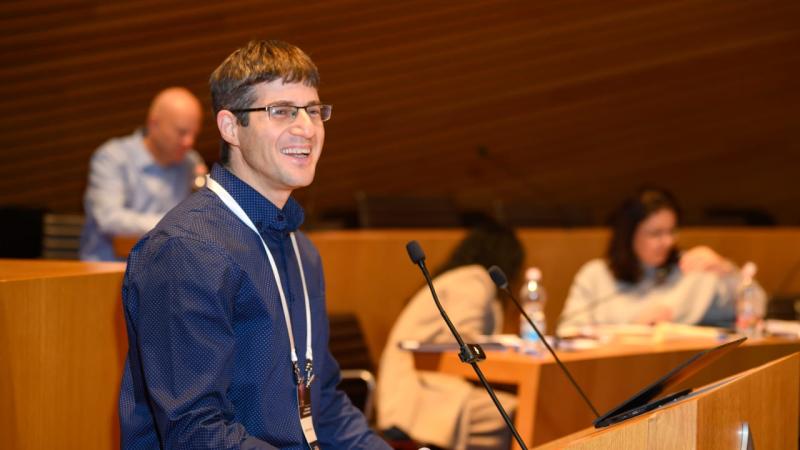
Ben-Gurion University Prof. Itay Marienberg-Milikowsky supports research in climate and literature at the Goldman Sonnenfeldt School of Sustainability and Climate Change. (photo credit: BGU)
Like the vast majority of experts, Itay Marienberg-Milikowsky thinks we are in the midst of a climate crisis. But it is among the hardest crises to relate to: vast, decades in the making, and extremely complex in its causes and solutions.
The Ben-Gurion University professor of Hebrew literature argues that such a "silent killer" crisis demands an equally gradual cultural shift, especially in literature and the arts. Stories help us imagine the world differently, he notes, and the way that books treat nature, even in passing, can shape how a society relates to it.

Interdisciplinary research workshop, Center for Environmental Humanities at The Writers’ House, Beersheba (credit: BGU)
Today, Marienberg-Milikowsky is helping bring this approach to Israel. But his view runs against conventional instinct: the literature most likely to change how we think about nature, he argues, rarely announces it.
Beyond climate fiction
Scholarship on literature and the environment is not new. "There has been very intensive research on the treatment of the environment in literature since the early 1990s, in Europe and in the United States," Marienberg-Milikowsky says.
"Climate literature" is usually associated with climate fiction - works such as The Drowned World or Parable of the Sower, where climate is the central theme - a genre that has inspired films and global attention.
It can also refer to allegorical works, which convey a clear climate message without mentioning it explicitly. But Marienberg-Milikowsky has something different in mind.
"The mere representation of nature in literature does not necessarily mean that nature is what we are actually thinking about," he says. "Whoever reads Orwell's Animal Farm isn't thinking about animals. They're thinking about human beings."
What interests him are stories that can be about anything, but in which "something is revealed in the way the characters relate to nature." Small hints, or "easter eggs," revealing characters' attitudes toward the environment and natural resources.
"Sometimes what's important is not what a story says explicitly, but what sits in the background, what is obvious to it," he says. "Gradually, you discover that if you only turn your eyes to the right place, it all jumps out in front of your eyes."
For example, he explains, a five-year-old child in Israel who grew up in the shadow of war may imagine that sirens and shelters are a regular part of life. Someone raised in a place with a strong car culture may assume that every adult must have a car. Literature can challenge those assumptions.
"The quiet power of literature and culture is that it enables the reader to imagine a different world, without being preachy," he notes. "Literature isn't bound to the current conditions on the ground. It can describe another reality."

Marienberg-Milikowsky’s research focuses on literature of all topics, but contain small references to the background environment. He believes these can gradually change societal norms and views on conservation-related issues. (credit: BGU)
.
From Herzl to the Sages
Although his primary focus is Talmudic literature, he draws key examples from the modern Hebrew canon, which he says is full of environmental concerns in its margins.
Herzl's 1902 novel Altneuland (Old-new land - not originally in Hebrew, but vital to Zionist literary imagination) follows two friends who stop in Jaffa en route to a remote island and find a poor, neglected country, tremendously hot and short of water.
Twenty years later, returning to Europe, they stop in Palestine again, surprised to find a land rebuilt, in Herzl's vision, by a planned, cooperative Jewish enterprise that devised efficient solutions to the heat, irrigated the land, and brought in modern technology.
"Suddenly, it's a utopia," he says. "They discover that there are solutions for the heat, for the lack of water, for all the challenges posed by the local environment."
The book is about Zionism, not climate. But the professor finds significance in climate being the first thing the pair noticed.
"In Herzl's conception of Zionism, he saw contending with the climatic difficulties of the country as the first thing Zionist society would have to face," he says, "as if this were the test."
Weather plays a more allegorical, less explicit role in S.Y. Agnon's masterpiece Only Yesterday (Tmol Shilshom): instead of testing the land's inhabitants, as in Herzl's work, it mirrors what happens to them, paralleling their failures and hopes.
The Sages of the Talmud also reference nature and stewardship, and sometimes this is their focus.
In one story, Honi the Circle-Drawer draws a circle during a severe drought and refuses to leave it until rain falls.
But more interesting cases, according to Marienberg-Milikowsky, are those in which this is not the focus.
For example, another Honi story tells of him seeing an old man planting a carob tree, which takes 70 years to bear fruit. Honi questions why the man invests in a tree he likely won't live to enjoy. The old man answers that he found a world filled with carob trees only because his ancestors planted them, so he must plant for his descendants.
Here again, the environment is not the central point - but it is clearly present, opening a different way to imagine the human bond with nature.
Change measured in decades
Literature's influence, he recognizes, advances far more slowly than technological breakthroughs.
"When we talk about the influence of literature and culture, we're not really talking about direct influences, not in short time frames," he says. "It's not that tomorrow morning, because someone read a compelling story which touches on nature, they start composting their organic waste. These are longer processes. But in time, our language changes. The questions we ask ourselves change. And eventually, policies, political priorities, and business norms change."
He draws a parallel to how language evolved in the area of gender. If one were to watch an episode of the 1990s sitcoms Seinfeld or Friends today, they would notice some sayings and norms that now seem awkward.
"You say to yourself, they say things that today we wouldn't say anymore," he says. "What has happened in the meantime is that our language has changed, sometimes almost without noticing."
He cites the Danish drama Borgen, whose protagonist is Denmark's prime minister.
"In almost every episode, you see her traveling from home to work on a bicycle. This image of a prime minister cycling, which seems so natural in Denmark, is almost unimaginable for someone living in Israel. And that subtle little detail is exactly where its significance lies," he says. "Because when you see it, your first reaction might be, 'This could never happen here.' But then, at a second glance, you ask yourself: 'Why not, actually? Maybe, someday, it could.'"
At BGU, Marienberg-Milikowsky, jointly with Dr. Michal Birkenfeld of archaeology, helped establish a framework for environmental humanities within the Goldman Sonnenfeldt School of Sustainability and Climate Change and the Faculty of Humanities and Social Sciences.
"The purpose is to really promote research in the fields of environmental humanities," he says.
While much progress has been made, the work is still at a very early stage.
"It's still a bit early to talk about results," he says. "But what is already happening is that researchers who previously felt left out of the loop of environmental discourse - and never imagined discussing their humanistic work with natural scientists, say, from the other side of campus - are now making it part of their own language. And that is no small thing."
This article was written in collaboration with Ben-Gurion University of the Negev.
The Environment and Climate Change portal is produced in cooperation with the Goldman Sonnenfeldt School of Sustainability and Climate Change at Ben-Gurion University of the Negev. The Jerusalem Post maintains all editorial decisions related to the content.
The Code of Conduct and Terms of Service must be complied with.
Any comment posted about politics or religion not relevant to the English Literature articles that are posted will be deleted.
The administrator reserves the right to delete any comment he considers to be offensive, off topic or of no value.
Videos or images or links to sources that the Administration cannot open must be described or explained when requested or they will be deleted.

Tags
Who is online
72 visitors
This article started me thinking back to the books about past times that I have read to try to remember references in them to the environment and weather Can anyone recall them in books they have read?
The Grapes of Wrath
To the red country and part of the gray country of Oklahoma,
the last rains came gently, and they did not cut the scarred
earth. The plows crossed and recrossed the rivulet marks. The
last rains lifted the corn quickly and scattered weed colonies
and grass along the sides of the roads so that the gray country
and the dark red country began to disappear under a green
cover. In the last part of May the sky grew pale and the clouds
that had hung in high puffs for so long in the spring were
dissipated. The sun flared down on the growing corn day after
day until a line of brown spread along the edge of each green
bayonet. The clouds appeared, and went away, and in a while
they did not try any more. The weeds grew darker green to
protect themselves, and they did not spread any more. The
surface of the earth crusted, a thin hard crust, and as the sky
became pale, so the earth became pale, pink in the red country
and white in the gray country.
In the water-cut gullies the earth dusted down in dry little
streams. Gophers and ant lions started small avalanches. And
as the sharp sun struck day after day, the leaves of the young
corn became less stiff and erect; they bent in a curve at first,
and then, as the central ribs of strength grew weak, each leaf
tilted downward. Then it was June, and the sun shone more
fiercely. The brown lines on the corn leaves widened and
moved in on the central ribs. The weeds frayed and edged
back toward their roots. The air was thin and the sky more
pale; and every day the earth paled.
In the roads where the teams moved, where the wheels
milled the ground and the hooves of the horses beat the
ground, the dirt crust broke and the dust formed. Every
moving thing lifted the dust into the air: a walking man lifte
a thin layer as high as his waist, and a wagon lifted the dust as
high as the fence tops, and an automobile boiled a cloud
behind it. The dust was long in settling back again.
A PERFECT example. Of course there is also the story of Noah.