
NASA's Nancy Grace Roman Space Telescope set to launch, promising fastest scans of the cosmos ever


 S E E D E D C O N T E N T
June 15, 2026, 5:55 PM EDTBy Denise Chow
GREENBELT, Md. — It's go time for NASA's next-generation space telescope.
After nearly two decades of development, $4.3 billion and the labor of hundreds of scientists and engineers, the Nancy Grace Roman Space Telescope is less than three months from launch.
From a point roughly 1 million miles from Earth, the telescope is expected to survey the cosmos, capturing panoramas of hundreds of millions of stars and billions of galaxies. With this observatory, NASA hopes to unravel the secrets of dark matter and dark energy and discover thousands of planets beyond our solar system.
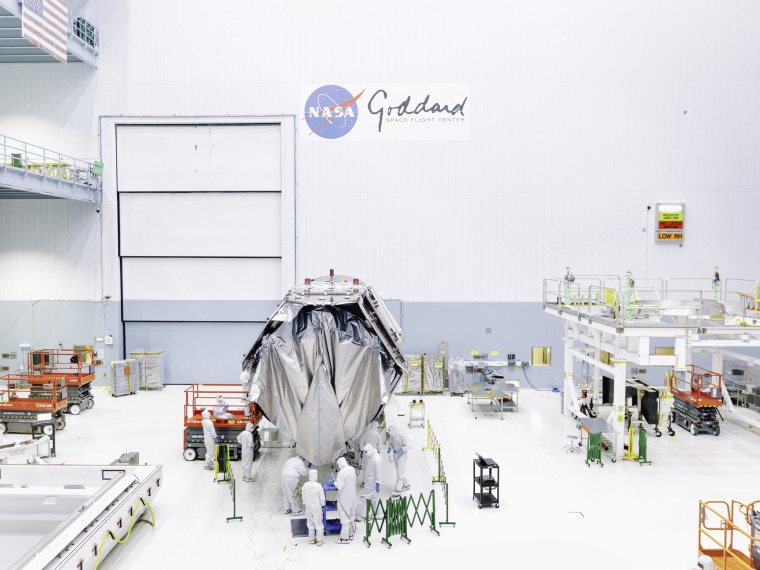 The Roman telescope inside the Spacecraft Systems Development and Integration facility at Goddard.Jason Andrew for NBC News
That's because Roman will be able to survey and map more of the sky than ever before, at a pace hundreds of times faster.
Julie McEnery, the senior project scientist for the Roman telescope here at NASA's Goddard Space Flight Center, said that in just one month of data collection, Roman will be able to peer at underexplored parts of the Milky Way to study stars across a deep slice of the galaxy, building an astronomical catalog far larger than any that exists today.
"In the mission's first five years, it's expected to unveil more than 100,000 distant worlds, hundreds of millions of stars, and billions of galaxies," she said.
The Nancy Grace Roman Space Telescope, named after the woman who became NASA's first chief of astronomy in 1959, will join roughly a dozen space telescopes that the agency has in operation focused on a range of science targets.
NBC News got a rare, up-close look at the telescope during its final days in the clean room, where NASA has assembled it piece by piece over the past decade. By the end of this month, the bus-sized observatory will have been packed up, transported to Baltimore, then barged to the Kennedy Space Center in Florida ahead of a targeted launch on Aug. 30.
"It's like the kids are going off to college," McEngry said, her face pressed against a window overlooking the clean room to take in one of her final views of the telescope. "It feels almost emotional."
Read more : A behind-the-scenes look inside the restricted room where NASA built the Nancy Grace Roman Space Telescope
Seeing more of the sky than ever before, 1,000 times faster
The scope of what the Roman telescope will observe during its mission is difficult for the mind to grasp.
"If we were to take a single image that is produced from our main survey and try to fully display it with a set of 4K TVs, you'd need more than half a million TVs," McEnery said. "And just to give you a sense of the scale of that, if I was to lay out those 4K TVs, it would cover 45 city blocks. Or to pick something you actually look at, it would entirely cover El Capitan in Yosemite National Park."
That main survey will take more than a year to complete, during which time the telescope will gaze through the Milky Way's dense, star-packed center, known as the galactic bulge.
It's one of three primary surveys planned; another calls for the Roman telescope to scan about 12% of the entire sky in under a year and a half. The resulting map of the cosmos will allow astronomers to measure how fast the universe is expanding — which could shed light on two of the most puzzling phenomena in the universe: dark matter and dark energy.
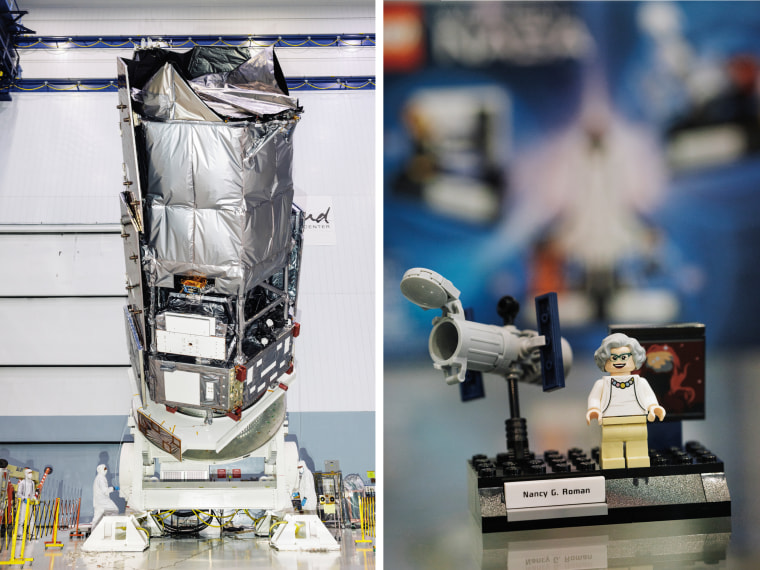 Left: the Nancy Grace Roman Space Telescope in the clean room. Right: a Lego model of Nancy Grace Roman, a pioneer of modern space-based astronomy after whom NASA named its next-generation telescope in 2020.Jason Andrew for NBC News
Scientists think dark energy is accelerating the universe's expansion, while dark matter is thought to make up most of the matter in galaxies, but it's invisible and can only be inferred by the gravitational effects it exerts.
"We know that Roman will give us the definitive data to help us understand the twin mysteries of dark matter and dark energy," said Dominic Benford, the Roman telescope's program scientist at NASA headquarters in Washington, D.C.
The third survey will focus on supernova explosions that occurred up to 8 billion years ago. Peering back through this cosmic time machine will help astronomers trace how the universe has expanded over its history — offering further insight into dark energy.
The Roman telescope is often compared to the Hubble Space Telescope, which launched in 1990. The two are roughly the same size — about that of a semitrailer truck — and similarly barrel-shaped. But the new observatory should be able to survey the cosmos 1,000 times faster than Hubble, and each image will capture a patch of sky at least 100 times larger than one of Hubble's, according to McEnery.
"To put this into context, one month of Roman observations would correspond to a century with Hubble," she said.
An iconic panoramic view of the Andromeda Galaxy that Hubble captured, for instance, was a mosaic stitched together from more than 400 observations. Roman's large field of view would be able to capture the same panorama with only two, according to NASA.
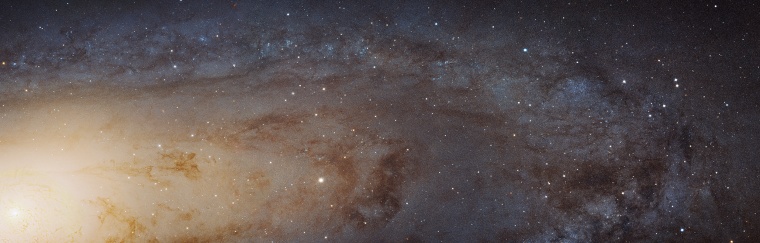 Hubble's view of the Andromeda galaxy, released by NASA in 2015, was stitched together from more than 400 observations.NASA
Both Hubble and Roman perform what's known as spectroscopy: the splitting of light into different wavelengths or colors. Astronomers analyze these patterns, including which colors are emitted, absorbed or reflected, to gauge the size, temperature and composition of objects in space.
The telescope will sit at a location in space called L2, which isa Lagrange point, where the gravitational acceleration from the sun and Earth balance out. This allows the observatory to remain in a stable orbit. Just five such points exist, and Roman will share the same one as the James Webb Space Telescope, which launched in 2021.
Benford said that once it's up and running, Roman should work synergistically with Hubble and Webb.
"We might discover a new star-forming region in our own galaxy that has never been seen before, and then we can use the amazing set of tools on Hubble to study those interesting parts of space and learn about them in greater detail," he said. "We can do the same thing with Webb, but we need Roman to discover those objects of great interest."
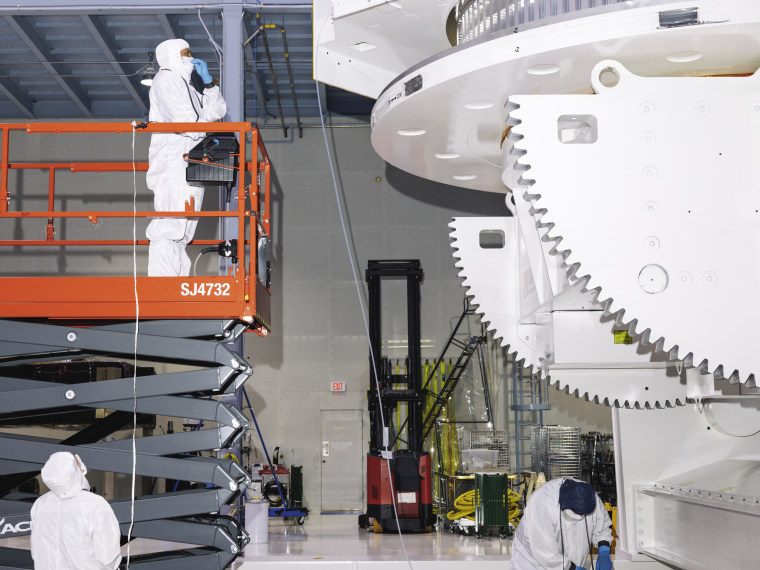 Workers in the clean room are required to wear white "bunny suits" to protect the telescope from contamination.Jason Andrew for NBC News
Under budget and ahead of schedule
Benford has been involved in the Roman telescope project since the observatory was a pen-and-paper idea nearly two decades ago.
"It is a little hard to believe that after almost 20 years of working on this project, the moment when we ship the Nancy Grace Roman Space Telescope to Florida and send her out into space is almost upon us, and that I'm never going to get to see it again," he said.
The telescope didn't yet have a name when Benford got involved. The one chosen nods to a woman considered a pioneer of modern space-based astronomy. Nancy Grace Roman, who was born in 1925 and died in 2018, was nicknamed the "mother of the Hubble Space Telescope" in part because her colleagues credited her with winning congressional approval for Hubble. NASA's newest space telescope was named in her honor in 2020.
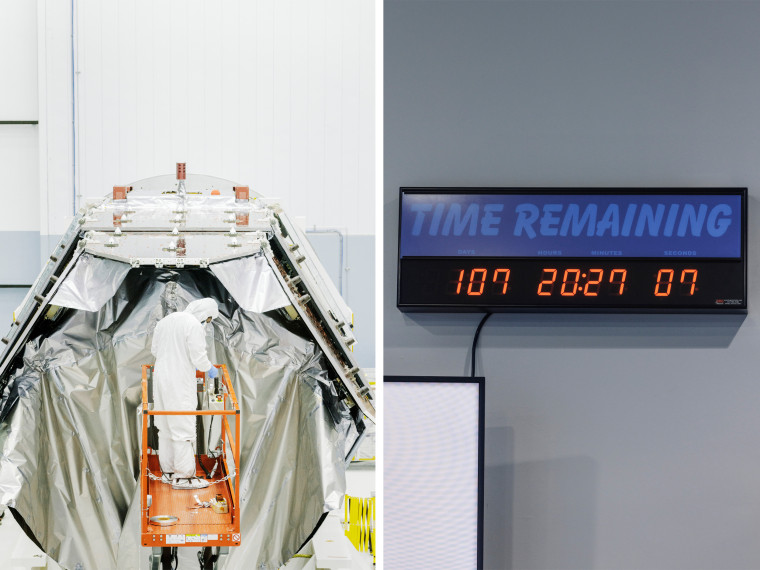 Left: A Goddard employee performs final checks on the Roman telescope in the clean room; right: a clock counts down the time remaining until the observatory is launched into space.Jason Andrew for NBC News
Unlike many other flagship NASA missions, the Roman telescope came in under budget and ahead of schedule — a feat that wasn't easy, Benford said.
"It has been a huge focus of my professional life to get this observatory into operation in space, and for many years it really felt like it was a constant struggle to do that," he said.
The project weathered major interruptions, including the Covid pandemic and the two longest government shutdowns in U.S. history (this year's and last year's). Originally, NASA had aimed to launch the Roman telescope no later than May 2027.
The observatory is slated to lift off atop a SpaceX Falcon Heavy rocket. After that, Benford said, the Roman telescope will journey for more than three months to its destination in space. Once it arrives, mission controllers will spend time testing the observatory's instruments before scientific observations can begin.
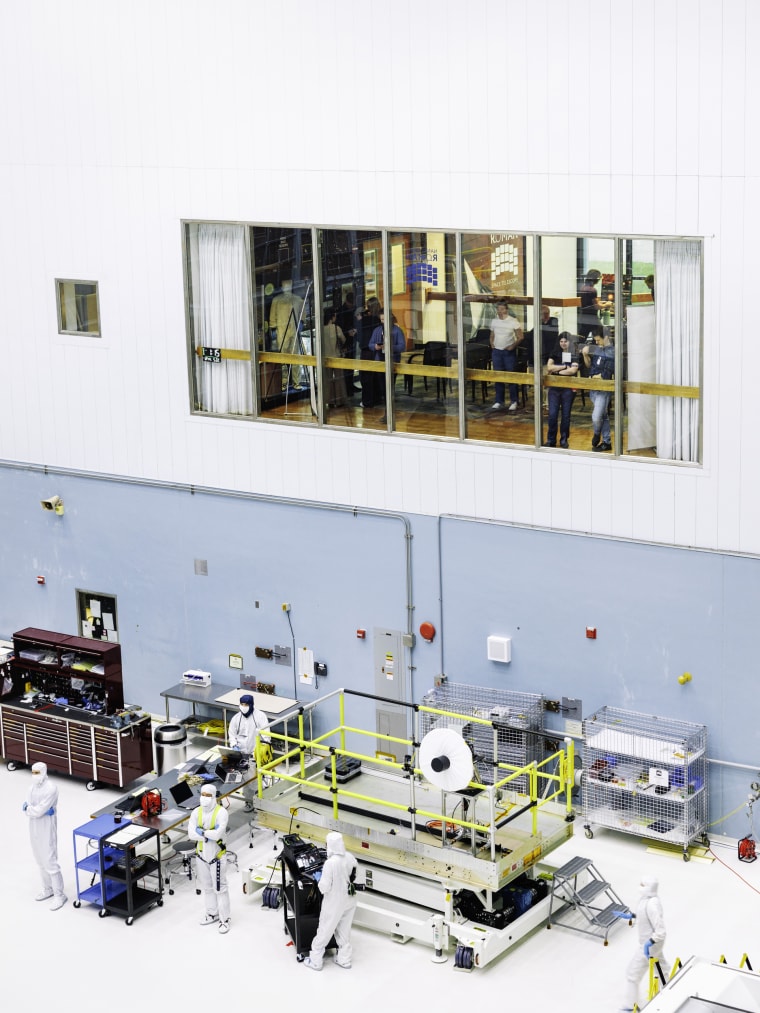 NASA employees and guests overlook the Nancy Grace Roman telescope in the clean room.Jason Andrew for NBC News
If all goes according to plan, Benford said the telescope's first images could be released by the end of this year.
"It could be around Christmas, so hopefully that's a nice present," he said.
NASA does not have another major space telescope in the pipeline. The agency has proposed a mission called the Habitable Worlds Observatory to search for signs of life on exoplanets, but even if that project moves forward, it would not launch until the 2040s.
As such, the Roman telescope's launch is particularly meaningful to Goddard's workforce, some of whom also worked on Hubble and Webb.
"Thrilled just seems insufficient — I've spent half my career on this," said Mark Melton, a mission systems engineer. He anticipates he will tear up when the telescope is finally deployed.
"It was paper. And now it's reality," he said.

Tags
Who is online
160 visitors
Even it it doesn't discover any SETI results, perhaps it can find a planet with a breathable atmosphee that humanity can colonize before the Earth becomes uninhabitable from the extremes of global warming. We would just have to develop a way to get there alive. Think of the Sci-Fi movie Passengers.
Lol if I remember correctly that did not go well for at least two passengers and one crew member, not to mention the supplies used that were meant for the colonists on arrival
Well, as you know, it's just science fiction. My prediction for the future - we're doomed.
Another telescope? How many telescopes do we need?
We seem to be spending an awful lot of money searching for a God that will be denied.
Why do you cast this as "searching for a God"? That is not the purpose of this technology.
Well, if we define 'GOD' as a "General Origin Device", I think it's fair to say scientists are always searching for the universe's origins. Just because some folks want to believe they already know the origin of the universe and claim it's a very human like entity that has genitals (is male) and human emotions (God is love, gets angry, gets jealous, etc.) doesn't mean scientists are searching the universe for some sort of 'God' those lazy religious bigots claim to already have found.
So, we're not spending any money searching for a God that will be denied, we're spending money searching for the actual origins of the universe which may not have even been guessed at yet due to the pitifully tiny amount of data we can access when compared to what's available to learn in this universe. Declaring one already knows who and what made the universe is like someone translating the first word out of a medical journal and declaring they know how to perform brain surgery. Anyone who trusts that moron deserves the lobotomy they are about to receive, amen.
It is a pretty fruitless search. The biggest mystery of our existence in my mind is how does it terminate? Obviously there is not a physical wall encapsulating everything, since walls have mass, and then we’d just be wondering what’s inside or on the other side of the wall. Maybe it ends in a spherical wormhole that just spits you out in some other location on that sphere inside our existence? Interesting, but I fail to see how that answer advances anything about humanity other than curiosity, and getting there is plainly impossible anyways.
Humans are naturally curious. I want to know what they find. I bet there's cool stuff out there
I’m more in line with Bill Maher thinking on this. Let’s get shit fixed here before we spend trillions searching for another planet to turn habitable and then destroy. The juice isn’t worth the squeeze.
Modern physics (and NASA) spends an inordinate amount of time and resources delving into metaphysics. There really is a growing belief among these scientists that a fundamental discovery of origin -- of creation -- will reshape humanity and overcome millions of years of evolution. The metaphysics of modern science is a cult belief that a rational explanation of origin will overcome the chaotic, often irrational nature of reality.
I'm a little more good with telescopes doing the work, rather than spacecraft, particularly manned spacecraft. I think there is little point to trying to colonize worlds it will take lifetimes to reach.
That is just a poetic notion. It is equating physics with God. Not very useful.
The search for knowledge is not ipso facto a search for God. The search for the moment of creation (if one exists) is not ipso facto a search for God.
The use of God as a label distorts the meaning from science to religion. Not helpful.
I want to know where all the missing mass is... is dark matter real or not?
Scientific exploration is all about innovation - 20 Inventions We Wouldn't Have Without Space Travel
I know Velcro is one of them.
Black holes....I think those are fascinating. Do they lead to wormholes?
... ugh, no comment ...
I did my high school final research paper on black holes and the einstein-rosen bridge theory.
Wow...you must have gone to a very good high school.
Lol it's a lot more likely that humanity will develop some sort of warp technology and travel the vast cosmos than it is we'll ever fix our shit.
Not really. It was rural with a graduating class of 62 people. I just liked nerd shit and spent as much time in the library as I could. I read a lot and did AP classes even though I was already enlisted in the Army between my junior and senior year in the delayed entry program. I always wondered what my life would have been like if I'd gone to college out of HS... I had thought about Art School for a while, but there was no way I could afford it and my parents wouldn't sign anything that mentioned money.
the vietnam war raged from the time I was in 4th grade until a couple years after I graduated high school. in jr and sr high school hearing about KIA's and MIA's connected to a classmate seemed like a daily occurrence. teachers got drafted out of my high school and the outlook for longevity looked bleak to us. so we made the best of it by adulting as hard as we could with the cloud of impending doom over our heads. college was a pipe dream for those that got lucky and made it back. I joined the counter culture when I turned 16 when my clique published an alternative school paper and we later invited the vietnam veterans against the war to our career day to counter the military recruiters. although I had been groomed to enlist in the army by family members, I burned my draft card and decided that instead of going to vietnam to die if I got drafted, I'd make my stand in america if they ever came for me. luckily the draft ended a few years after graduation and I'm still here. I was offered a free ride at rutgers, but I was in love, and didn't go. I regret it a little, but in hindsight, I wouldn't trade my life experiences or my 3 kids that happened instead.
I bet you find the results of trump's new $13 million algae machine (the former reflection pool) pretty humorous ...
My school was small, too, I graduated with 124 people. I asked because even the biggest nerd in my school probably never would have thought of doing a research paper on the Einstein-Rosen bridge theory. And we didn;t have AP classes tho I wish we had.
I went to college right of high school THEN joined the Air Force. And no, I was not an officer. My gpa was dismal. I should have joined the military first then went to college. But I got the rank of E-3 out of basic and that helped me get promotions faster.
I think we should direct that funding and research into geothermal energy production. Using the same cutting edge lasers as used in nuclear fusion development, the prohibitive heat encountered at great ground depths is overcome, allowing for nonstop and limitless clean energy production. That is far more important in the short term than space exploration.
I graduated in the 80's. Technically it was peacetime, but while I was stationed in Germany we dealt with terrorist groups protesting the US there. My roommate was sitting in the same row of seats in the Frankfort airport twenty minutes before a bomb went off in the trashcan next to them.
We all got separated into three groups in school by achievement scores. They kept trying to shuffle me into the middle one, because I was a C student. I was a C student because I hated homework and I was bored. When we got to HS and I could choose classes I chose the college track classes and still did C work... LOL.
I was a library nerd... Took computer classes at another school and assisted one of our math teachers so he could teach classes at our school. I also took independent study classes in sentence structure, paragraph structure and essay writing... my friends and I ran short story magazine for three years. I was horrible at trig and never got to calc, but I took chemistry and physics classes acing the theory part... picked out the proper equations, but couldn't solve them.
I turned 18 two weeks before graduation and two weeks after that I was in BT wondering what the fuck I'd gotten myself into. I went with a kid I grew up with, our parents were friends. He dropped out before BT was half over. I got a pay raise to E2 after because of the delayed entry program.
I think that's a fantastic idea.
I think we can do both.
We had similar in my high school as to where students were placed. I got to my high school in 7th grade about 3/4 of the way thru the year. They placed me in Level 3 (1 - the highest, 5 - the lowest). Then when the new school year started I was in Level 2. That actually did no better than Level 3 because Level 1 got geometry and chemistry in 10th grade while I had to wait until 11th grade to get those classes. Level 1 got Advanced Math and Science while I was still working on trig and physics.
I liked math and science. Especially geometry. And I was also a library nerd. I was in the Library Club which meant that a few times a week I worked in the library either checking books in/out or shelving books. I liked shelving best of all tho I sucked at it because more books came off the shelves than went on them. I also would open a book that I was supposed to be shelving and get lost. My librarian still loved me, tho.
We didn't have a Library Club, so much as I would help out when I was there. Checking out and shelving... When the school changed from those mimeograph copies to a modern copy machine I showed the librarian how to use it.
I was Flagged from the library. Didn't realize you weren't supposed to smoke weed there.
that's what the student parking lot was for iggy ...
the copy machine in the library was the only reason I passed thru the door, although I had gotten plenty of hall passes to go there to study ... >cough, cough<
we had accidentally discovered that the gasamat pumps and a local carwash had dollar bill readers that couldn't tell the difference between real dollar bills and copies of dollar bills ...
I loved the 70's ...
They had magnetic heads that were supposed to read the iron content in treasury ink, but could be fooled with high contrast photocopies. Those were replaced with ultraviolet bill validators and now they have a number of sensors and micro cameras checking everything from watermarks to security threads.
I remember when people used slugs in candy & pop machines too.
this was back in the early 70's, and if I recall, you placed the bill in the tray that had an etched glass rendition of a dollar bill that light was shown thru to match when you slid the tray back in ...it was a short lived scam once word got out ...
I can't remember where we had access to slugs that were the exact same size as quarters, but I recall having to grind the casting nubs off them ...
I got my cowboy killer marlboro's from a stocker at a grocery store for $1 per carton ... smokes were $0.35 per pack then ...
They have not spent, in the grand scheme of things, all that much on this project. It may increase our understanding directly, or perhaps better stated, it may increase the effectiveness of future directions of inquiry.
On the other hand, not following this research when the instrument is already built and the questions are already before us seems foolish to me.
If we had not explored, we would still be sitting in caves. There has to be some exploration of what we do not know. Not every question has an immediate practical application, but that does not make the question fruitless.
As a corollary, I would also say that we already know a great deal about what would improve the human condition here on earth, but we choose, for whatever reason, not to make it so. That failure is not caused by looking outward. It is caused by our unwillingness to act on what we already know.
We will never know the answers to the origins of existence. Never. If there is a "beginning" determined, there will always be the question "what caused that "beginning"?. The alternative is the creation of something from nothing, which is impossible.
I can't wrap my head around the idea that there was ever "nothing", and it's not from a religious point of view. I've long held the belief that the universe, a physical universe with stars and planets, always existed, and not in a state of nothingness.
There is good reason that an origin of 'nothing' does not make sense to you. If the 'beginning' were nothing, then nothing would exist. Something cannot emerge from nothing. This is based on logic (the meaning of the word 'nothing') and physics.
What is quite a challenge to imagine is: why is there something? I hypothesize that there is a quintessential substance (think of it as the lowest possible form of energy ... some substance that we do not know of currently) that has always existed. If we can get to that point, we can use logic and physics to explain how our universe might have formed. We routinely observe random interactions of energy (matter is energy too) producing temporary forms that we perceive as purposeful (e.g. the formation of stars, planets, galaxies, ...).
And, curiously enough, we can even logically get to a sentient creator from this substance. Given no restrictions on time, who is to say that an emergent property of this substance could not be a sentient being with sufficient power to direct the formation of our universe?
But, why is there something? This quintessential substance, this something, is necessarily eternal (because if it could fade into nothing, we would have nothing right now).
It is very difficult to imagine infinite time and very difficult to reason why something exists.
Personally, I find it much easier to believe that there exists a perpetual quintessential substance that interacts than to believe that the most complex, most powerful sentient entity possible simply 'always existed'. The latter is not at all satisfying to me.
The answer may be just because there is.
That's theoretically possible.
That's too much of a stretch for me. I can't imagine it.
With that I agree.
This is a nod to our religious friends to make it crystal clear that what I have described does not translate into 'there can be no sentient god'. But it does, it seems, translate into 'the omnipotent, omniscient, eternal first-cause god as described in the Bible makes no sense'.
My knowledge of physics is rusty but isn't the first law of Thermodynamics is that matter can neither be created or destroyed (or is that energy?). Either way, something does not come from nothing
Quantum physics doesn’t follow the same rules as classical physics. Here’s a good book that may clear things up. I listened to the audio version.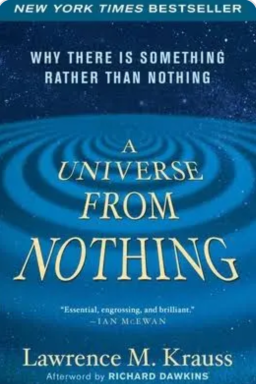
Kraus' 'nothing' is something.
He is not using the word 'nothing' in the colloquial sense. He redefines 'nothing' to be a zero energy state, quantum vacuum, etc. rather than the absolute absence of everything. His 'nothing' is actually something ... it is at the very least a quantum state and that is most definitely something.
It has bugged me for years now that Kraus went for sensationalism here.
I don’t know how anyone couldn’t feel sorry for something sentient that has no choice but to exist, alone from the beginning of time, and alone until the end of time. Then it makes other sentient beings, for a tiny blip of time, but refuses to interact with them. The faithful never consider this, they just shower praise on the thing that shows no evidence of existing.
It has bugged me for years now that Kraus went for sensationalism here.
He clearly didn’t intend for the book title to be literal. It’s just the phrase that is proliferated by the nonscientific community to attack the idea that there is no god.
Trouble is, people have been taking it literally for years now.
The irony is that for god to exist it must be a something, so how did it come from nothing. God is just where the faithful let the buck stop.
They hold that God has always existed (rather than emerge from nothing).
But the problem with that is that God is defined as an unfathomably complex entity with omnipotence and omniscience.
While the question of why there is something rather than nothing is itself awesome, it is certainly more sensible (parsimony) that the 'first-cause' something would be incredibly simple rather than complex. We see over and over that complexity is an emergent property that reduces to much simpler parts.
Agreed. They will say that the chances of life arising from nothing are like the chances of a tornado sweeping through a junkyard and assembling a 747, but the supposed most complex yet evidence-free entity in existence gets a pass.
Excellent point.
Their argument, at its inception, is ridiculous.
And it is worse. They argue that life arising from chemistry is nil. So there is an abundance of something in place with all sorts of complex interactions taking place and they claim that the emergence of biology is next to impossible and that it is more likely (to the point of certainty for some) that the most complex entity has always existed.
The human body is nothing but chemicals!
Yes, but the claim is that chemicals in an active environment (heat, electricity, pressure, etc.) could not form into a cell. Thus the claim is that biology could not be an emergent property of nature.
And that's why I ignore the religious nutbags
I am fine with people who believe in a higher sentient entity. A creator entity is possible.
What bothers me are those who insist with certainty that one or more of the various gods (with all their stories, personalities, characteristics, powers, desires, etc.) defined (of course) by mere human beings actually exist. And, of course, that their god is the one true god.
absentee landlord.
That's an apt description for a "creator". He won't fix the heater, the plumbing and the pool has algae growing in it!
I'm back to believing we're some intergalactic feedlot, and it's the duty of people like you and me to promote the idea that thumpers are the free range, and healthier, version of earth proteins. I'll be anxiously awaiting for the galactic processing and freezer ship, the 2nd coming, to arrive and start running the shuttles to and from evangelical church parking lots ... /s
Flying Spaghetti Monster
It's a cycle JR.
Black holes eventually collapse into each other and create a big bang which keeps expanding and eventually repeats inself.
Like life on earth and probably humanity.
Rinse, repeat, recycle.
Could be.
That's one theory. Another that I like is cosmic inflation - where new realities are spawned from others that already exist within a larger multiverse. It's like soap bubbles in a bath were each bubble becomes a new universe with it's own completely unique reality.
I like that theory
We got stuck in the shitty bubble where the one sperm in 100 million reached the egg and spawned Donald Trump.
Trump would be nothing if there were not so many gullible / spineless sycophants.
We got stuck in the bubble where enough sperm reached enough eggs to spawn a society were 25% of the population are dumb enough to think Trump's a good guy and want to help them.
lots of universes in those long necks ...