The man from Nevada had no known health problems or immune defects that would make him particularly vulnerable to Covid.
What happened when
25 March - First wave of symptoms, including sore throat, cough, headache, nausea and diarrhoea
18 April - He tests positive for the first time
27 April - Initial symptoms fully resolve
9 and 26 May - He tests negative for the virus on two occasions
28 May - He develops symptoms again, this time including fever, headache, dizziness, cough, nausea and diarrhoea
5 June - He tests positive for the second time, and is hypoxic (low blood oxygen) with shortness of breath
Scientists say the patient caught coronavirus twice, rather than the original infection becoming dormant and then bouncing back. A comparison of the genetic codes of the virus taken during each bout of symptoms showed they were too distinct to be caused by the same infection.
"Our findings signal that a previous infection may not necessarily protect against future infection," said Dr Mark Pandori, from the University of Nevada.
"The possibility of reinfections could have significant implications for our understanding of Covid-19 immunity."
He said even people who have recovered should continue to follow guidelines around social distancing, face masks and hand washing.
Scientists are still grappling with the thorny issue of coronavirus and immunity.
Does everyone become immune? Even people with very mild symptoms? How long does any protection last?
These are important questions for understanding how the virus will affect us long-term and may have implications for vaccines and ideas such as herd immunity.
So far, reinfection seems to be rare - there have been only a few examples out of more than 37 million confirmed cases.
Reports in Hong Kong , Belgium and the Netherlands said they were no more serious than the first. One in Ecuador mirrored the US case in being more severe, but did not need hospital treatment.
Humans aren’t the only creatures at risk from dying of covid-19, it seems. In recent weeks, the state of Utah has been dealing with mass die-offs at mink farms that health officials believe are linked to the viral pandemic—outbreaks that likely began from contact with infected human handlers. So far, nearly 10,000 minks in Utah are thought to have died during these outbreaks in the span of two weeks.
According to Utah Department of Agriculture and Food (UDAF), these deaths have been concentrated among nine fur farms in the state. Shortly before dying, UDAF veterinarian Dean Taylor told NBC News, these minks experience respiratory symptoms like trouble breathing or runny noses and eye discharge, similar to what happens in people sick with covid-19. As with people, older minks seem to be more susceptible to dying from the coronavirus, he added.
For months now, scientists have known that minks and other weasels, like ferrets, can become infected with the coronavirus that causes covid-19, and that they can catch it from infected humans. Unlike cats, dogs, and other animals that the virus has infected through human contact, however, weasels seem to be especially vulnerable to more serious illness. That’s made these animals a useful model for studying the virus outside of a petri dish in the lab, but it’s also made them an easy target for the virus in the real world.
Indeed, Utah’s outbreaks are not the first to have hit mink farms. Earlier outbreaks in the Netherlands and Spain prompted officials there to cull more than 1 million minks to prevent the infection from spreading further. So far, no minks in Utah have been killed as a precaution during these recent outbreaks, though affected farms have enacted quarantines. The UDAF is also working with the Centers for Disease Control and Prevention and other federal agencies to secure more personal protective equipment and training for farmers working with minks in the state.
As dire as these outbreaks have been for the mink industry, the danger to people seems to be low. Though people can spread the virus to minks and other animals, the risk of these animals then spreading the infection back to other susceptible people is thought to be very low, according to the CDC.
That said, the original strain of the coronavirus that became responsible for covid-19 likely came from an unknown animal source, possibly bats.
On March 16 , back when White House news conferences were still deemed safe to attend, President Trump stood before reporters and announced that drastic nationwide restrictions — in schools, work places, our social lives — were needed to halt the coronavirus.
The guidelines, “ 15 Days to Slow the Spread ,” were accompanied by a grim chart . Based on a prominent model by London’s Imperial College, the chart illustrated with a sinuous blue line how many Americans might die if nothing were done to protect the public’s health.
The line rose sharply as the estimated deaths went up, then drifted slowly down until finally, at the far right end of the graph, the number of new cases reached zero. Our national nightmare would end by October 2020 — that is, right about now. Along the way, if no action was taken, about 2.2 million Americans would die. Dr. Deborah Birx, one of Mr. Trump’s science advisers, referred to the graph as “the blue mountain of deaths.”
Clearly, the pandemic has not ended. So far some 215,000 Americans have lost their lives to the coronavirus, and reliable estimates suggest that the number could reach 400,000 . Health experts agree that, with stronger leadership, the death toll would have been far lower.
Nonetheless, there is a collective accomplishment here worth acknowledging. In the Imperial College report, the authors underscored that their worst-case estimate would almost certainly not be realized, thanks to human nature: “It is highly likely that there would be significant spontaneous changes in population behavior even in the absence of government-mandated interventions.”
That prediction proved true, as millions of Americans agreed, however reluctantly, to accept the sacrifices involved in shutting down parts of the economy, keeping distance from one other and wearing masks.
In the day-to-day fights over reopening schools or bars, it is easy to forget that there was a time when the idea of canceling large public gatherings — the St. Patrick’s Day Parade, the N.C.A.A.’s March Madness basketball tournament — did not seem remotely necessary. That there was a time when leading health officials said that only sick people and hospital workers needed to wear masks.
Today, and despite the president’s own resistance, masks are widely accepted. Various polls show that the number of Americans who wear them, at least when entering stores, went from near zero in March to about 65 percent in early summer to 85 percent or even 90 percent in October. Seeing the president and many White House staffers stricken by the virus may convince yet more Americans to wear masks.
The slow but relentless acceptance of what epidemiologists call “non-pharmaceutical interventions” has made a huge difference in lives saved. The next step is pharmaceutical interventions.
Some are already modestly successful, such as the antiviral drug remdesivir and steroids like dexamethasone. But in the near distance are what Dr. William Schaffner, a preventive medicine specialist, has called “the cavalry ” — vaccines and monoclonal antibodies. They are likely to be far more effective.
Since January , when I began covering the pandemic, I have been a consistently gloomy Cassandra , reporting on the catastrophe that experts saw coming: that the virus would go pandemic , that Americans were likely to die in large numbers, the national lockdown would last well beyond Easter and even past summer. No miracle cure was on the horizon; the record for developing a vaccine was four years .
Events have moved faster than I thought possible. I have become cautiously optimistic. Experts are saying, with genuine confidence, that the pandemic in the United States will be over far sooner than they expected, possibly by the middle of next year.
That is still some time off. Experts warn that this autumn and winter may be grim; indoor dining , in-classroom schooling, contact sports , jet travel and family holiday dinners may all drive up infections, hospitalizations and deaths. Cases are rising in most states , and some hospitals already face being overwhelmed .
Even if the cavalry is in sight, it is not here yet. To prevent deaths reaching 400,000, Dr. Anthony S. Fauci has warned, “We all need to hunker down .”
We Know What to Do
The final death toll from Covid-19 will depend both on how we behave going forward and how quickly innovations arrive.
Already the United States is faring much better than it did during the Spanish influenza — the worst pandemic to hit the country to date, and the one to which this one is often compared. It began in early 1918 and did not completely fade away until 1920, when herd immunity arrived, at the cost of 675,000 lives. The country’s population at the time was 103 million, so that toll is equivalent to 2 million dead today.
Pandemics don’t end abruptly; they decelerate gradually, like supertankers. The Centers for Disease Control and Prevention has estimated that about 10 percent of the American population has been infected. As that figure grows, and as people begin to get shots after a vaccine is approved, transmission should slow.
Every Covid survivor and every vaccine recipient will be a broken link in the chains of transmission. There have been rare cases of people becoming infected twice ; this happens even with chickenpox . But scientists assume that almost everyone who recovers from Covid cannot get or transmit the virus, at least for many months. Even by spring, we will not be entirely safe, but we probably will be safer.
In the interim, as the pandemic runs its course, the percentage of infected people who die from the virus has been falling. The reasons are many.
The average age of each new person infected is almost 30 years lower than it was in March. Fraternit y brothers may be reckless, but few older Americans are.
Nursing homes have become better at protecting their wards. The death rate per nursing home resident in states that were hit by the virus in late summer is about one-quarter the rate in the northeastern and southern states that were hit first.
Another good omen: Although in the spring health experts were fearful that a bad winter flu season could send thousands of patients to hospitals, all competing for ventilators and medical attention, the possibility of a “ twindemic ” of coronavirus and influenza now seems far less likely .
Emiliano Ponzi
Flu is “seeded” in the United States each year by travelers from the Southern Hemisphere after the winter there ends. But this year their flu season was almost nonexistent — because they were socially distancing and, in some countries, wearing masks. And in this country, flu shots became available earlier than usual ; so many Americans are rushing to get inoculated that spot-shortages are developing. If flu does arrive, those shots and our masks should blunt it.
Another intervention that might make a big difference is monoclonal antibodies.
That attention could speed up their clinical trials, which had been delayed . (Many patients declined to volunteer, preferring to not risk being given a placebo when instead they could receive convalescent plasma, which Mr. Trump was promoting in August .)
But experts believe that the antibodies could prove far more effective than plasma. Last year, in the Democratic Republic of Congo, monoclonal antibody cocktails proved 90 percent effective at saving Ebola victims from death.
But this approach has limitations. It is believed to work only if administered soon after infection, and monoclonal antibodies are hard to produce and expensive, at least at the moment. If the treatment becomes popular, demand will quickly outstrip supply, forcing health officials to make hard choices.
Early testing in animals and humans suggests that a dose a fraction the size of the one Mr. Trump received can protect an uninfected person against the virus. If that finding holds up, the antibodies could be used like a fast-acting vaccine, lasting just a month or so but providing a crucial “bridge” to the arrival of the new vaccines.
Such a treatment could protect people at highest risk, such as health workers and nursing home residents. Or, in a “ ring vaccination ” strategy, antibodies could be given to the household contacts of known cases. Ring vaccination was how smallpox was defeated .
But the number of doses will initially be limited, and choosing to use antibodies for prophylaxis over treatment may be frowned upon by medical ethicists.
Engaging Warp Speed
Sometime in the next three months, health experts say, the F.D.A. is likely to begin granting approval to vaccines now in the works.
Despite the chaos in day-to-day politics and the fighting over issues like masks and lockdowns, Operation Warp Speed — the government’s agreement to subsidize vaccine companies’ clinical trials and manufacturing costs — appears to have been working with remarkable efficiency. It has put more than $11 billion into seven vaccine candidates, and the F.D.A. has said it will approve any one that is at least 50 percent effective at preventing infection or reducing its severity.
By then, Dr. Slaoui has estimated, the factories under contract will have produced enough vaccine for 30 to 40 million people, and then another 80 to 90 million people every month after that. Assuming nothing goes wrong, he said, there will be enough doses for all 330 million Americans to be vaccinated by next June. Bill Gates, who is not part of Operation Warp Speed but works with it to develop vaccines for the world’s poor, has agreed with that timetable .
There will inevitably be distribution problems , but the military is standing by to help. The chief operating officer of Operation Warp Speed is General Gustave F. Perna , a logistics specialist.
Vaccine Skepticism May Fade
Some health officials fear that when a vaccine arrives, many Americans will be reluctant to take it . Indeed, about half of Americans have told pollsters that they feel this way. Nonetheless, I believe that hesitancy may dissipate, if no major safety problems emerge as the first few million Americans are inoculated.
The last time the nation faced a moment like this was in the 1950s, when polio vaccine became available . For years, parents had lived in fear of the virus, as they saw children die, living in iron lungs or walking with braces on withered legs. When the Salk vaccine became available in 1955 — and again in the 1960s when it was replaced by the Sabin vaccine — Americans lined up in droves to receive it.
The demand for polio vaccine survived even the horrifying Cutter Incident of 1955, in which a bad batch of 200,000 Salk doses from Cutter Laboratories in Berkeley, Calif. partially paralyzed 260 children and killed 10.
I have seen a similar trend as I covered the polio eradication drives in Pakistan and Nigeria . When a disease is actually tearing through a population, vaccine hesitation collapses. Even in the face of persistent rumors that polio vaccines would make their daughters sterile , mothers in Pakistan who had seen other children crippled defied their husbands and imams and sneaked their own children off to be vaccinated. Even in the most resistant areas , such as those controlled by the Pakistani Taliban or Boko Haram, vaccination campaigns attracted parents by setting up “ health camps ” that offered a dozen vaccines , polio just one among them.
No vaccine is 100 percent safe. “The most effective one may have the greatest risk if it stimulates the immune system enough to create the risk of autoimmune disease,” said Dr. George D. Yancopoulos , an immunologist and founder of Regeneron Pharmaceuticals. “There will be some risk-benefit calculations to make.”
But the alternative to being vaccinated is to risk a nearly 1 in 100 chance of death , as well as unquantifiable but still worrying threats of heart disease , lung damage and even brain damage . Not to mention the prospect of being unable to return to work, having to home-school one’s children for years and not eating in a restaurant, flying on an airplane or watching a movie in a theater without the specter of anxiety.
Those are strong motivations to take a chance on a vaccine, especially if one’s friends and relatives have had it and fared well.
The Whole World Must Be Safe
In September, the actress Jennifer Garner conducted an entertaining interview with Dr. Fauci on her Instagram feed, during which she asked when it would be safe to attend live theater again . “The end of 2021 or maybe even the middle of 2021,” he replied. By then, he explained later, so many Americans would be vaccinated — or immune by virtue of having survived an infection — that it would be safe to sit unmasked in a crowded theater.
Until then, masks and caution are our best alternative. If we rigorously protect ourselves and each other, we can starve the virus of new hosts until our national epidemic finally evaporates.
Then we must help other countries get vaccines too; until they are protected, we cannot venture beyond our borders as tourists or business travelers, nor can others come here. No country can be forgotten; charitable motives aside, their tourists fill our hotels .
Many economists think our national recovery will be rapid, like those that followed the first and second world wars, rather than what followed the financial crashes of 1929 and 2008. China, having beaten the virus, has a growing economy again . Among Americans who have not lost their jobs, personal savings are at record levels . Despite loan defaults in this recession, banks are flush with cash and, if need be, can borrow from their thriving Asian counterparts . When the moment is safe, loans to revive restaurants, hotels and other small businesses should flow.
In the interim, as we hunker down, Congress must find ways to ensure that millions of Americans who are out of work do not go hungry or get evicted.
Donald G. McNeil Jr. is a science reporter covering epidemics and diseases of the world’s poor. He joined The Times in 1976, has reported from 60 countries and is a winner of the John Chancellor Award.




Covid reinfection: Man gets Covid twice and second hit 'more severe'
The 25-year-old needed hospital treatment after his lungs could not get enough oxygen into his body.
But the study in the Lancet Infectious Diseases raises questions about how much immunity can be built up to the virus.
The man from Nevada had no known health problems or immune defects that would make him particularly vulnerable to Covid.
What happened when
Scientists say the patient caught coronavirus twice, rather than the original infection becoming dormant and then bouncing back. A comparison of the genetic codes of the virus taken during each bout of symptoms showed they were too distinct to be caused by the same infection.
"Our findings signal that a previous infection may not necessarily protect against future infection," said Dr Mark Pandori, from the University of Nevada.
"The possibility of reinfections could have significant implications for our understanding of Covid-19 immunity."
He said even people who have recovered should continue to follow guidelines around social distancing, face masks and hand washing.
Scientists are still grappling with the thorny issue of coronavirus and immunity.
Does everyone become immune? Even people with very mild symptoms? How long does any protection last?
These are important questions for understanding how the virus will affect us long-term and may have implications for vaccines and ideas such as herd immunity.
So far, reinfection seems to be rare - there have been only a few examples out of more than 37 million confirmed cases.
Reports in Hong Kong , Belgium and the Netherlands said they were no more serious than the first. One in Ecuador mirrored the US case in being more severe, but did not need hospital treatment.
Coronavirus Has Killed Nearly 10,000 Minks in Utah
Humans aren’t the only creatures at risk from dying of covid-19, it seems. In recent weeks, the state of Utah has been dealing with mass die-offs at mink farms that health officials believe are linked to the viral pandemic—outbreaks that likely began from contact with infected human handlers. So far, nearly 10,000 minks in Utah are thought to have died during these outbreaks in the span of two weeks.
According to Utah Department of Agriculture and Food (UDAF), these deaths have been concentrated among nine fur farms in the state. Shortly before dying, UDAF veterinarian Dean Taylor told NBC News, these minks experience respiratory symptoms like trouble breathing or runny noses and eye discharge, similar to what happens in people sick with covid-19. As with people, older minks seem to be more susceptible to dying from the coronavirus, he added.
For months now, scientists have known that minks and other weasels, like ferrets, can become infected with the coronavirus that causes covid-19, and that they can catch it from infected humans. Unlike cats, dogs, and other animals that the virus has infected through human contact, however, weasels seem to be especially vulnerable to more serious illness. That’s made these animals a useful model for studying the virus outside of a petri dish in the lab, but it’s also made them an easy target for the virus in the real world.
Indeed, Utah’s outbreaks are not the first to have hit mink farms. Earlier outbreaks in the Netherlands and Spain prompted officials there to cull more than 1 million minks to prevent the infection from spreading further. So far, no minks in Utah have been killed as a precaution during these recent outbreaks, though affected farms have enacted quarantines. The UDAF is also working with the Centers for Disease Control and Prevention and other federal agencies to secure more personal protective equipment and training for farmers working with minks in the state.
As dire as these outbreaks have been for the mink industry, the danger to people seems to be low. Though people can spread the virus to minks and other animals, the risk of these animals then spreading the infection back to other susceptible people is thought to be very low, according to the CDC.
That said, the original strain of the coronavirus that became responsible for covid-19 likely came from an unknown animal source, possibly bats.
I hope that the assholes that run/own the mink farms all go broke. WTF, raised to die and be skinned to satisfy assholes need to wear their skins.
Off topic but it really pisses me off.
Careful, K!! That way lies... ... veganism...
A Dose of Optimism, as the Pandemic Rages On
The months ahead will be difficult. But the medical cavalry is coming, and the rest of us know what we need to do
The guidelines, “ 15 Days to Slow the Spread ,” were accompanied by a grim chart . Based on a prominent model by London’s Imperial College, the chart illustrated with a sinuous blue line how many Americans might die if nothing were done to protect the public’s health.
The line rose sharply as the estimated deaths went up, then drifted slowly down until finally, at the far right end of the graph, the number of new cases reached zero. Our national nightmare would end by October 2020 — that is, right about now. Along the way, if no action was taken, about 2.2 million Americans would die. Dr. Deborah Birx, one of Mr. Trump’s science advisers, referred to the graph as “the blue mountain of deaths.”
Clearly, the pandemic has not ended. So far some 215,000 Americans have lost their lives to the coronavirus, and reliable estimates suggest that the number could reach 400,000 . Health experts agree that, with stronger leadership, the death toll would have been far lower.
Nonetheless, there is a collective accomplishment here worth acknowledging. In the Imperial College report, the authors underscored that their worst-case estimate would almost certainly not be realized, thanks to human nature: “It is highly likely that there would be significant spontaneous changes in population behavior even in the absence of government-mandated interventions.”
That prediction proved true, as millions of Americans agreed, however reluctantly, to accept the sacrifices involved in shutting down parts of the economy, keeping distance from one other and wearing masks.
In the day-to-day fights over reopening schools or bars, it is easy to forget that there was a time when the idea of canceling large public gatherings — the St. Patrick’s Day Parade, the N.C.A.A.’s March Madness basketball tournament — did not seem remotely necessary. That there was a time when leading health officials said that only sick people and hospital workers needed to wear masks.
Today, and despite the president’s own resistance, masks are widely accepted. Various polls show that the number of Americans who wear them, at least when entering stores, went from near zero in March to about 65 percent in early summer to 85 percent or even 90 percent in October. Seeing the president and many White House staffers stricken by the virus may convince yet more Americans to wear masks.
The slow but relentless acceptance of what epidemiologists call “non-pharmaceutical interventions” has made a huge difference in lives saved. The next step is pharmaceutical interventions.
Some are already modestly successful, such as the antiviral drug remdesivir and steroids like dexamethasone. But in the near distance are what Dr. William Schaffner, a preventive medicine specialist, has called “the cavalry ” — vaccines and monoclonal antibodies. They are likely to be far more effective.
Since January , when I began covering the pandemic, I have been a consistently gloomy Cassandra , reporting on the catastrophe that experts saw coming: that the virus would go pandemic , that Americans were likely to die in large numbers, the national lockdown would last well beyond Easter and even past summer. No miracle cure was on the horizon; the record for developing a vaccine was four years .
Events have moved faster than I thought possible. I have become cautiously optimistic. Experts are saying, with genuine confidence, that the pandemic in the United States will be over far sooner than they expected, possibly by the middle of next year.
That is still some time off. Experts warn that this autumn and winter may be grim; indoor dining , in-classroom schooling, contact sports , jet travel and family holiday dinners may all drive up infections, hospitalizations and deaths. Cases are rising in most states , and some hospitals already face being overwhelmed .
Even if the cavalry is in sight, it is not here yet. To prevent deaths reaching 400,000, Dr. Anthony S. Fauci has warned, “We all need to hunker down .”
We Know What to Do
The final death toll from Covid-19 will depend both on how we behave going forward and how quickly innovations arrive.
Already the United States is faring much better than it did during the Spanish influenza — the worst pandemic to hit the country to date, and the one to which this one is often compared. It began in early 1918 and did not completely fade away until 1920, when herd immunity arrived, at the cost of 675,000 lives. The country’s population at the time was 103 million, so that toll is equivalent to 2 million dead today.
Pandemics don’t end abruptly; they decelerate gradually, like supertankers. The Centers for Disease Control and Prevention has estimated that about 10 percent of the American population has been infected. As that figure grows, and as people begin to get shots after a vaccine is approved, transmission should slow.
Every Covid survivor and every vaccine recipient will be a broken link in the chains of transmission. There have been rare cases of people becoming infected twice ; this happens even with chickenpox . But scientists assume that almost everyone who recovers from Covid cannot get or transmit the virus, at least for many months. Even by spring, we will not be entirely safe, but we probably will be safer.
In the interim, as the pandemic runs its course, the percentage of infected people who die from the virus has been falling. The reasons are many.
The average age of each new person infected is almost 30 years lower than it was in March. Fraternit y brothers may be reckless, but few older Americans are.
Nursing homes have become better at protecting their wards. The death rate per nursing home resident in states that were hit by the virus in late summer is about one-quarter the rate in the northeastern and southern states that were hit first.
Simple interventions like pulse oximeters are detecting pneumonia before it becomes life-threatening. Steroids like dexamethasone have lowered the number of deaths among hospitalized patients by about one-third. Rolling patients onto their stomachs and delaying ventilator use also helps.
Each lesson learned saves lives.
Winter Is Survivable
Another good omen: Although in the spring health experts were fearful that a bad winter flu season could send thousands of patients to hospitals, all competing for ventilators and medical attention, the possibility of a “ twindemic ” of coronavirus and influenza now seems far less likely .
Emiliano Ponzi
Flu is “seeded” in the United States each year by travelers from the Southern Hemisphere after the winter there ends. But this year their flu season was almost nonexistent — because they were socially distancing and, in some countries, wearing masks. And in this country, flu shots became available earlier than usual ; so many Americans are rushing to get inoculated that spot-shortages are developing. If flu does arrive, those shots and our masks should blunt it.
Another intervention that might make a big difference is monoclonal antibodies.
Two weeks ago, most Americans had no idea what they were. Now, President Trump is touting them as his “miracle cure ” and, whether or not he is ultimately cured , monoclonals are famous.
That attention could speed up their clinical trials, which had been delayed . (Many patients declined to volunteer, preferring to not risk being given a placebo when instead they could receive convalescent plasma, which Mr. Trump was promoting in August .)
But experts believe that the antibodies could prove far more effective than plasma. Last year, in the Democratic Republic of Congo, monoclonal antibody cocktails proved 90 percent effective at saving Ebola victims from death.
But this approach has limitations. It is believed to work only if administered soon after infection, and monoclonal antibodies are hard to produce and expensive, at least at the moment. If the treatment becomes popular, demand will quickly outstrip supply, forcing health officials to make hard choices.
Early testing in animals and humans suggests that a dose a fraction the size of the one Mr. Trump received can protect an uninfected person against the virus. If that finding holds up, the antibodies could be used like a fast-acting vaccine, lasting just a month or so but providing a crucial “bridge” to the arrival of the new vaccines.
Such a treatment could protect people at highest risk, such as health workers and nursing home residents. Or, in a “ ring vaccination ” strategy, antibodies could be given to the household contacts of known cases. Ring vaccination was how smallpox was defeated .
But the number of doses will initially be limited, and choosing to use antibodies for prophylaxis over treatment may be frowned upon by medical ethicists.
Engaging Warp Speed
Sometime in the next three months, health experts say, the F.D.A. is likely to begin granting approval to vaccines now in the works.
Despite the chaos in day-to-day politics and the fighting over issues like masks and lockdowns, Operation Warp Speed — the government’s agreement to subsidize vaccine companies’ clinical trials and manufacturing costs — appears to have been working with remarkable efficiency. It has put more than $11 billion into seven vaccine candidates, and the F.D.A. has said it will approve any one that is at least 50 percent effective at preventing infection or reducing its severity.
Moncef Slaoui, Operation Warp Speed’s chief scientific adviser and a former pharmaceutical executive who has overseen the development of 14 vaccines , has said repeatedly that he expects some of the candidates that he picked to have 75 to 90 percent efficacy and at least two to win approval by early January.
By then, Dr. Slaoui has estimated, the factories under contract will have produced enough vaccine for 30 to 40 million people, and then another 80 to 90 million people every month after that. Assuming nothing goes wrong, he said, there will be enough doses for all 330 million Americans to be vaccinated by next June. Bill Gates, who is not part of Operation Warp Speed but works with it to develop vaccines for the world’s poor, has agreed with that timetable .
There will inevitably be distribution problems , but the military is standing by to help. The chief operating officer of Operation Warp Speed is General Gustave F. Perna , a logistics specialist.
Vaccine Skepticism May Fade
Some health officials fear that when a vaccine arrives, many Americans will be reluctant to take it . Indeed, about half of Americans have told pollsters that they feel this way. Nonetheless, I believe that hesitancy may dissipate, if no major safety problems emerge as the first few million Americans are inoculated.
The last time the nation faced a moment like this was in the 1950s, when polio vaccine became available . For years, parents had lived in fear of the virus, as they saw children die, living in iron lungs or walking with braces on withered legs. When the Salk vaccine became available in 1955 — and again in the 1960s when it was replaced by the Sabin vaccine — Americans lined up in droves to receive it.
The demand for polio vaccine survived even the horrifying Cutter Incident of 1955, in which a bad batch of 200,000 Salk doses from Cutter Laboratories in Berkeley, Calif. partially paralyzed 260 children and killed 10.
I have seen a similar trend as I covered the polio eradication drives in Pakistan and Nigeria . When a disease is actually tearing through a population, vaccine hesitation collapses. Even in the face of persistent rumors that polio vaccines would make their daughters sterile , mothers in Pakistan who had seen other children crippled defied their husbands and imams and sneaked their own children off to be vaccinated. Even in the most resistant areas , such as those controlled by the Pakistani Taliban or Boko Haram, vaccination campaigns attracted parents by setting up “ health camps ” that offered a dozen vaccines , polio just one among them.
No vaccine is 100 percent safe. “The most effective one may have the greatest risk if it stimulates the immune system enough to create the risk of autoimmune disease,” said Dr. George D. Yancopoulos , an immunologist and founder of Regeneron Pharmaceuticals. “There will be some risk-benefit calculations to make.”
But the alternative to being vaccinated is to risk a nearly 1 in 100 chance of death , as well as unquantifiable but still worrying threats of heart disease , lung damage and even brain damage . Not to mention the prospect of being unable to return to work, having to home-school one’s children for years and not eating in a restaurant, flying on an airplane or watching a movie in a theater without the specter of anxiety.
Those are strong motivations to take a chance on a vaccine, especially if one’s friends and relatives have had it and fared well.
The Whole World Must Be Safe
In September, the actress Jennifer Garner conducted an entertaining interview with Dr. Fauci on her Instagram feed, during which she asked when it would be safe to attend live theater again . “The end of 2021 or maybe even the middle of 2021,” he replied. By then, he explained later, so many Americans would be vaccinated — or immune by virtue of having survived an infection — that it would be safe to sit unmasked in a crowded theater.
Until then, masks and caution are our best alternative. If we rigorously protect ourselves and each other, we can starve the virus of new hosts until our national epidemic finally evaporates.
Then we must help other countries get vaccines too; until they are protected, we cannot venture beyond our borders as tourists or business travelers, nor can others come here. No country can be forgotten; charitable motives aside, their tourists fill our hotels .
We will have competition — or help, if we take a generous view of a global effort. China claims to already have five vaccines in phase 3 trials , and Russia is already marketing its vaccine abroad , although it has not even conducted a phase 3 trial.
Many economists think our national recovery will be rapid, like those that followed the first and second world wars, rather than what followed the financial crashes of 1929 and 2008. China, having beaten the virus, has a growing economy again . Among Americans who have not lost their jobs, personal savings are at record levels . Despite loan defaults in this recession, banks are flush with cash and, if need be, can borrow from their thriving Asian counterparts . When the moment is safe, loans to revive restaurants, hotels and other small businesses should flow.
In the interim, as we hunker down, Congress must find ways to ensure that millions of Americans who are out of work do not go hungry or get evicted.
And once the pandemic is over, one more mission lies ahead: to make sure this does not happen again. We must search for the viruses in nature that are most likely to infect us, and spend the billions of dollars necessary to create vaccines and designer antibodies against them . So that next time we are ready.
The light at the end of the tunnel!
Where have I heard that before...??
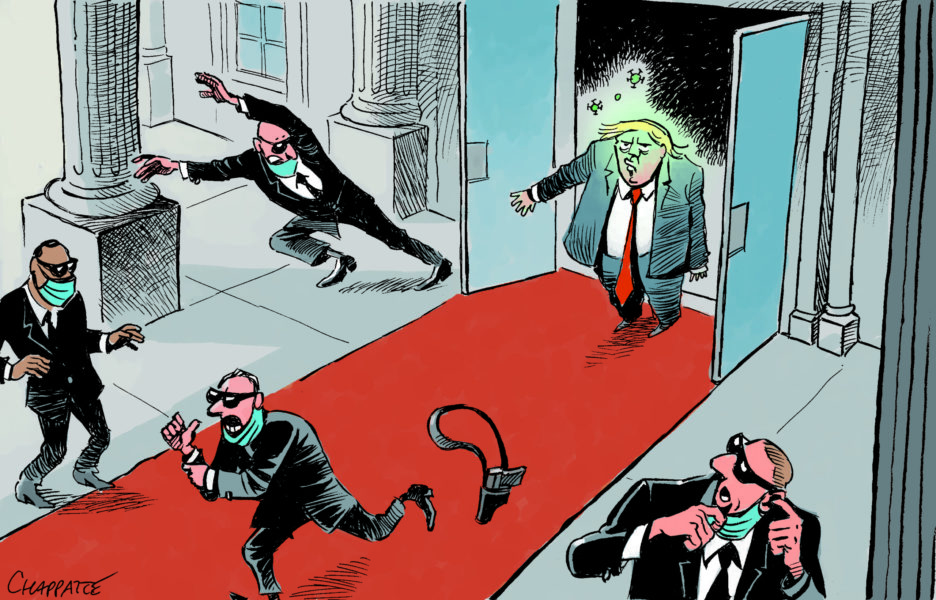
I just read a report that some of the new agencies reporters will not be traveling with the President any longer due to concern of catching COVID.
Logical...