
There's more than just Joe and Donald...



Voters in several states will be voting on some important stuff:
Ranked choice - maybe give third parties a chance
Abortion... of course...
State legislatures... and House apportionment for a decade
... and most important of all... marijuana

Next to this important stuff,
voters will also stand long hours in line
in order to vote for offices they don't know anything about...
BIDEN 2020

Massachusetts and Alaska May Join Maine in Letting Voters Rank Their Choices
Two November ballot initiatives would introduce ranked-choice voting in two more states
by Scott Shackford, reason
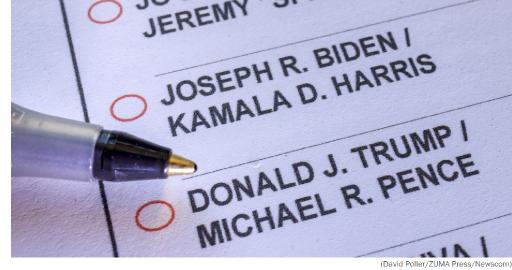
If voters approve, they'll join Maine , which in November will be the first state to use ranked-choice voting for the presidential race.
In ranked-choice voting (sometimes called "instant runoff voting"), citizens don't just select one of the candidates for an office (though they can if they want to). They are permitted to rank each of the candidates on the basis of preference.
To win a ranked-choice election, one must receive more than 50 percent of the vote, not just a plurality. If no candidate has a majority, the candidate with the least votes is eliminated from contention. Then the votes are tallied again. If you ranked the eliminated candidate as your first choice, your second choice is instead tallied as your vote. And so the process goes until a candidate gets more than 50 percent.
In Maine, voters approved a proposition to introduce ranked-choice voting there for some state and federal elections in 2016 . The state's Republican Party has been fighting it ever since, unsuccessfully. In 2018, ranked-choice voting contributed to the ouster of a GOP incumbent .
In Massachusetts, Question 2 will ask voters if they want ranked-choice voting for state officials and lawmakers, members of Congress, and some county offices. It would not implement ranked-choice voting in presidential races.
In Alaska, Ballot Measure 2 combines ranked-choice voting with open primaries. If it becomes law, candidates for state or congressional offices will first run in a single open primary where candidates for each office all face each other, regardless of party. After the vote, the top four (regardless of party) will face each other again in the general election. There voters will have the option to rank the four candidates for each seat, and then the rules of ranked-choice voting will be followed.
Why bother with such a complicated system? Proponents argue that under ranked-choice voting, you aren't "throwing your vote away" by supporting a third-party candidate and you don't have to feel beholden to the two-party model. In Maine, for example, voters will be able to vote for Libertarian candidate Jo Jorgensen or Green candidate Howie Hawkins and still also support either Joe Biden or Donald Trump. Research from FairVote , an activist organization supporting and promoting ranked-choice voting, found that voter turnout trends upwards in cities that have implemented ranked-choice voting.
All of this may explain why the state Libertarian Party affiliates in both Massachusetts and Alaska are supporting these ballot measures.
In Maine, voters have consistently shown support for implementation. But in Massachusetts, polling is currently divided almost evenly between support and opposition, with more than a quarter of voters undecided. In Alaska, it's polling ahead , 59 to 17 percent. Even so, the most recent poll had about a quarter of the voters undecided.
Ranked choice is not perfect, and it comes with its own set of frustrations. If you support only one of the candidates and that candidate does poorly, then your vote can get tossed out and mean nothing, just like in a winner-takes-all elections. It doesn't even necessarily make it easier for a third-party candidate to win. But it does mean that major party candidates cannot simply ignore the interests of more independent voters and run simply by appealing to their bases. Those independent voters' second choice might be what determines the election.
Colorado Proposition 115, 22-Week Abortion Ban Initiative (2020)
A "yes" vote supports prohibiting abortions in Colorado after a fetus reaches 22-weeks gestational age as calculated from the first day of the woman's last menstrual period.
A "no" vote opposes prohibiting abortions in Colorado after a fetus reaches 22-weeks gestational age, thereby maintaining current Colorado law that does not restrict abortion after a certain point in a pregnancy.
Statehouse Seats Are Up for Grabs, and With Them, Great Power
In most states, control of the state legislature comes with the authority to redraw state and federal electoral maps
Sabrina Tavernise, NY Times
Schools. Health care. Covid-19.
These are just a few of the issues that state legislatures will make laws about next year. Not to mention the once-a-decade event: Redrawing state and national electoral maps after the decennial census, an exercise that can give one political party a deep and enduring advantage in lawmaking for years.
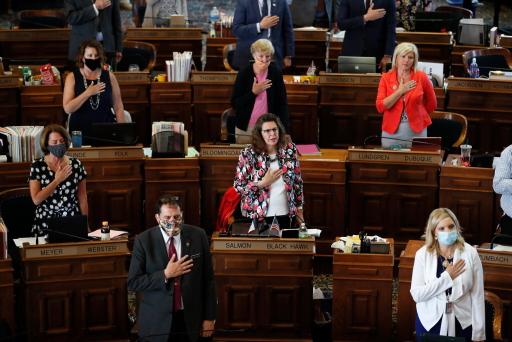
More than 5,000 state house and senate seats across the nation are at stake in the election on Tuesday. Members of the Iowa House of Representatives stood for the Pledge of Allegiance at a session in June.
Charlie Neibergall/Associated Press
So, while the campaigns for president and seats in Congress may have absorbed much of the nation’s attention, the elections to determine control of state government — more than 5,000 legislative races farther down the ballot — could also have a major effect on Americans’ lives.
About 80 percent of the nation’s 7,383 state legislative seats are up for grabs this year, with elections in 44 states, according to Tim Storey, an expert at the National Conference of State Legislatures , or N.C.S.L.
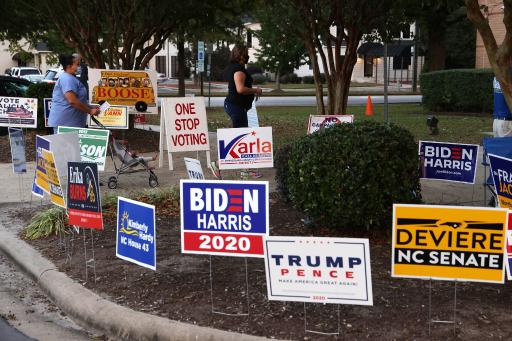
Many of the lawn signs greeting voters near
an early voting site in Fayetteville, N.C., last week
promoted candidates for state legislative seats.
Alex Wong/Getty Images
“If there are gains, they won’t be extraordinary or off the charts,” Mr. Storey said. Demographic change is slow, he said, and movement of a state from one party to the other is usually gradual.
A few of the chambers Democrats are aiming to flip, he said, are the Texas House , the North Carolina House and Senate, the Arizona House and Senate, the Minnesota Senate, and the Pennsylvania, Michigan and Iowa Houses. Republicans, for their part, are looking to take New Hampshire’s House and Senate.
Republicans have a distinct advantage in statehouses today. Of the 98 partisan legislative chambers in 49 states, about three-fifths — 59 chambers — are controlled by Republicans, and the remaining 39 by Democrats, according to the N.C.S.L. (Nebraska’s legislature has only one chamber and its elections are officially nonpartisan.)
In all but one of the states with two chambers (Minnesota is the exception), the same party controls both chambers. That is an effect of rising polarization and the growing tendency of voters to stick with a single political party up and down the ballot.
The 2010 Republican sweep coincided with a census, giving Republicans disproportionate control just when lines were to be redrawn for Congressional and state electoral districts across the country. The effects are still being felt today.
“I think most people, including Democrats, realize that Republicans were ahead of the game in 2008 and 2009 and 2010, and got control of the legislatures,” said Wendy Underhill, a specialist on redistricting at the N.C.S.L. This time, she argued, “both teams are equally well prepared.”
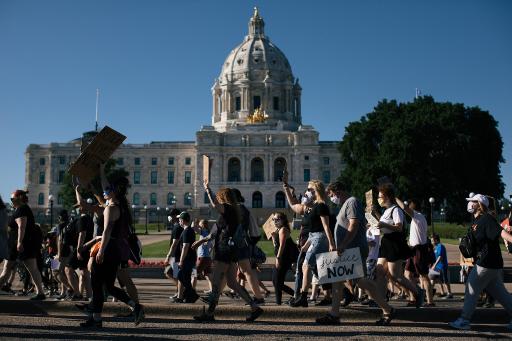
Minnesota is the only state with a two-house legislature where the houses are not currently controlled by the same party.
Alyssa Schukar for The New York Times
Whatever the timing, though, the outcome of next week’s balloting will be critical. While some states use nonpartisan or bipartisan commissions to draw electoral maps, the process in most states is controlled by the majority party in the state legislature.
“The state races have never been more important than they are this year,” said David Abrams, deputy executive director of the Republican State Leadership Committee, which focuses on electing Republicans to state offices. He said his group is focusing on 14 target states and that in many of them, Democrats who flipped Republican seats in 2018 are vulnerable now. “The conventional wisdom is that we are entirely on defense, but that’s not actually true,” he said.
Issues beyond redistricting power are at stake, too — for example, health care access, which is especially important during the pandemic.
In North Carolina , where Republicans have controlled both chambers since the national sweep in 2010, Democrats are fighting to take back control, and want to expand Medicaid to cover low-income North Carolinians.
North Carolina is one of 12 remaining states — all with Republican-controlled legislatures and most of them in the South — that have not expanded their Medicaid programs under the Affordable Care Act.
Abortion is another example. Joe Pojman, the executive director of the Texas Alliance for Life, said his organization was focused not just on helping Mr. Trump win the state, but also on the down-ballot races for the Texas House, which Democrats hope to flip .
If that happens, Mr. Pojman said, “it would be very difficult to advance our agenda.”
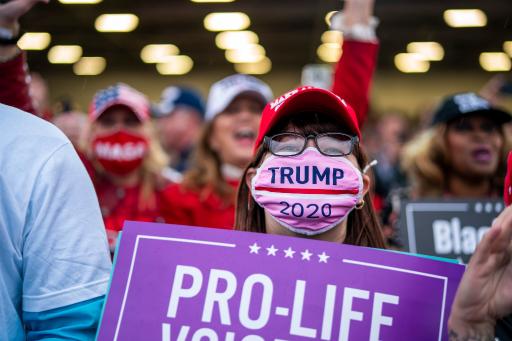
With the confirmation of Amy Coney Barrett cementing
the Supreme Court’s conservative tilt, the abortion issue
has become a focal point of many down-ballot races.
Doug Mills/The New York Times
Abortion rights advocates say they are watching the Iowa House, which Democrats are trying to flip. The chamber voted this year to place on the ballot a proposal to amend the state constitution to say that it does not protect abortion, according to Elisabeth Smith, chief counsel for state policy and advocacy at the Center for Reproductive Rights, an abortion rights group. If Republicans lose control of the Iowa House, she said, the initiative would not pass a second time, a requirement for putting the proposal before the voters.
Elsewhere, efforts at curbing police violence are at stake. In Minnesota, where Democrats control the House and are hoping to flip the Senate, a policing bill that passed the legislature over the summer was weaker than Democrats wanted. It did not require officers to live in the communities they serve, nor did it completely ban choke holds or impose penalties for using them, according to Jessica Oaxaca, a spokeswoman for Senate Democrats. It also lacked protections for police officers who report illegal uses of force, she said, adding that in order to pass tougher changes, Democrats would need control of the Senate.
“We have to win the majority to have the conversation,” she said.
Cannabis In The 2020 Election
Where Legalization Is On The Ballot
Robert Hoban, Forbes
This November, voters in six states will be sharing their voices on cannabis initiatives for medical and adult-use legalization. As of today, 35 states have medical marijuana programs. Eleven states, plus Washington, D.C., have a commercial, adult-use program for those 21 and older.
In November 2019, a Pew Research study revealed that nine out of ten Americans favor legalization of either medical or adult-use marijuana, with support for cannabis legalization crossing party lines. While conservatives and liberals likely back legalization for different reasons, the national consensus is growing, which is reflected in the 2020 election. The states where cannabis initiatives are on the ballot show promise that the green wave will continue to spread. Here’s a closer examination.
Arizona
Four years ago, a ballot initiative to legalize recreational cannabis was narrowly defeated, failing by fewer than 67,100 votes. Two new polls have found that support for Proposition 207, the measure to legalize marijuana in Arizona on the 2020 ballot, is rising significantly.
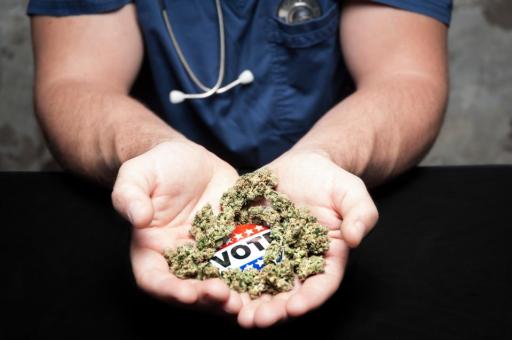
As cannabis legalization takes root in more and more
states around the country, the opportunity for the U.S.
to position itself as a global industry leader grows.
Getty
The lawsuit was swiftly decided in favor of Smart and Safe Arizona by Maricopa County Superior Court Judge James Smith, and while the vote will surely be close, there’s reason for hope.
Mississippi
In Mississippi, two competing measures for medical cannabis legalization are on the ballot. One is a citizen petition, the other an alternative offered by the State Legislature.
The citizen measure allows physicians to recommend medical cannabis for patients with qualifying conditions. A competing measure would require “pharmaceutical quality” cannabis products for medical marijuana patients. This measure would limit the consumption of smokable marijuana flower to those who are terminally ill. Further, it would require the legislature to craft policy and a regulatory framework for the state’s medical program. According to a poll from 2019, 67% of Mississippi voters supported medical legalization, though it’s unclear which of the two measures currently has the advantage.
Montana
In 2004, Montana voters approved an initiative legalizing medical cannabis, passing an expansion measure more than a decade later.
This year, two cannabis initiatives are on the ballot in Big Sky Country. One would allow adults over 21 to purchase, possess, and consume cannabis for recreational use, while establishing a regulatory framework and imposing a sales tax rate of 20% to benefit national parks and wildlife. The other would establish 21 as the legal age to purchase, possess, and consume cannabis, but not position itself to establish an industry within the state.
Recent polls have indicated that Montana voters seem to be in favor of the legalization initiatives.
New Jersey
This is near and dear to my heart, as the Garden State is my home state. In 2017, when Phil Murphy was elected Governor, he vowed to deliver on a campaign promise to legalize cannabis.
New Jersey’s adult-use legalization measure, Question 1, would amend the state constitution to legalize the recreational use of marijuana for anyone 21 and older. In addition, the measure would legalize the cultivation, processing, and sale of retail cannabis, effective January 1st of next year.
How likely is Governor’s Murphy promise looking?
A Fairleigh Dickinson University statewide poll published on October 9th, 2020, found that 61% of voters were in support . I’d say that’s pretty good.
Oregon
While Oregon already has an adult-use marijuana program, it deserves mention here. This year, citizens of the Beaver State are voting on Measure 109, the Oregon Psilocybin Program Initiative.
It would provide psilocybin to qualifying individuals over 21. The measure requires a two-year development period for the Oregon Health Authority to lay out regulations.
Additionally, citizens are voting on a first for our nation. Oregon’s Drug Addiction Treatment and Recovery initiative, ballot measure 110, would remove criminal penalties for the personal, non-commercial possession of all drugs listed as Schedule I, II, III, or IV by the federal Controlled Substances Act. The measure would provide treatment, including housing and access to social services for drug users, while reducing penalties for controlled substances to a $100 fine and/or a health assessment.
No polling is available for this initiative, but in February 2019 64% of Oregon voters expressed support for lawful access to therapeutic psilocybin services.
South Dakota
Rather than taking the typical approach of adopting medical cannabis legalization prior to recreational, South Dakota could do both this year.
While no polling data is yet available, on October 9th former Senate Majority Leader Tom Daschle and former Reagan Administration Senior Official Chuck Parkinson announced their support for the initiatives.
Four years ago, the 2016 election resulted in a green wave for cannabis legalization. If this election follows suit, it could create a domino effect, causing more states to advance cannabis reform. The U.S. and global cannabis industries are poised for significant growth in the years to come. As legalization takes root in more and more states, opportunity in the industry expands. In turn, the U.S. becomes better positioned to be a leader in the global marketplace — where the future of cannabis lies.
Tags
Who is online
97 visitors
State Houses count!
The down ballet is as important as the top. Voting for legislative candidates and various propositions is critical.
Isn't the down ballot even more important this year? We just finished another national census, won't the incoming state houses determine voting districts in the coming term?
That's... ummm... the topic of the seed...