
TRILOBYTE TWOSOME


This Plant Evolved to Hide From a Predator.
It Might Be Us.
This Unusual Bird Superpower Goes Back to the Dinosaur Extinction

There is s-o-o-o much cool stuff... all around us.
We're really foolish to fixate on gutter politics.
... says a 24/7 newsaholic...
This Plant Evolved to Hide From a Predator. It Might Be Us.
While people deliberately breed plants, a team of researchers say humans have inadvertently prompted this one to develop camouflage.
Climb for long enough in the Hengduan Mountains near Yulong, China, and you’ll probably spot Fritillaria delavayi. The small, charming plants have elegant green leaves and bell-shaped yellow flowers. Each one pops against the gray scree like a statement brooch.
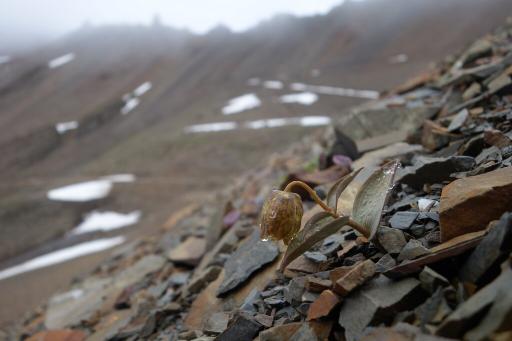
Fritillaria delavayi, a plant used for traditional medicines, evolved camouflage coloring in areas where it is frequently harvested.
Yang Niu
Why does this one species come in so many different colors? It might be hiding from you.
According to a paper published last month in Current Biology , F. delavayi has evolved several distinct color types because people harvest its bulbs. The finding suggests that the plant is the latest example in a growing list of species that humans appear to have inadvertently influenced into evolving new traits.
The impressive tricks animals use to disguise themselves are familiar to most people, but plant camouflage gets less attention. Yang Niu, a researcher at the Kunming Institute of Botany at the Chinese Academy of Sciences and lead author of the new paper, has spent years documenting possible examples of how plants conceal themselves. The mottled leaves of some forest plants may make it harder for herbivores to spot them. Lithops , also known as “living stone plants,” seem to be masquerading as pebbles.
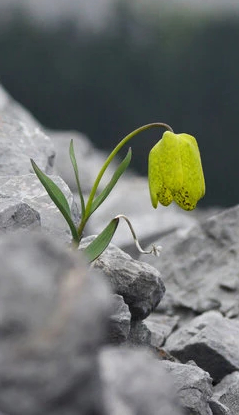
“Other such kinds of camouflaged plants reported in other places all over the world — they also have enemies,” he said. The divergent coloration of F. delavayi was initially puzzling because no animals seemed to eat it.
Fritillaria delavayi’s coloring in an area with low harvest pressure.
Yang Niu
But the bulbs of this and other Fritillaria plants are common medicinal ingredients, used to treat coughs. People have been harvesting them for over 2,000 years. What if this plant’s enemy is us? If so, F. delavayi plants in areas that experience more intense collection should be better camouflaged than those in places where people pick them less.
To test this, the researchers focused on eight plant populations. To judge the harvest pressure at each site, they asked for records from herb dealers and used those to figure out what proportion of each F. delavayi population had been picked annually for six years. They also estimated how difficult it was to collect the plants at different sites.
To determine how closely the plants matched their backgrounds, they took rock and leaf samples from each site, and compared the color and intensity of the light they reflected.
And to establish whether a closer match actually makes the plants more difficult to see, they created an online game called “ Spot the Plant” — which shows players photographs of F. delavayi plants in different locations, with instructions to click on them as fast as they can. Local collectors also told the researchers that they had noticed plants in certain places were better camouflaged, Dr. Niu said.
When they put these metrics together, they matched up as expected. For F. delavayi populations that are largely left alone, it’s easy enough being green. But those under high harvest pressure now fade into the background, whether that’s tan, reddish-brown or gray.
The study makes “a fairly convincing case” that humans are driving the camouflage of this plant, said Ilik Saccheri, a professor of ecological genetics at the University of Liverpool who studies color change in moths and butterflies and was not involved in this work. However, he added, more experiments would bolster the evidence.
As people continue to manipulate other species, it’s good to remember that other species have moves to make in response.
“Humans have been artificially selecting all sorts of plants, animals and yeasts for thousands of years,” Dr. Saccheri said. “This is a nice example of unintentional selection.”
by Cara Giaimo
This Unusual Bird Superpower Goes Back to the Dinosaur Extinction
Kiwis, ibises and sandpipers share this sensory power with birds that lived millions of years ago
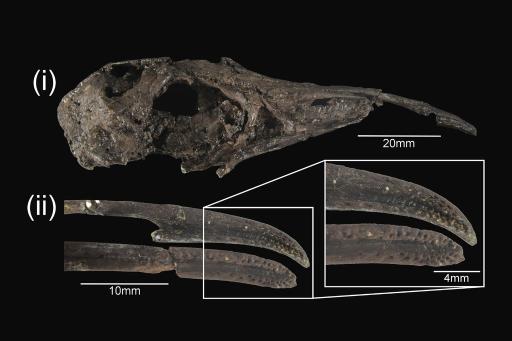
Fossil beaks of two specimens of a prehistoric bird, Lithornis promiscuus , showing the beak shape, top, and the high degree of pitting preserved on the surface of the beak bones.
Toit et al., 2020
But then scientists discovered something far more peculiar: Their beaks are threaded with cells that can detect vibrations traveling through the ground. Some birds can feel the movements of their distant quarry directly, while others pick up on waves bouncing off buried shells — echolocating like a dolphin or a bat, in essence, through the earth.
There’s one more odd detail in this story of birds’ unusual senses: Ostriches and emus, birds that most definitely do not hunt this way, have beaks with a similar interior structure. They are honeycombed with pits for these cells, though the cells themselves are missing. Now, scientists in a study published Wednesday in Proceedings of the Royal Society B report that prehistoric bird ancestors dating nearly as far back as the dinosaurs most likely were capable of sensing vibrations with their beaks.
“We had a look to see if we could find fossils of early birds from that group,” Ms. du Toit said. “And we’re very lucky.” There are very well-preserved fossils of birds called lithornithids dating from just after the event that drove nonavian dinosaurs to extinction.
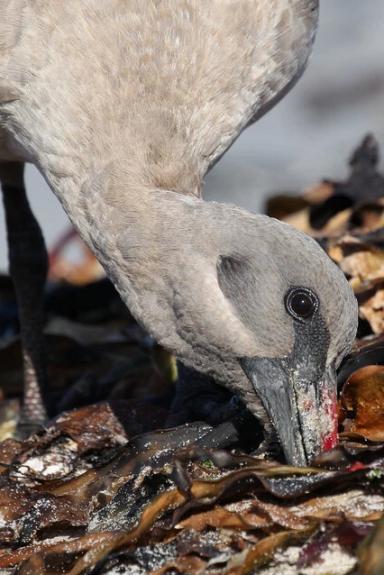
A modern species of remote-touch probing bird,
a hadeda ibis, in South Africa.
Peter Ryan
First they had to gather data on the beaks of more than 50 bird species so that they would be able to say how similar or different the fossil birds were to modern birds. The team recorded the number of pits in the bone of the beak and the size of the beak and the head, important details because birds that dig for their food have a characteristic shape.
Then they took a look at the lithornithids. And indeed, the ancient beaks and head structure were extremely similar to the beaks of kiwis, ibises and sandpipers, far closer than any other bird in the study.
“It seems that they have this organ and were able to use the sense of remote touch to probe and locate prey as well, which is really cool, because it just shows that this is really old,” Ms. du Toit said.
That means that the ancestors of ostriches and emus lost the ability sometime after the lithornithids lived, leaving them with only traces in their bone structure of this lost talent. They lack as well the enlarged brain regions that kiwis, ibises and shorebirds devote to processing the sensory information pouring in from the beak.
Ms. du Toit and her colleagues are now studying the hadeda ibis, a South African bird that uses remote sensing, to see just how far away it can sense hidden objects — perhaps buried as much as eight inches below the surface.
Tags
Who is online
138 visitors
We really need to kick our habit...
Trilobites were awesome critters....hung around for long time and were very diverse.
In fact... they're still here. Horseshoe crabs are trilobites.