
'The platypuses were glowing': the secret light of Australia's marsupials

By: Graham Readfearn (the Guardian)
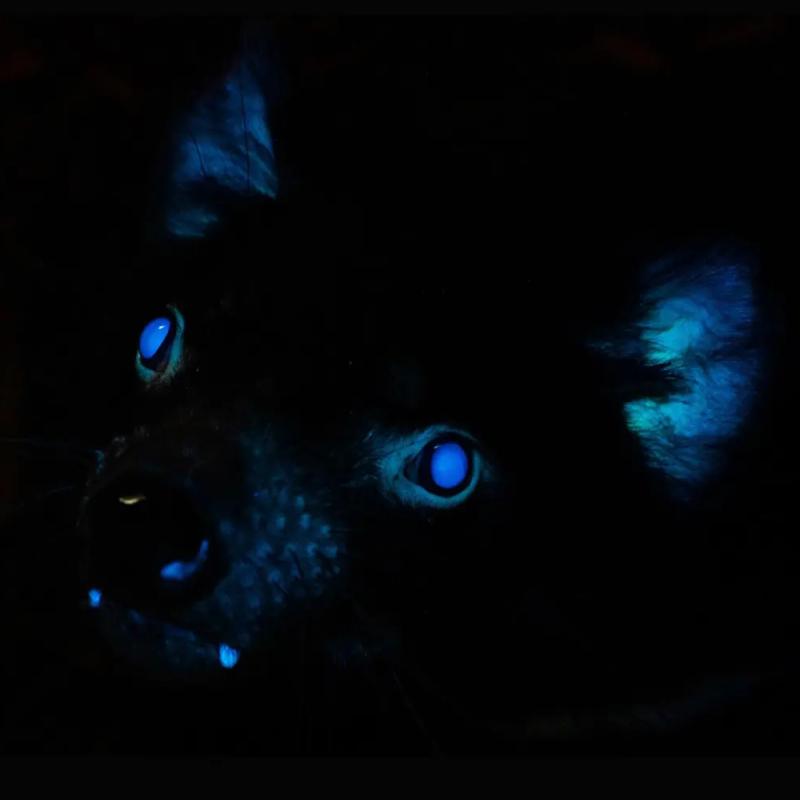

The discovery that bilbies, bandicoots, Tasmanian devils and echidnas emit bio-fluorescence under UV light has sparked the burning question.
Why?

Platypuses were already weird.
Now, with all the rest... they glow!
 S E E D E D C O N T E N T
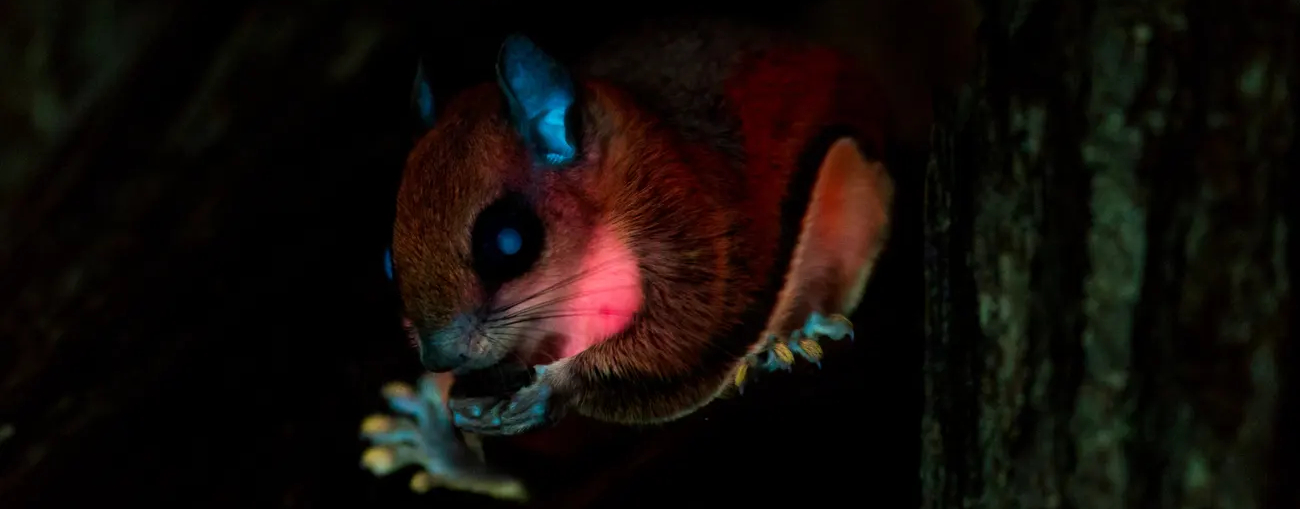
Dr Kenny Travouillon turned off the lights and headed straight for the shelf holding the stuffed platypus, armed with an ultraviolet torch to test something out. Would the monotreme glow?
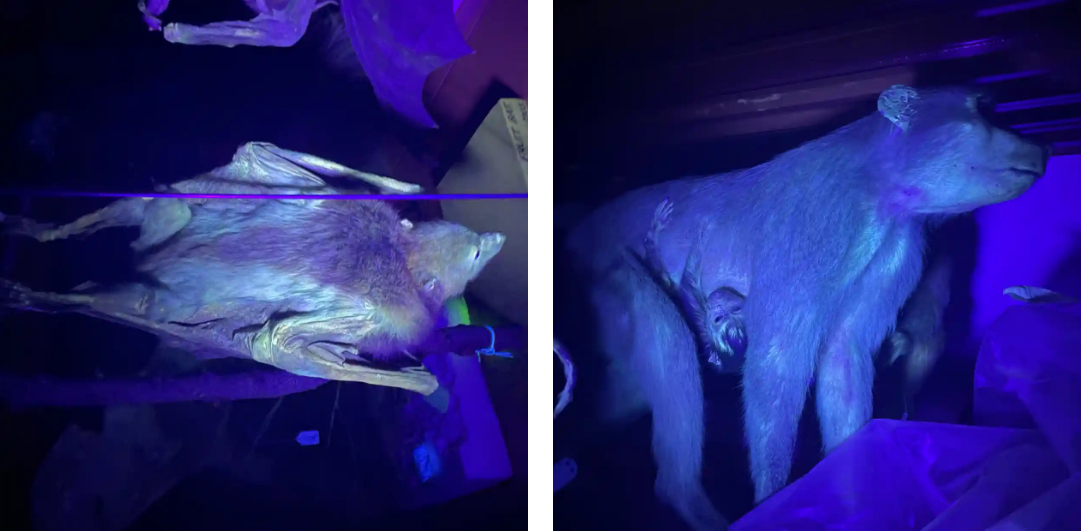
"All the platypuses were glowing," says Travouillon, the mammals curator at the Western Australian Museum in Perth. "We went through with other mammals and we found they were glowing too."
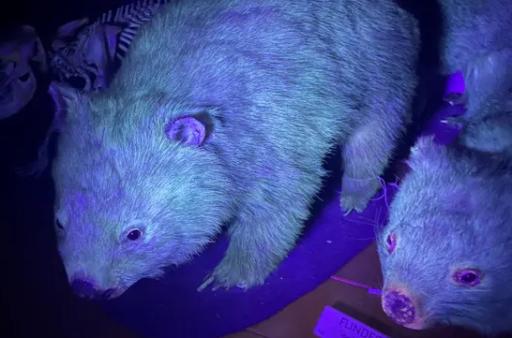
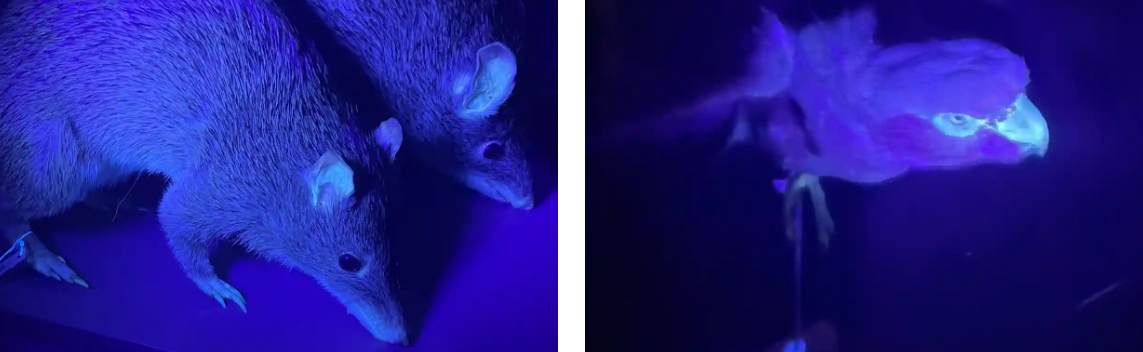
Bare-nosed Wombats under ultraviolet light.
Western Australian Museum
Under the UV light, creatures including bilbies, bandicoots, wombats, flying foxes, microbats, Tasmanian devils and echidnas all took on a distinct disco-like glow. Kangaroos, though, were "rather disappointing".
Travouillon's urge to point a UV torch at his specimens was sparked by a scientific paper in October in the journal Mammalia and later reported in the New York Times.
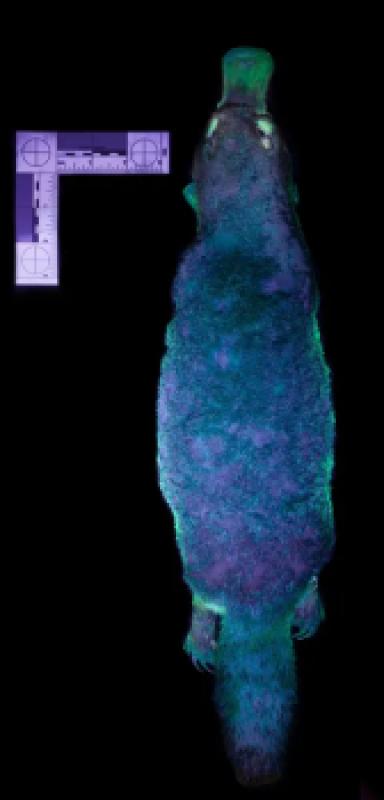
Now scientists are asking why. Was the glowing fur an evolutionary leftover, or was it somehow useful for Australia's marsupials and other animals?
A platypus under visible light, UV light unfiltered
and UV light yellow filter.
J. Martin/ Northland College
Monotremes are a curious order of egg-laying mammals that live only in New Guinea and Australia - the platypus and four species of echidna.
Their fur glowed green and cyan under different UV lights that shine at different wavelengths. This, the researchers said, was "the first report of bio-fluorescence in a monotreme mammal under UV light."
But a few months earlier, zoologist Linda Reinhold was out in the tropical rainforests of north Queensland looking for glowing fungi. In the newsletter of the Queensland Mycological Society, Reinhold said she'd found 14 species that fluoresced under her UV torch. But she was also looking for something else.
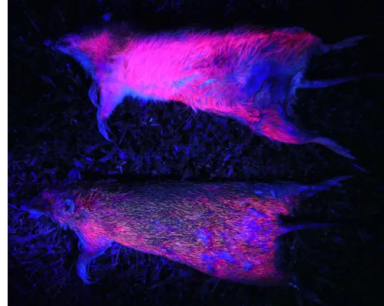
Roadkill that has been lit with a UV light.
Linda Reinhold
On a road beside a field she found two dead northern brown bandicoots. To the human eye, they were a dull and lifeless brown. But under her UV torch the corpses were a parade of pinks and yellows.
"Realising that the marsupials were too skittish for fluorescence photography, I spent three days looking for roadkills," Reinhold wrote.
'It was like seeing a Macca's sign'
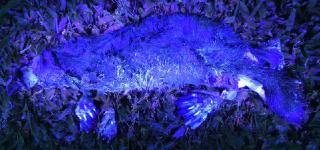
If the bio-fluorescence was simply an artefact of the chemicals used to preserve the stuffed animals, then the fur of Reinhold's roadkill wouldn't have lit up, nor would the fur of live Tasmanian devils at Toledo Zoo - another institution that became curious with a UV torch.
One answer could lie in research carried out almost 20 years ago and started by Prof Lyn Beazley, a celebrated neuroscientist who was the first woman to take a chief scientist role when she won the post in Western Australia in 2006.
In the early 2000s, Beazley was researching the vision of honey possums and fat-tailed dunnarts. In one study, they found these two species both possessed cells in their eyes that would give them the ability to see UV light.
But in a further study, Beazley and colleagues put dunnarts into a maze and tempted them with crickets and mealworms using UV light to see if the animals could actually use the ability. They could.
"It was huge fun," says Beazley, of Murdoch University. "They knew there was no reward with the other colours. To them it was like seeing a Macca's [McDonald's] sign - there was going to be a reward there."
Western Australian Museum
Beazley and colleagues had established that these tiny mouse-like marsupials were able to see in UV and use that ability in the real world - something the mammals reading this story can't do.
"What's pretty clear is that most animals can see UV. But we can't," Beazley says.
"Fish, amphibians, birds … but it was the mammals that lost out and that was why we were so fascinated that marsupials could see it.
"We're interested in it as humans because we can't see it, but for animals it's just there."
Beazley thinks it could have a multitude of uses in the animal kingdom.
Rodent urine, like human urine, glows under UV light but birds of prey don't need a UV torch to see the trail of pee that can lead them to a juicy meal. They can just see it.
Beazley says some animals that have areas on their bodies, such as fur or skin that emit light in the UV wavelengths can use it to deliver cues to potential mates or rivals.
With the animal kingdom awash with UV that humans can't see, the UV patterns and colours could have a whole range of uses that are difficult for humans to understand, she says.
For animals like the platypus, which are active at dusk and dawn, she says the ability to distinguish colours could be vital for searching for food or avoiding prey.
Western Australian Museum
Honey possums' vision is particularly attuned to wavelengths around the colour orange, Beazley says, and that could help them get to their favourite banksia flowers just as the nectar is ready.
"You'd want to get to the right flowers and you'd want to get there first," she says.
All of this UV curiosity has kickstarted more formal scientific endeavours seeking answers to key questions.
Reinhold, from Cairns, tells Guardian Australia she is starting a university research project in 2021 loosely titled: "Fluorescence in mammals: Prevalence and causes".
At the Western Australia Museum in Perth, Travouillon has been sharing pictures of glowing Australian animals on Twitter but hopes for a more formal scientific publication next year.
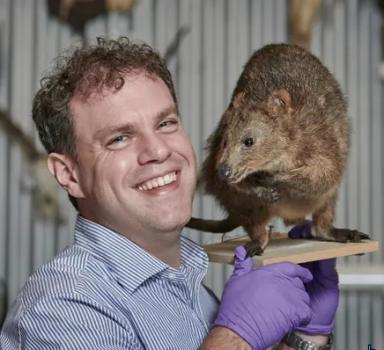
Dr Kenny Travouillon, Curator of Mammalogy,
Western Australian Museum.
He's going to be working with Prof Simon Lewis at Perth's Curtin University who leads research on forensic crime scene techniques, including the use of different light sources.
Lewis says: "We have access to instrumentation that will allow us to investigate the spectral characteristics of the apparent fluorescence. This will allow us to determine whether it is actually fluorescence and not some other optical phenomenon."
Travouillon does have a word of warning for members of the general public keen to undertake their own investigations into the secret light of animals: don't shine a UV torch near their eyes, it could harm their sight.

Tags
Who is online

229 visitors
How cool is that?
This is so cool. When we lived in Australia we were members of the Taronga Zoo in Sydney which allowed us to areas off-limits to the general public. It was absolutely wonderful as we spent a lot of time with many of the marsupials in the article. There was a baby wombat that I spent a lot of time with and if I wore sneakers with white laces he would race across the lawn and grab a hold of the laces and try to run off with them.
BTW, Duckbilled platypus have venomous barbs on their back legs.
This article brought back a lot of great memories.
Do Australians find non-marsupial mammals strange?
In my experience yes they do. Especially carnivores like bears, wolves, badgers since the dingo and the Tasmanian Devil and fox which is relatively small nothing the size of our carnivores. The Tasmania Tiger went extinct in the 1930s.
The saltwater crocodile is very large and a carnivore but not a mammal.
Yes I agree with Kavika we do find other countries animals fascinating..for me especially your bears and bison. Huge lumbering beasts which we have nothing to compare with here..oh and your squirrels could watch them for hours... one thing I wish we did have here..
How widespread are kangaroos and wallabies? Do you see them wandering free kinda everywhere, like we have antelope?
If you ever get to the US I'll take you to a ranch with plenty of buffalo, Shona.
Yes, they are.
A herd of buffalo is... impressive...
Anoon. Yes basiciallly everywhere in Australia..I see wallabies and roos here all the time. In paddocks in the bush..had wallabies hopping down the road past my place.
The all differ as large stretches of land has different vegetation etc and they have evolved to eat what is available. For instance in the outback they have the big Red roos. Where I live we have the smaller eastern grey. It is the same with possums wombats bandicoots etc.
And Tasmania is unique again some of their animals are not found on the mainland at all.
Thank you Kavika.. that is very kind of you...hope I can take you up on that offer one day...
S-o-o-o cool...
They look like they are big and lumbering but the buffalo can run at 35 miles per hour and turn on a dime and the males will weight up to 2,000 lbs.
Bears are the same they are very fast. A human cannot outrun them, outclimb them, or outswim them. If one sets his sights on you, you are in a world of trouble.
Wombats...bulldozers on legs..lol..
LOLOL, perfect description of a wombat.
Anoon...us Aussies just naturally glow in the dark.
Our animals sure are unique in many ways and only just finding out more all the time.
I love them all other than the snakes spiders crocs sharks stingers...but hey they can't all be cute and furry...
I'll agree with that and won't comment any further. LOLOL