
A Brief History of the LaSalle Automobile

By: Craig Duerling
 S E E D E D C O N T E N T

A Brief History of the LaSalle Automobile
Many folks are not familiar with the LaSalle automobile other than possibly from the introduction to the classic TV show, "All in the Family", where Archie and Edith sing, "Gee our old LaSalle ran great. Those were the days." This is a brief history of this groundbreaking but now little known automobile.
Cadillac dominated the U.S. luxury-car market in the Teens and early Twenties. But by 1925, there was trouble in the air - big trouble. Packard had replaced Cadillac as America's most popular premium automobile.

1925 Packard 236
.
1925 Cadillac S82
Ever since Alfred P. Sloan had become President, Chairman, and CEO of General Motors Corporation, he had arranged GM's various car lines into an orderly price and prestige progression. His idea was that buyers, as their fortunes improved, would move onward and upward to larger, more luxurious, and more expensive models-- all in the GM family of course. However, there were a couple of rungs missing from Sloan's carefully conceived ladder. There were substantial price gaps between Chevrolet and Oakland, between Oakland and Oldsmobile, and between Oldsmobile and Buick. An even wider chasm separated the top-of-the-line Buick, at $1925, and the bottom-end Cadillac, selling at $3195. This gap was driving faithful GM customers to Packard's smart new group of lower-price offerings.
To fill these gaps, GM pioneered the idea that consumers would aspire to buy up an automotive product ladder if a company met certain price points-called the Companion Make Program. To address this, General Motors authorized the introduction of four brands priced and designed to fill the gaps. Cadillac would introduce a car to fill the gap between Cadillac and Buick. Buick would introduce the Marquette to handle the gap between Buick and Oldsmobile, Oldsmobile would introduce the Viking, which took care of the gap between Oldsmobile and Oakland, and Oakland would introduce the Pontiac to fill the gap between Chevrolet and Oakland.

Cavelier de LaSalle
Since Cadillac had been named for the famed French explorer, what could be more logical than to honor another French explorer with the new car, and so the LaSalle was born. Lawrence P. Fisher, president of Cadillac Motors Division and one of the famed Fisher brothers of Fisher Body fame, felt that the new make should have a more dashing and youthful image than the staid Cadillac, which meant that it would have to be far more stylish. In those days, the only bodies that were styled were those built by custom coach builders. Standard factory bodies were designed by engineers. Fisher was aware that Don Lee, Cadillac's California distributor, was turning out superb custom coaches at his Los Angeles facility using a talented young stylist named Harley Earl.
Fisher was sufficiently impressed that he hired the young stylist as a consultant to design the first LaSalle. It was supposed to have been a one-shot deal; Earl would be back in Los Angeles in a few weeks, but it didn't quite work out that way, and Earl would remain with General Motors until he retired as the company's director of design some 32 years later. In the process, he changed the course of the entire industry with regard to styling and marketing strategy.
1928 LaSalle Series 302 Phaeton
Formally introduced on March 5, 1927, the LaSalle was priced at $2685 in base four-door sedan form, exactly $100 higher than the equivalent Fifth Series Packard. The 1927 LaSalle is recognized as the first mass production car to be consciously designed in the modern sense. With its dashing looks, fine performance, and adroit pricing, LaSalle was enthusiastically received, and it was largely because of this that Sloan hired Harley Earl full-time. After completing work on the 1928 Cadillac, the designer was asked to head up a new GM department called the Art & Colour Section (note the British spelling of Colour to add "class"), the industry's first in-house styling operation.
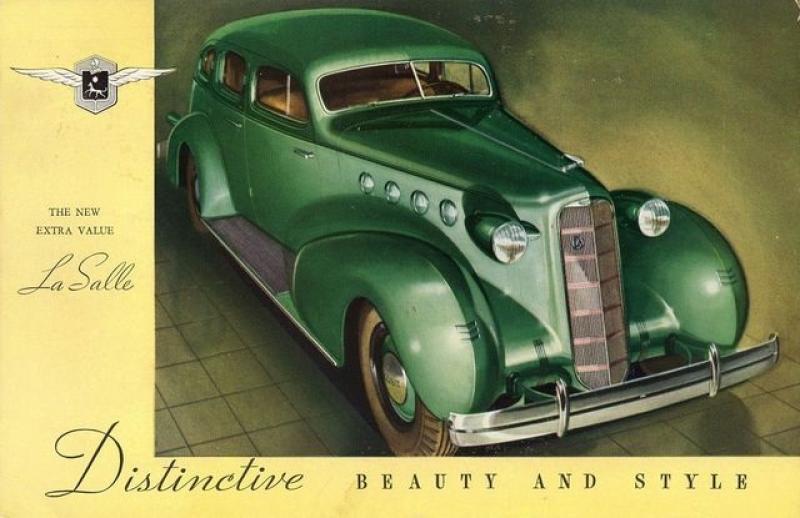
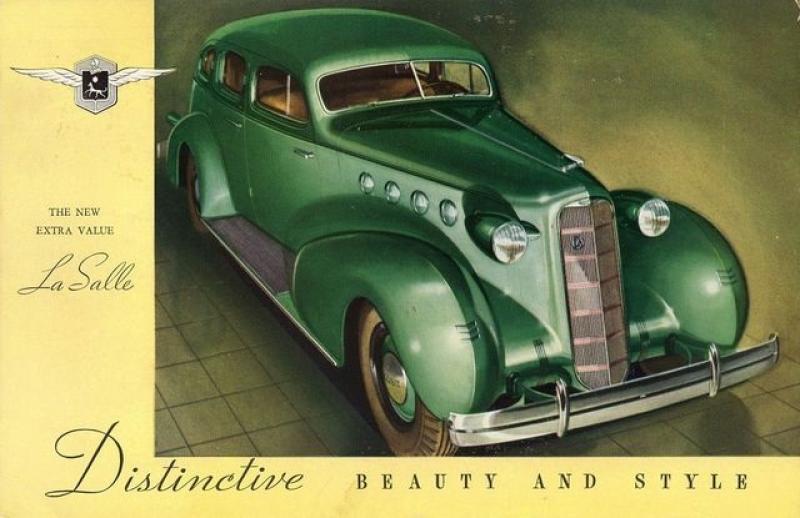
 By 1932, the companion car concept had all but disappeared. Buick had dropped the Marquette, Oldsmobile had dropped the Viking, and the Oakland name was dropped in favor of Pontiac. It was generally accepted that Cadillac would drop the LaSalle for 1934. This really bothered Harley Earl because the 1927 phenomenon had been his baby. He asked his design staff for new and fresh ideas for the 1934 LaSalle that might reverse this decision. Influenced by the narrow-fronted British beach racers, Earl's team came up with a design where the grill was slender and tall, the nose and hood were narrow, the headlights were attached to the radiator shroud with short stubby wings, the two-piece windshield was raked, the spare tire was concealed, and there were art deco taillights, streamlined fenders, and flowing body lines. Earl gave the go-ahead to make clay models and then ordered a sample body made.
It was customary for GM executives to preview Art and Colours' styling proposals for all the divisions. Each proposal would be placed behind curtains of the GM auditorium and then "unveiled" to the executives. After all of the divisions offerings had been reviewed, Earl rose to make one more presentation saying, "Gentlemen, if you decide to discontinue the LaSalle, this is the car you are not going to build." As the curtains parted, the GM executives sat speechless as they gazed at the mock-up of the revolutionary 1934 new design. Everyone liked the design and in less than five minutes, the GM executives reversed their decision to discontinue the LaSalle. LaSalle had been revived and remained on the scene for six more model years.

1940 LaSalle 52 Special
In 1940, the model 52 "Special" was introduced. It was built on the C-body chassis, as was the Cadillac model 62, and was often referred to as the "torpedo" body form. Rounded rear windows were all part of the smooth integrated design. In the opinion of many, it was the most beautiful and refined LaSalle produced. It used the Cadillac flat-head V-8 (322 in3, 130 HP) with a Carter two-barrel carburetor and Cadillac synchromesh transmission for propulsion. It was the first GM car to mount the headlights in the fenders instead of on pods attached to the radiator shroud. This was also the first year in which turn signals became standard equipment. The convertibles had the first power top.
While a 1941 LaSalle was designed, production ended in August of 1940 with the 1940 models, and the design for the 1941 LaSalle was partially used in the 62 series Cadillac. Throughout its fourteen-year production run, it showed that potential purchasers would flock to a car that was good looking, that performed, that was dependable, and carried a well-known name. LaSalle had its own unique styling while being marketed as an automobile "built by Cadillac." It was always Cadillac's objective to ultimately sell more Cadillacs, to have LaSalle owners motivated to move up to a Cadillac, and have Cadillac reign supreme as the "Standard of the World."
Note: Much of the information in this article came from non-copyrighted articles on the Internet and from the book LaSalle, Cadillac's Companion Car by Ron Van Gelderen and Matt Larso
No politics, no religion, no instagrams, and commentary must be civil. The ToS and the CoC will be enforced, and anything that the administrator deems to be offensive will be deleted. YouTubes, videos and images that the administrator is unable to open must be described and explained or they will be deleted.

Tags
Who is online

281 visitors
There are a lot of car brands and models that I never heard of because they were dropped well before my time. For example, I never heard of some cars mentioned in this article that were produced by General Motors such as the Marquette, the Viking and the Oakland. However, I knew about the LaSalle. Some LaSalle models were really stunning - I would have loved to have driven one of these:
Harley Earl was a genius.
He sure was.
good info on car history
This car has a good history.