
1952 Hudson Hornet Looks Fabulous in Two-Tone Blue, Packs Twin H-Power Setup

By: Ciprian Florea (autoevolution)
BUZZ NOTE: There is a YouTube video as part of this article at the end of the article that I am unable to open, but you can by clicking the SEEDED CONTENT link just below this message, which will open the original source article.
 S E E D E D C O N T E N T

1952 Hudson Hornet Looks Fabulous in Two-Tone Blue, Packs Twin H-Power Setup
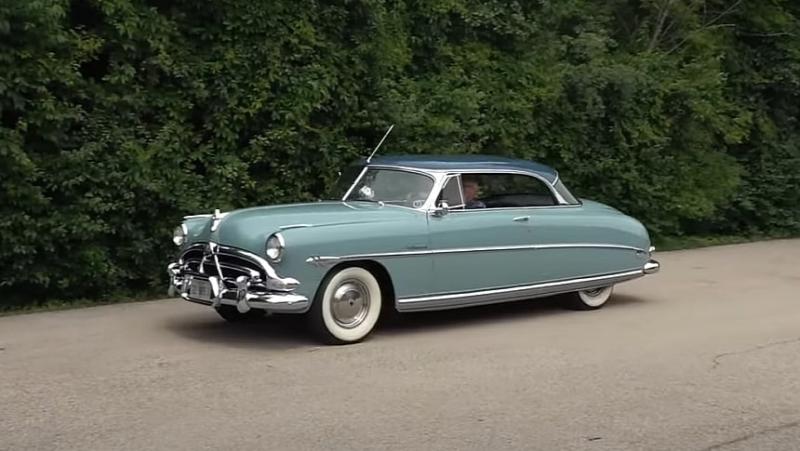
One of fewer than 2,200 hardtops produced in 1952, this Hudson Hornet is a semi-survivor with an original interior and matching engine.

All photos by Lou Costabile/YouTube


One of America's many orphan brands, Hudson was established in 1909 and disappeared in the 1950s. It merged with Nash-Kelvinator to form American Motors Corporation (AMC) in 1954 and was retired for good in 1957. Although it's not quite as iconic as Plymouth or Oldsmobile, Hudson left a few notable cars behind. The Hornet is arguably the most celebrated.
The Hornet debuted for the 1951 model year on the same "step-down" architecture first seen in the 1948 Commodore. Unlike a unibody setup, the "step-down" design did not fully merge the body and chassis frame into a single unit. Instead, the floor pans recessed down between the chassis rails. This lowered the car's center of gravity, improving handling and comfort.
The Hornet employed a low-slung look and relies on a 308-cubic-inch (5.0-liter) inline-six engine. Even though it wasn't designed with high performance in mind, the Hornet found its way into stock car racing and dominated the Grand National series for three years. It was NASCAR's first factory-backed initiative.
The Hornet remained in production beyond Hudson's merger with Nash, but the second-gen version, launched for 1955, had nothing in common with the original rig. The nameplate went into the history books in 1957.
Hudson sold 131,628 first-gen Hornets from 1951 to 1954, so the car is far from rare based on production output. However, most are currently rotting away in junkyards, so highly original survivors are quite rare. The 1952 Hollywood hardtop you see here is one of the lucky ones. It's not a fully-fledged survivor, but it's still on the road after more than 70 years.
This Hudson is pretty much a semi-survivor. It's been repainted and had its bright bits re-chromed, but it still has an original interior. The Twin H-Power engine, rated at 170 horsepower, was rebuilt some 30 years ago but remains highly original.
The Hornet sports what I consider to be one of the coolest color combos from the era. It has a light Southern Blue body with a darker Broadway Blue top. This layout just screams 1950s.
The interior is just as gorgeous. And if you're into pinstripe fabrics, it has you covered. The pattern adorns both the door panels and seats, complemented by dark grey/blue vinyl and gray/brown paint. Even though it's 73 years old as of 2025, the headliner is still solid, which is outstanding, to say the least.
Oh, did I mention this Hudson is actually rare, thanks to its Hollywood hardtop body style? Hudson sold 35,921 Hornets in 1952, but only 2,160 were ordered with this roof. The hardtop is the second-racking body style after the convertible, produced in just 360 examples. It's also a low-mileage gem with only 31,741 miles (51,082 km) on the clock.
The car belongs to Frank Ziberna, who shares that he bought it only a few weeks ago. He wanted a Hudson because his father had one and waited five years to purchase this specific example. He's obviously happy with his purchase and spends a lot of time discussing it with car enthusiast Lou Costabile. Check it out in the video below, and make sure you subscribe to Lou's YouTube channel for more stories like this.
No politics, no religion, no instagrams, and commentary must be civil. The ToS and the CoC will be enforced, and anything that the administrator deems to be offensive will be deleted. YouTubes, videos and images that the administrator is unable to open must be described and explained or they will be deleted.
Tags
Who is online

281 visitors
And when I was 16 years old, my father bought one of those 35,921 Hornets, the same colour as the article car, but as a 4-door sedan.
It did not have power steering or power brakes, but the car handled superior to any car I drove back then for years - you got the actual feeling of the steering and brakes, not an artificially adjusted one. It was so unique I can still remember (from 72 years ago) driving it, going around a specfic curve (on Mayfair Crescent in Hamilton, Ontario) at high speed and the car held the road.
The back seat of my father's 1952 Hudson Hornet was where I was initiated into one of my importand growing up life experiences. Thank you, Kitty, wherever you may be.
Cars had really big back seats then!
No bucket seats in standard cars back then, so it made a good bed. Also, no bucket seats in the front made it nice for the girl friend to cuddle up to you when driving. Ah, those were the days.
LOL. Well THAT'LL teach me to post an article that isn't about politics or wars.
Two days without a comment or a vote up. Don't worry, I won't take up the space that should be used for a political article if nobody shows any interest whatsoever by posting a vote up or, God forbid, a comment. Without any interest whatsoever this article will be deleted to free up a space for a political article 12 hours from now.
OK I just now saw it
You just saved this article from being deleted.
What I love about classics like this is that they will never be built to this quality today. Nothing flashy aside from their quality and age. Not to mention that they are easy to repair. YOu don't need computers or some degree. These are some of the smoothest rides you will every take.
I have only seen a few Hornets at car shows, They were ahead of their time
Remember the AMC Hornet? Friend of mine in High School had one with the 360 c.i. engine. That car was a hell of a lot of fun.
There were a couple of those around. Light weight and would run
This is a modern 2025 Dodge Hornet. Depending on options they sell for between $30,000 and $40,000.
Thanks for pointing that out. I should have remembered the new Hornet