
2025 Des Moines Concours to feature rare Scarab

By: By Robert D. Cunningham
 S E E D E D C O N T E N T

2025 Des Moines Concours to feature rare Scarab

Stout Scarab #4 will be a featured attraction of the 2025 Des Moines Concours
The depression-era concept car tops the list of "Star Cars"
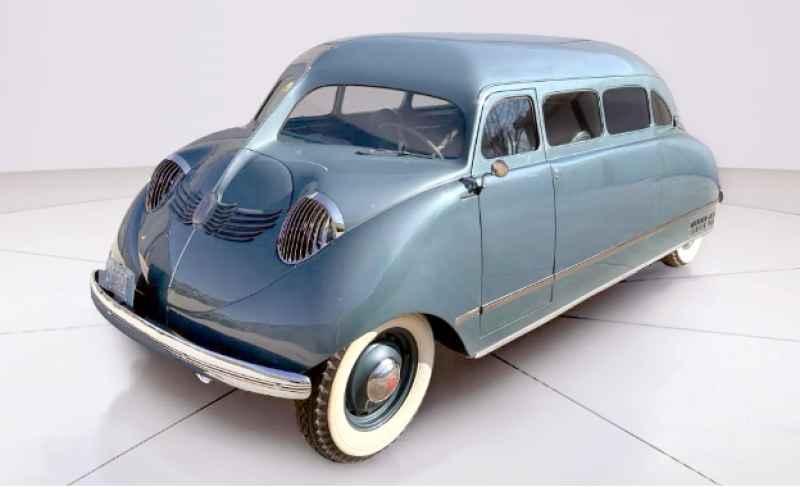
The Iowa Automotive Heritage Foundation is proud to announce one of the most advanced and futuristic automobiles of its day will be featured as a "Star Car" of the 2025 Des Moines Concours d'Elegance. Do not miss this opportunity to see the ultra-streamlined 1936 Stout Scarab.
In the early years of automotive development, form followed function. Motorcars were simply horsedrawn carriages without the smelly beasts up front. However, as engines became larger and hoods became longer, drivers were forced to crane their necks to see the road ahead.

Automotive engineers debating streamlined designs, as depicted in a Hollywood motion picture.
The Society of Automotive Engineers (SAE) addressed the dilemma during their 1931 meeting in West Virginia. "Precedent and tradition are among the greatest handicaps to progress," future SAE president William Bushnell Stout told the assembly. "Too often, they squeeze ideas into a jelly. Real progress comes from new assumptions; new viewpoints. Engineering that depends on slide-rule and mathematics for creation is doomed to failure."
Many of Stout's fellow engineers envisioned an entirely new style of rear-engine automobile shaped like a finless fish, or "the perfectly formed teardrop falling from a movie actress's eye." Enveloping fenders, running boards, and wheels into the body would provide more interior room, better visibility, greater comfort, improved safety, and less noise.
Stout was a strong proponent of such streamlining, but not of the fishy teardrop type. He publicly trounced the concept, stating, "the teardrop is three times more likely to lose control at high speed than the typically designed motor car." Instead, Stout looked to the lowly turtle. "The flat bottom of a turtle shell provides stability and minimizes air passage underneath," he proclaimed.

William Stout at the wheel of Scarab #1, which he completed during the winter of 1932.
OUT OF THE AIR - TOMORROW'S CAR
The Stout Motor Car Corporation of Dearborn, Michigan, was established to prove William Stout's streamlining theories. Stout constructed his Scarab prototype by applying aircraft technology - shaping aluminum body panels over a welded chrome-moly tubular skeleton. The Scarab's turtle shape allowed the windows to slant inward and reduce night glare. Instead of using traditional shock absorbers under a frame and floor, the Scarab's suspension points were shoulder-high to the seated passengers. "With this pendulum type of suspension, there is an actual banking movement of the body as the car rounds a corner," Stout explained.

Commercial Illustrator Lester Johnson refined the Scarab’s striking design. Interior appointments were plush. The car’s sound-absorbent headliner was covered with woven reeds.
Stout's eight subsequent Scarabs featured styling refinements by Lester Johnson. Up front, between the headlights, stamped fresh-air louvers formed the wings of a scarab beetle. No two cars were exactly alike. Several, including our Concours Star Car, Scarab #4, featured a series of chrome strips that spilled like a waterfall over the rear window and engine louvers.
The Scarab occupied a space no larger than a contemporary Ford but offered twice the interior room. The driver entered through a door beside his seat. All other passengers entered through a right-side door near the back of the car. Although the driver's seat was fixed to the floor, passenger chairs were completely movable. The cushions of the rear divan could be placed on the flat floor to create a comfortable bed. A folding table allowed occupants to play cards or conduct business as the Scarab traveled.

R. E. Stranahan, of the Champion Sparkplug Co., drove his Scarab through Iowa in 1942.
Power came from an 85 hp Ford L-head V8 engine mounted backward, at the rear, over the differential. This placement allowed the car and its passengers to travel away from noxious engine noises and fumes rather than through them.
Priced at a whopping $5,500 each, Scarabs were sold exclusively to Stout's investor friends, including Philip K. Wrigley, the chewing gum magnate; Willard Dow of Dow Chemical; and R. E. Stranahan of the Champion Sparkplug Company. Stout actively pursued a partnership with an established manufacturer to mass produce his cars at a retail price of $650, equal to a Ford 4-door sedan. But Detroit was not interested in a partnership.
However, most of Stout's innovative ideas were eventually adopted, including unit-body construction, smooth body lines, flush-type hinges, electric door locks, four-wheel independent suspension, and a laundry list of other features. By the 1980s, millions of families the world over were traveling in "minivans", each one a design descendant of Stout's revolutionary Scarab.

William Harrah acquired the dilapidated Scarab #4 in the early 1970s.
DESERTED IN THE DESERT
Of the nine Scarabs built between 1932 and 1939, only five are known to survive. Scarab #4 was repainted several times and languished in a Southwestern desert before being rescued and added to Harrah's Automobile Collection in Reno, Nevada. After Harrah's death in 1978, Holiday Inn acquired his properties, including 1,400 cars and trucks. Most of the automobile collection was auctioned off over a period of three years.
By 1987, Ron Schneider, of Franklin, Wisconsin, had acquired Scarabs #3 and #4. He simultaneously restored both to concours quality. Moreover, as a testament to the Scarab's roadworthiness, Schneider piloted #4 when he competed in The Great Race across America in 1989 and 1990 — the last time a Scarab has traveled through Des Moines. Since then, #4 has been featured in some of America's most prestigious events, including the Pebble Beach Concours d'Elegance.

With smooth sides that enveloped the wheels, the Scarab was unlike any other car of its day.
On Sunday, September 7, the Iowa Automotive Heritage Foundation will proudly present the 1936 Stout Scarab as a featured "Star Car" during the 2025 Des Moines Concours d'Elegance. To commemorate the event, West Des Moines illustrator Bob Cunningham was commissioned to create a portrait of Stout Scarab #4. He chose to depict the car among several other depression-era streamliners in front of the famous Butler Mansion, located at 2633 Fleur Drive, south of downtown Des Moines. American Magazine declared the mansion "the world's most modern house" when it was completed in 1937. Poster prints of Cunningham's "Dinner at Butler Mansion" will be available for sale on the show field.

Automotive author/illustrator Bob Cunningham depicted Scarab #4 on the 2025 Des Moines Concours program cover. This is the fourth time Cunningham was selected as the cover artist.
WHEN AND WHERE
Come see the fabulous 1936 Stout Scarab - plus more than 100 other automobiles of distinction - at the 2025 Des Moines Concours d'Elegance. Sunday, September 7 th at the Pappajohn Sculpture Park. Show hours will be 10am to 4pm. Bring your friends!
No politics, no religion, no instagrams, and commentary must be civil. The ToS and the CoC will be enforced, and anything that the administrator deems to be offensive will be deleted. YouTubes, videos and images that the administrator is unable to open must be described and explained or they will be deleted.

Tags
Who is online
90 visitors
Never heard of that car before, and it sure is unusual.
I'm glad that style didn't catch on
LOL. I understand how you feel. However, it does kind of point the way to the development of camper vans.