
The History of the Woodie

By: Historic Vehicles
 S E E D E D C O N T E N T

The History of the Woodie
Cars and station wagons with polished wood rear bodywork became affectionately known as ‘woodies’ in the USA in the 1930s, but the origin goes back to Europe’s ‘shooting brake’, some 100 years before then.
Wikipedia tells us that a break or brake was an open horse-drawn carriage that was in common use from the mid-19th to early 20th centuries. This heavy, four-wheeled vehicle was pulled by two or four horses and was designed to break young horses, accustoming them to hauling various types of sulkies, drays and carriages.
Originally spelled break in England (from breaking horses), the spelling brake became common in the latter part of the 1800s and both spellings can be used.
A derivation of this open-bodied vehicle became popular for pursuits that required something more basic than an enclosed carriage. Sporting breaks were used to transport groups of friends to sporting events such as horse races. Shooting breaks and hunting breaks carried shooting parties and their gun dogs, and were drawn by a single horse or a pair.

1910 Rolls Royce Silver Ghost Croal Shooting Brake – Alf van Beem
The first automotive shooting brakes were manufactured in the early 1900s in the United Kingdom. The vehicle style became popular in England and the USA during the 1920s and 1930s, produced by vehicle manufacturers or as conversions by coach builders. Some European vehicle makers also produced shooting brakes.

1928 Rolls Royce 40-50hp Phantom 1 Shooting Brake: a famous Aintree Racecourse support vehicle in the 1950s and 60s.
The most famous shooting brakes had custom two-door bodies fitted to the chassis of pedigreed cars.
From the 1930s, the term was used in Britain interchangeably with estate car and in the USA as station wagon : a wagon you used to transport people and their luggage from a railway station.

The same Rolls Royce Phantom 1 Shooting Brake at the Bonhams Paris Sale in 2012 – The Supermat
Contemporary descriptions include: “A sleek wagon with two doors and sports-car panache, its image entangled with European aristocracy, fox hunts, and baying hounds”; “A cross between an estate and a coupé”; “Essentially a two-door station wagon”; In France, a break de chasse , which translates as, “hunting break”.
The UK’s weekly magazine, The Commercial Motor described a shooting brake as having: “seats for eight persons as well as the driver, whilst four guns and a large supply of cartridges, provisions baskets and a good ‘bag’ can be carried”.
Hunting in the USA was much more of a ‘grass roots’ affair than it was among European aristocracy, so posh, polished wood shooting brake bodywork was confined to a very small, well-heeled boutique market in the USA.

1923 Star Four Model C StationWagon – David Berry
However, the launch of the short-lived 1923 Star Station Wagon changed that situation completely. Instead of shipping a chassis out to a custom builder, who added a wooden wagon body, the wagon body was delivered to the Star factory and fitted to the chassis there. That gave Henry Ford an idea.

1923 Ford Model T Depot Hack – Ryan Hildebrand
Wooden body framing was still the norm in the 1920s, with most car and light commercial bodies consisting of shaped steel panels fitted over shaped wooden frames. That type of body construction continued until the late 1930s, by which time all-steel bodywork dominated.
In the early 1920s, Henry’s ‘one-stop-shop’ production policy was clearly evidenced by his giant River Rouge plant in Michigan: the largest car factory in the world. Raw materials went in at one end and finished vehicles came out the other.
Back then, wood was an essential component of automobiles and Ford wanted to guarantee uninterrupted supply of finished timber frames. In 1920, Henry Ford purchased more than 400,000 acres of forest reserves in Michigan’s Upper Peninsula and constructed a timber processing plant nearby. Ford handled all its wood-supply operations: growing trees; felling timber; running the sawmill and shaping body parts.
Shaped wooden frames were parts of vehicle bodies and the costs of using that wood solely internally, underneath metal panels, or partly externally, as woodie bodywork, weren’t greatly different.
His assured supply of wood encouraged Henry Ford to introduce a production-line woodie station wagon, aping what Star had done six years before, but on a much larger scale.

That 1929 Model A wagon bodywork was made of maple, with birch or mahogany inserts and liquidambar (sweet gum) paneling. The cabin was completely hand-made of wood, including the headliner, doors, dashboard and tailgate. There were four doors, a glass windscreen and canvas side curtains with small plastic openings.
Ford made 5200 woodies in that first year, selling for US$695, so Nash, Plymouth, Willys, Studebaker and Chevrolet just had to follow. Woodies proved popular and were produced as variants of sedans, convertibles and station wagons, from basic to luxury.
Nash also produced a bed-in-a-car option, in which the rear seat in its woodie folded to become a double bed.

1939 Ford Custom Woodie – Barrett-Jackson Fall Auction 2024
Ford’s 1935 woodies featured hand-cranking glass windows in the front doors, with optional rear glass added a year later. The 1937 swing-out rear window was an industry first and Mercury models scored a horsepower boost, from 80bhp to 85bhp from their flathead V8s.
Woodie interiors picked up more polished wood trim, leather seat covers and several rear accommodation seating options.

1946 Mercury – Stanley Hamel collection
World War II put an end to recreational vehicle production in Europe and the USA, but the end of hostilities and the need for people to return to normality saw a revival of post-war woodie production, on both sides of the Atlantic. Steel shortages also contributed to wood popularity with vehicle makers.

1950 Chrysler Newport Coupe Woodie – Stephen Foskett
However, all-steel vehicle bodywork was the post-War norm and wooden body fabrication was much more expensive than pressing steel panels. When steel availability improved, production costs went down and woodies became comparatively much more expensive. Most makers opted for steel-bodied station wagons and estate cars, not wooden ones.

The last traditional Ford woody was built in 1948, after which the company opted for pressed, glued-laminate wood frames and panels. Also, steel roofs and inner frames were introduced. That modernisation saw 1951 volumes of Ford and Mercury woodies hit all-time highs, but the end was in sight.

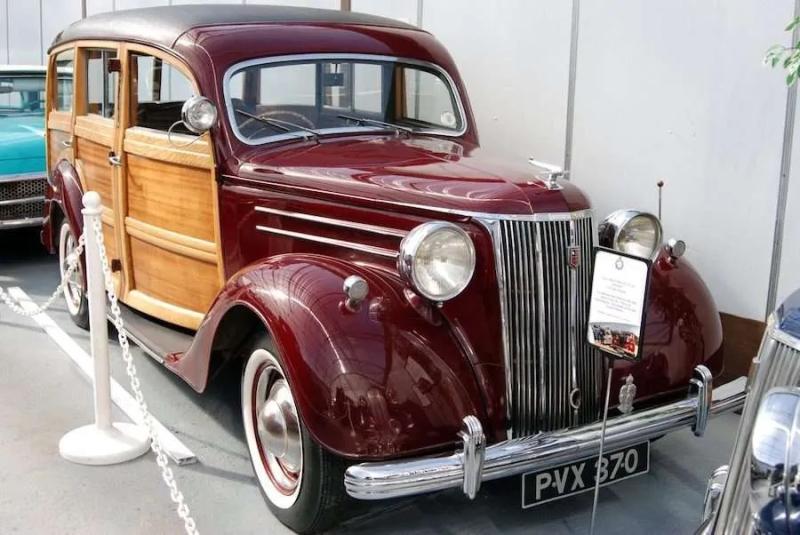
Ford V8 Pilot Woodie – Automotive Heritage Foundation
In Europe, there were several woodie variants of cars and light commercials, but not on a scale to rival that in the USA.

1964 Morris Minor Traveller – Jack Murray
By the end of the 1950s, wooden body variants had all but disappeared from mass produced vehicle ranks, but the woodie managed to survive … sort of.
Part of the woodie attraction was the ‘rebel’ surf culture of the 1960s, where used woodies were in great demand as surf wagons. Jan & Dean’s Surf City was a global hit that immortalised the traditional woodie.

1970 Ranchero Squire – Brian Toad
The invention of woodgrain plastic materials saw the re-introduction of mass-produced ‘woodie’ wagons in the 1970s. Wood construction of rear and side bodywork was replaced by a variety of materials and methods that evoked wood construction, including curved woodgrain ‘veneers’ and moulded three-dimensional framework.

The best known example from the somewhat kitsch pseudo-woodie era is the 1979 Ford LTD Country Squire that starred in National Lampoon’s Vacation movie, about the Griswold family’s holiday trip to Walley World.
The woodie attraction

1948 Peugeot 202 Canadienne camionette boisee – The Supermat
High quality wooden furniture has been traditionally characterised by elegant grain pattern and fine gloss finish; often the result of multi-coat varnish application. It’s not unusual for woodgrain patterns to be enhanced by up to 20 coats of lacquer, with fine hand-sanding between coats, going an almost prismatic quality to the wood.
Station wagons with wooden bodies replicated that upper-crust genre, in bodywork that could be paraded outside the confines of the home. A classy woodie conferred status and implied wealth and good taste.
Much of the work was done by the hands of well-trained craftsmen. As many as 150 separate pieces of wood were involved in the production of a single vehicle.

1947 woodie wagon bodywork – State Library of NSW
In an age where the necessary wooden frames were largely hand-crafted it made economic sense to make a woodie, with externally visible woodwork, rather than clad in steel, but when pressed-steel bodies became common practice, wooden bodywork was anachronistic.
Fully original surviving woodies are virtually impossible to find, making genuine examples six or seven figure purchases in the classic vehicle market.
Of course, an old woodie makes an ideal project for a retired boat builder or woodworking expert!
Living with a woodie

Nash Suburban four-door sedan woodie – CZmarlin
We’ve never owned a true woodie, because they were always hard to come by in Australia; never being as popular as they were in the more temperate Northern Hemisphere. However, we have owned two wooden boats, so we have a very good idea of the work needed to maintain a high-gloss finish on wood, in the harsh Australian climate.
We found that maintaining the varnished finish on a moored kauri and spotted gum yacht was similar to that required to rot-proof the Sydney Harbour Bridge: when you finished at the stern; it was time to return to the bow and start all over again!
At one stage, our neighbours had a Morris Minor Traveller that was a steel-bodied van, enhanced with decorative external wooden framework. It very quickly developed black stains in the woodwork, thanks to rain water intrusion. Nearly every woodie we’ve inspected has more or less the same problem.
Various theories are available about the best timber and the best coating for woodie bodywork, but none are worth a squirt in the face of fresh water and high-UV levels.
Because the woodwork grew and shrank with weather changes, flexible but high-maintenance, short-lived canvas roofs were the norm.

1940 Ford woodie- Audrain Auto Museum
As we learnt from wooden boat ownership, replacing one or more pieces of rotted wood is an absolute nightmare. In the case of a boat with a rotted or broken frame it’s possible to ‘partner’ it with a duplicate and leave the damaged one in place, but in the case of a woodie that’s not an option: damaged wood must be cut out and replaced. Even then, it’s virtually impossible to impart the age patina that the rest of the bodywork has.
The glossy show woodies we’ve seen spend very little time in the great outdoors; are never driven in scotching sunlight or in the rain and are kept in temperature-regulated garages.
If you’re planning a woodie restoration or replica construction, don’t even think about it unless you have weather-proof storage for the finished article.

1949 Packard Station Sedan – Mr Choppers
No politics, no religion, no instagrams, and commentary must be civil. The ToS and the CoC will be enforced, and anything that the administrator deems to be offensive will be deleted. YouTubes, videos and images that the administrator is unable to open must be described and explained or they will be deleted.
Tags
Who is online
84 visitors
Although there were cars called woodies that had only painted as wood on metal doors, I never thought of them as real woodies.
When I was a kid most of the neighbours had 2 cars-- an ordinary car and a "Station Wagon". (I never heard them called "Woodies"-- everyone called them Station Wagons).
And IIRC they didn't buy them for beautiful wood-- they bought them because they had a lot of room to carry things.
I never knew they were called woodies until surfin' movie days, but I never knew why they were called station wagons until today.
A friend of mine restored a 1940 woody wagon. He built a custom wooden surfboard for it (although he doesn't surf) and has also restored a wooden old town canoe. He's an amazing woodworker.
Do you have any photos of his works you can post?
No. Sorry I'm not much of a picture taker.
Okay, no problem.
Good article.
I thought so as well - long, perhaps. but educational.