Link
Anthony Randazzo | September 26, 2013
As the federal governments fiscal year 2013 wheezes to a close without a budget in place for fiscal 2014, here is some basic information everyone should understand.
According to the Congressional Budget Office (CBO), current spending levels are estimated to result in a $560 billion federal deficit in 2014, smaller than last year, but projected to start growing again by 2016.
Deficits can hurt the economy by forcing the government to borrow and add to the national debt owed to the publicpresently about $12 trillion, or roughly 72 percent of the whole economywhich hurts the economy in the long run. That same borrowing might cause businesses to delay investing in the economy in case their taxes are raised to pay for the added debt, and creating short-term pain. So, what would it take to actually eliminate the deficit?
Lets start by considering how much of federal spending is mandatory and how much is discretionary.
Mandatory spending is what Congress has promised in previous years it would distribute, and it includes things like Medicare, Medicaid, social security, and veterans benefits. According to the CBOs most recent budget projection (from which all estimates below are derived) , mandatory spending is estimated to be $2.2 trillion in the coming year.
As the few attempts to actually reform entitlement spending have shown, this money is very, very hard to cut. Discretionary spending is pretty much everything other than entitlement programs,. For example, it covers most of the defense budget, education spending, bailouts for Wall Street, and erectile dysfunction studies . The CBO projects $1.2 trillion in discretionary spending for 2014, and this is typically where Congress cuts. If at all.
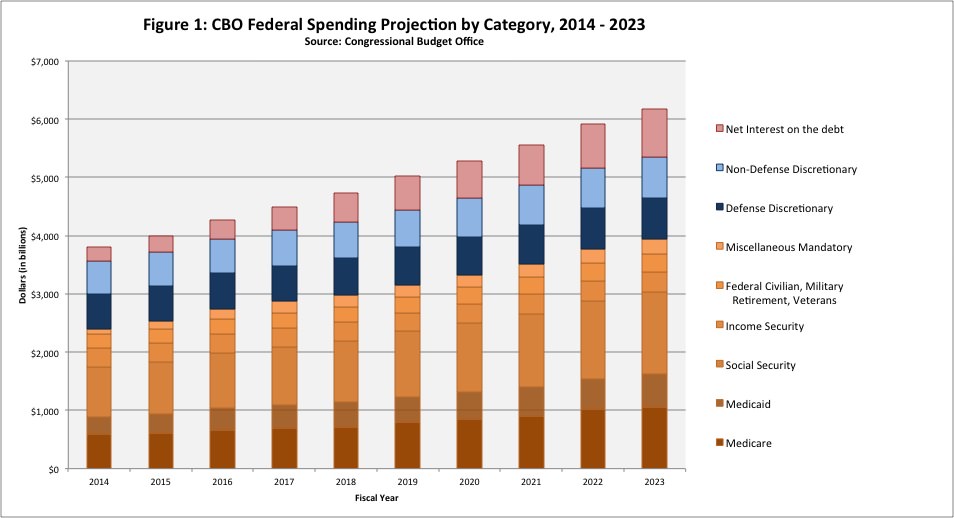
Figure 1 shows that spending is projected to increase from $3.6 trillion in 2014 to $5.8 trillion in 2023. (CBO bases its budget projection on how current law directs spending and the Bureau of Economic Analysiss model of the economy.)
 CBO
Thats right, your eyes do not deceive you: mandatory spending is over half of the federal budget, taking up 61 percent in 2014. Meanwhile, defense spending is 16.5 percent and non-defense discretionary spending 15.9 percent of the anticipated 2014 budget.
Total federal spending for 2014 is projected to be 20.9 percent of GDPmeaning the government will spend about a fifth of the whole productive value of the economy. At the same time, revenue is projected to be 17.7 percent of GDP, creating the estimated $560 billon deficit. Figure 2 shows spending growing to 21.8 percent of GDP in 2023 with revenue of 18.5 percent. The gap between the two is the federal deficit.
 CBO
An important note: 10-year budget estimates like this really are little more than a wild guess at what the economy and political environment will be like in a decade. About the only thing that is for certain from this graph is that the numbers will not be exactly these. Still, they enable us to critique the governments own projected policy goals on its own terms.
The 19% Spending Ceiling
 CBO If Congress wants to eliminate the deficit, a simple way would be to cap spending at the projected revenue to GDP ratio. The CBO projects based on current tax law that over the next decade federal revenues will average about 19 percent of GDP, as shown in Figure 3.
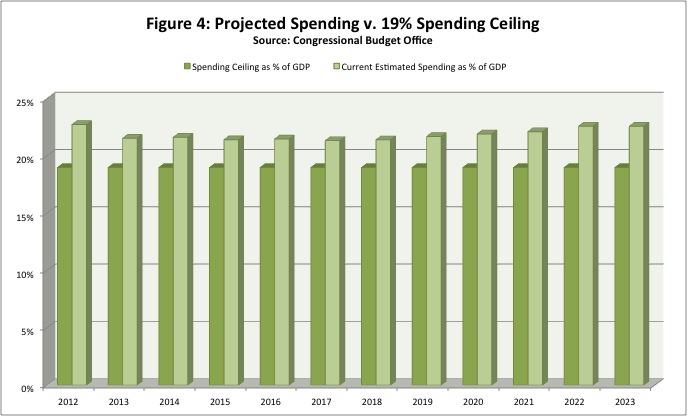
 CBO If Congress wants to eliminate the deficit, it could simply create a spending ceiling of 19 percent of GDP. (My colleagues Nick Gillespie and Veronique de Rugy fleshed out the full rationale behind this idea in Reason magazines March 2011 issue .) Figure 4 shows how that target based on CBO projected federal revenue would change spending levels.
That might look like a crazy target, with expenditures never below 22 percent of GDP during the Obama administration. But since 1954, federal revenue has averaged 17.5 percent of GDP, according to White House Office of Management and Budget. And during that six-decade stretch the highest revenue hit was 20.6 percent in 2000, and in recent years revenue hasn't been higher than 17 percent of GDP. So in relative terms the cap probably doesnt go far enough to ensure eliminating the deficit.
But a 19 percent spending ceiling is more politically realistic than 17 percent, so lets stick with the thought experiment. What would Congress actually have to do to target a 19 percent of GDP spending ceiling and eliminate the projected deficit?
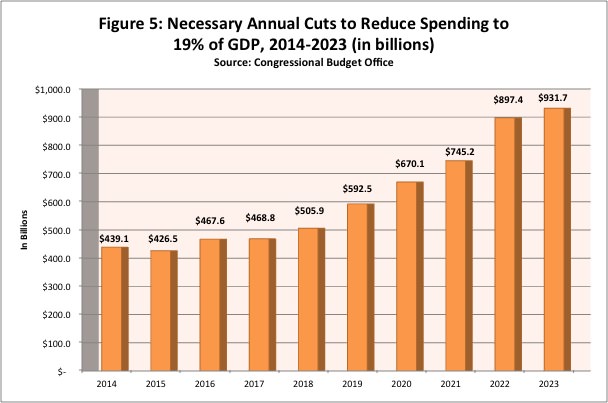
For the 2014 budget Congress would have to cut $439.1 billion from total spending, or 12 percent of the estimated $3.6 trillion budget. Over the next 10-years the CBO estimates federal spending of $46.68 trillion, and to meet the 19 percent spending ceiling, Congress would need to reduce that projection $6.14 trillion. Essentially six more sequesters.
Figure 5 shows how much would need to be cut from the budget each year to get to the 19 percent spending ceiling.
Where will those dollars come from? The options are from mandatory spending, discretionary spending, or both.
Theoretically, these cut levels might be reduced if interest on the debt falls because of the spending ceiling. Over the next 10-years, interest payments on the national debt will be growing as a percent of the total budget, from 6.6 percent in 2014 to 14.1 percent in 2023. In nominal terms, discretionary spending is set to grow 17 percent over the next decade, while mandatory spending will grow 36 percent. Meanwhile interest payments on the national debt are set to more than triple over the next 10 years.
It is not guaranteed that debt service payments would fall in coming years relative to projections if the budget were balanced because it is impossible to know how private sector lending and interest rates would respond in the near-term to less federal spending. For the sake of simplicity well treat spending for interest on debt as neutral over the next decade and look to apply the cuts just on mandatory and/or discretionary spending.
 CBO
Since cutting entitlement spending is hard, lets consider what would happen if Congress only cut discretionary in order to achieve the 19 percent of GDP spending ceiling.
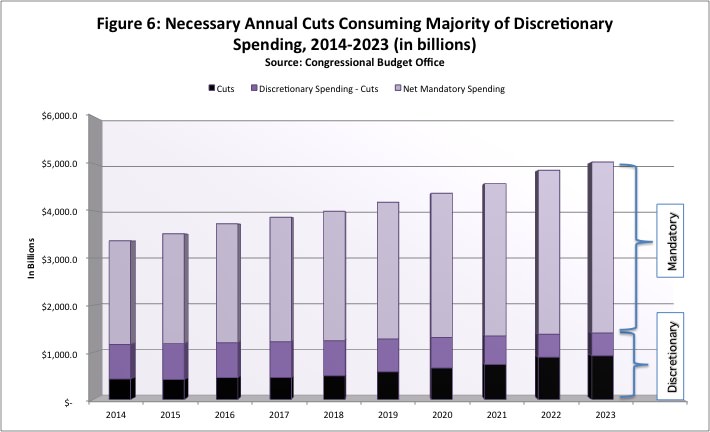
Figure 6 shows discretionary spendingincluding both defense and non-defense spendingwould fall from 32 percent of the budget to 24 percent of the budget (the black area indicates the portion of the budget that would be cut).
 CBO
As the graph makes clear, by the end of the decade, the cuts would represent more than half of projected discretionary spending, which is completely untenable. Moreover, if you think the so-called fiscal cliff was portrayed as portending the end of the world, imagine what the Big Government lobby will say about a 35 percent cut from projected discretionary spending in 2014 and 36 percent in 2015!
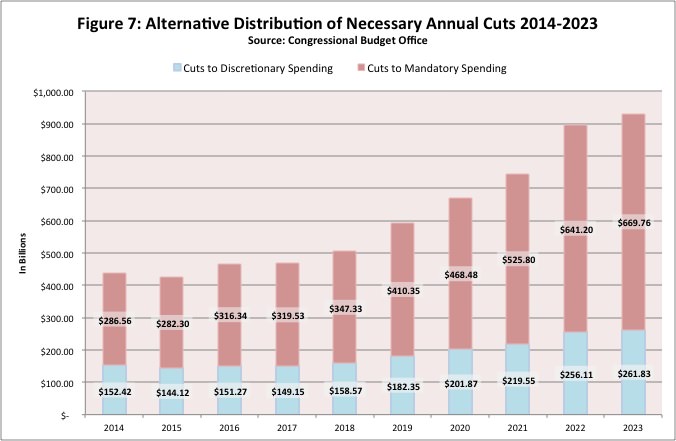
So what if, instead, the necessary annual cuts could be divided between mandatory and discretionary spending? The cuts could be applied to the two categories at the same ratio of their shares of overall spending. For instance if discretionary spending is 35 percent of combined mandatory and discretionary spending for 2014, then 35 percent of the annual cuts would apply to that category. Figure 7 shows how the annual cuts would be distributed by category of spending.
 CBO
And to clarify further what the cut sharing would mean, Figure 8 shows the overall portion of discretionary and mandatory spending these cuts would consume.

Under this cut sharing scenario, discretionary spending would be reduced 13 percent in 2014 and 12 percent in 2015, no doubt raising cries of social Darwinism and other taunts from progressivesand likely from many conservatives too.
To call this politically daunting is beyond mild. And that is even before facing the reality that if there was some general agreement to eliminate the deficit by spending cuts that would still leave open the details on which discretionary and mandatory programs would get reduced or shut down.
The best solution to getting spending under control is to reduce both entitlement and discretionary spending. Yet, to put what cutting 12 percent of total spending next year would mean: the $42 billion sequester cut from federal spending in 2013 was just 1.3 percent of combined discretionary and mandatory spending. The $89 billion in 2014 sequester cuts are estimated be 2.4 percent of combined spending. Getting serious about ending the deficit would raise the level political hyperbole to potentially unseen, blood-in-the-streets levels (Sen. Ted Cruzs recent tone-deaf reference to the Bataan Death March aside).
However, it might be accomplished, at a minimum the process of ending the deficit would take true political braveryor perhaps just good ol fashion statesmanship.



 CBO
 CBO
 CBO
 CBO
Trumps math and defies logic too!
I hate graphs that are all projections . There are no reference points in the present or past to compare to .
Is a centralized banking system and no IQ test for politicians needed to get us out of this mess still reasonable?
That would be like ... the kama sutra ? No , that would be uncommon fucking sense .
Don't forget raising the debt ceiling doesn't raise the debt. It stopped doing that back in 2008.