
Revolution incorporated: How Clinton can bring Sanders supporters into the fold


Robert Borosage is president of the Institute for America’s Future and was an adviser to Jesse Jackson’s 1988 campaign.
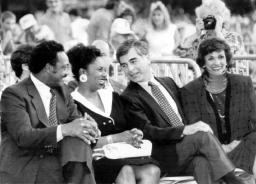
Yes, modern party conventions have been turned into slickly packaged made-for-TV unity fests: Carefully vetted speakers deliver carefully crafted messages, while any disagreements are settled off-camera. And yes, Barack Obama and Clinton made amends after a bitter primary season eight years ago. But there’s far more ideological conflict between this year’s candidates than between Clinton and Obama in 2008.
The most likely scenario at this point is that Clinton will be the nominee but Sanders will arrive in Philadelphia with a formidable number of delegates. In that case, the closest parallel is when Michael Dukakis overcame Jesse Jackson’s insurgent movement in 1988. That year didn’t end well for the Democrats, but it offers some useful lessons about achieving party unity, allowing ideological differences and generating passion.
Like Sanders, Jackson stunned the party establishment with a strong showing in the primary race. He won 13 primaries and caucuses and 7 million votes, amassing 1,200 delegates. Also like Sanders, he electrified young Americans. He helped register legions of new voters and outperformed Dukakis with voters under 30 .
Going into the convention, Jackson and his followers demanded recognition for what they had built. They wanted Dukakis to acknowledge that they were integral to the Democratic coalition. They sought debate over the direction of the party and the country. And they thought Jackson had earned serious consideration for the vice presidency . Jackson delayed his endorsement, waiting for respect to be paid.
Dukakis, meanwhile, was eager to focus on the general election. He was tired of dealing with Jackson and intent on proving that he would stand up to him. He snubbed Jackson in his running-mate selection, and, by blunder or calculation , failed to tell Jackson before news leaked that he’d tapped Sen. Lloyd Bentsen. When Jackson learned of the pick from a reporter, he didn’t hesitate to broadcast his grievances, capitalizing on the six busloads of reporters that accompanied his caravan from Chicago to the convention in Atlanta. He suggested that he might contest Bentsen’s nomination at the convention. When he arrived, he was greeted by thousands of activists ready to march at a nod of his head.
Only as the convention got underway did Dukakis finally meet with Jackson. At a negotiated “unity” news conference, Dukakis promised that Jackson would be involved in the campaign “actively and fully in a way that will bring us together and that will build the strongest grass-roots organization.”
Jackson met with his delegates that morning and convinced them to keep their powder dry. “We came looking for noble works, not fireworks,” he told them. “Not show business, but serious business.” As William Greider wrote at the time for Rolling Stone : “Jackson’s speech was as deft as anything I’ve ever seen a politician achieve with his listeners — building their commitment to future struggles and simultaneously cooling them out about the one they had just lost.” A less-skilled orator might not have been able to pull it off. And a less-committed Democrat might not have wanted to.
Sanders, too, will finish the primary contest with an army of impassioned supporters eager for recognition of their revolution — some even urging a third-party run. Clinton’s campaign operatives will want Sanders to step back, salute and turn his fire on the Republican nominee. But Sanders will be in a position to determine what happens in Philadelphia and will have major influence on whether his supporters turn out for the nominee. Respect must be paid.
In contrast to Jackson in ’88, Sanders has no interest in the vice presidency. His focus is on the direction of the party. “When people respond by the millions to your message, then that message is now mainstream,” Sanders recently told the New Yorker . “That changes political reality. Smart politicians like Hillary Clinton and anybody else have got to move where the action is, and the action is on those issues that I’ve been raising.”
Like Sanders, Jackson built his campaign around a fundamental challenge to the party’s timid agenda, calling for raising taxes on the rich and corporations, reducing military spending, increasing social spending, and barring the first use of nuclear weapons. When Jackson continued to press this agenda beyond the primaries and ahead of the convention, some Democrats accused him of being divisive. Jackson countered : “We grow through debate and deliberation. We can have unity without uniformity.”
The Dukakis camp incorporated some of Jackson’s agenda into the party platform, though it was often masked in vague language. At the convention, three additional measures went to the floor for debate, including the first call for a two-state solution to the Israeli-Palestinian crisis. And in his prime-time speech, Jackson challenged the party’s direction, even as he praised Dukakis. Disagreements were aired, but the convention ended with Jackson’s family joining those of Dukakis and Bentsen on the stage in unity.
In Philadelphia, Sanders will demand a debate over the platform. He’ll push for rule changes, particularly curbing the role of unelected superdelegates. He will seek floor votes on key issues in dispute. His ideas, in fact, will have the support of most of the delegates. And he’ll get a prime-time address to make his case.
The Clinton campaign would be well advised to embrace some of Sanders’s ideas and graciously endure public debate on others. Endorsing tuition-free public college would generate excitement. Banning super PACs in Democratic primaries would acknowledge Sanders’s challenge to big money. Floor debates on issues such as breaking up big banks, national health care, a $15 minimum wage and the right to a union may be inevitable.
As 1988 demonstrated, unity doesn’t require the suppression of conflicting ideas. In fact, the nominee may be better served by being big enough to allow an airing of the party’s differences. Sanders has won a staggering percentage of young voters, the future of the party. They are more likely to stay engaged if they see their champion and their causes given a hearing and making headway at the convention.
One final lesson from 1988: While unity at the convention provides peace, it doesn’t promise passion.
Dukakis left Atlanta with a double-digit lead in the polls over George H.W. Bush. He was hailed for unifying the party and for “handling” Jackson. Jackson stumped across the country for the ticket, registering black voters and rousing audiences wherever he went. But Dukakis continued to frame the general election as a question of — and this may sound familiar — competence, not direction. As Rolling Stone’s Greider warned at the time: “Running for president on a promise to be competent and honest is thin gruel.”
Indeed, Dukakis sank after the convention, undermined by his own missteps and a viciously negative Bush campaign, featuring the infamous race-based Willie Horton ads. In November, he lost in a low-turnout election, with black participation falling even more than that of the general population.
Sanders has vowed to endorse Clinton if she gets the nomination. But he can’t transfer the passion he has generated to her. She’ll have to figure out how to inspire those voters or depend on the Republican nominee to terrify them into the voting booths.
Tags
Who is online


84 visitors
In 1988 I supported Jesse Jackson. I voted for him in the Michigan Primary (which he won) and thought he should have been the VP choice. I still believe if he had been the Democrats would have won the White House that year and made history with the first Black Vice-President!
The groups calling for Bernie to drop out of the race, need their heads examined. Bernie has done more to wake up the Clinton camp than anyone else, and to tell the stuck in the mud Clinton that the party is changing and she better wake up to that fact.
He has appealed to group that have been ignored by the party. Case in point, Clinton has ignored American Indians, while Bernie has held numerous meeting with different tribes. In OK, MN, MI, ID, and a few other states, with a heavy concentration of Indians, he won going away. Now all of a sudden she wants meeting with tribal leaders in WA. She may get her ass beat there today. If she and her campaign don't learn the lessons of Jackson campaign, she'll go down in flames. One saving grace that she has is that the clowns that are dominating the republican candidates are mostly unelectable with the exception of Kasich.
The groups calling for Bernie to drop out of the race, need their heads examined. Bernie has done more to wake up the Clinton camp than anyone else, and to tell the stuck in the mud Clinton that the party is changing and she better wake up to that fact.
As the old proverb goes, "As iron sharpens iron, so one person sharpens another".
Bernie & Hillary are good for each other.
Let the spar and tighten up both of their messages while showing America what a governing party's leadership should look like.
All she has to do to get Bernie supporters in her camp is promise them free shit at the expense of the working man. If she promises free basic cable to the 47 percent that don't pay taxes paid for by the 53 percent that do she's got the election locked up. The democrats have been very successful at creating a poverty class dependent on government from birth to grave in return for their votes. Bernie supporters are the lowest form of pond scum looking for a free ride on the backs of others. Have you heard him claiming free education? What he really means is you the working man gets stuck paying for some couch potato, Oprah watching bums kids. His plans would boost spending enormously and taxes too.
I agree, hopefully she raises taxes on the 53 percent. Then you can really whine and cry, Dean.
I don't want to be stuck carrying the dead weight of all the meth head bum neighbors you've told me about.
Oh yes, my white trash meth heads neighbors. They need your help Dean, consider it a gift.
Welfare is what creates these people in the first place. What they need is the rug pulled out from under them and pulled away from the governments free crap food, cloths, housing, healthcare and force them to carry their own weight. As long as they have enablers carrying their water they will never hit rock bottom and turn their lives around.
It's not a gift it's the government stealing our earnings and giving it to them.
Question about those superdelegates. ....are they truly committed to Hilary or, if Bernie keeps getting a few more states, can they switch?
are they truly committed to Hilary...can they switch?
At this stage of the game they have announced a preference for Hilary, like an endorsement, but they are not bound to vote for anyone in particular.
When it comes time to vote at the convention they're free to chose whoever the view as the best pick in that moment.