
Which nations prosper? Those with governments that spend much or spend little?


Steven Pearlstein is a Post economics and business writer. He is also the Robinson Professor of Public Affairs at George Mason University.
A curious thing has happened in the three decades since Ronald Reagan swept into office declaring that government is the problem rather than the solution. Much to the chagrin of Reagan’s ideological heirs, government has continued to grow as Americans have demanded more education, better health care, and greater economic and physical security. Even as liberals have achieved these modest increases in spending and regulation, however, they have been reluctant — Bernie Sanders has been a prominent exception — to offer a full-throated defense of the idea that a wealthier and more complex society demands more government, not less.
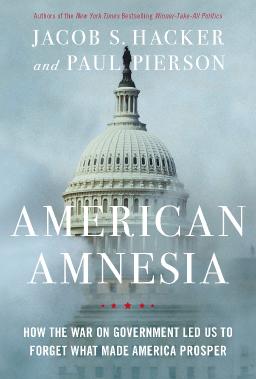
That is precisely what Jacob Hacker and Paul Pierson aim to do in their latest collaboration, “American Amnesia.” In the century before Reagan, they note, the United States grew to become the world’s richest, most powerful and most admired country. And it did so, they argue persuasively, not in spite of the rapid growth in the size and reach of government, but precisely because of it — because government put a high school and college education within reach of all its citizens, because government made serious and systematic investments in railroads, highways and scientific research, because government protected investors and workers and consumers from the natural excesses of market competition and put an economic safety net under all Americans.
And it’s not just America. Across the world, the authors note, the richest countries invariably allocate a large share of their economic output to government, while the poorest tend to allocate the least. It is neither the government-run nor the free-market economies that prosper but rather the mixed economies that have proved to be the most durable and successful.
The economics of all this is pretty well established. But Hacker and Pierson are not economists — they are political scientists at Yale and Berkeley who mean to explain why and how the mixed economy became so unloved and its successes so quickly forgotten.
To illustrate the change, they start by comparing the actions and attitudes of George Romney — president of American Motors Corp., governor of Michigan, and secretary of housing and urban development in the Nixon administration — with those of his son Mitt Romney, a private-equity-fund manager who leveraged his fortune to become governor of Massachusetts and the Republican nominee for president in 2012.
The elder Romney, they write, understood that prosperity is not an individual achievement but is generated by the collective efforts of managers, workers, customers and the community at large. As a liberal Republican governor, he worked with Democrats to raise Michigan’s minimum wage, enact an income tax, double state spending for education and increase benefits for the poor and the unemployed. Paeans to “rugged individualism,” the elder Romney declared, were “nothing but a political banner to cover up greed.”
A generation later, a much more conservative Mitt Romney was helping to pioneer a different model of capitalism, one built on successful companies run by heroic, job-creating entrepreneurs whose only legitimate goal was to maximize profits for shareholders and themselves. And as he famously revealed while speaking to well-heeled political contributors, the younger Romney saw great danger in a welfare state that now had so many citizens reliant on government for their livelihoods that they would use their political power to impose burdensome taxes and regulations on genuine wealth creators.
In trying to explain this “breathtaking” transformation of business norms and political opinion, Hacker and Pierson fall into the common trap of trying to construct a simple narrative of cause and effect, good guys and bad guys. They largely repackage the familiar liberal tale of a disciplined, well-funded conspiracy to spread free-market propaganda through a network of right-wing think tanks and media outlets, eventually overwhelming the hapless mainstream press and reshaping the public debate. Meanwhile, using gobs of political money, the anti-government crusaders succeeded in driving out moderates to capture control of a Republican Party whose only goals now are to starve government of funds and force it into a permanent state of political stalemate and dysfunction — a dysfunction that further reinforces the message that government is inept.
It’s easy enough for the authors to find plenty of historical evidence to support this narrative. There is, for example, then-Rep. Newt Gingrich’s speech to the Heritage Foundation in 1988 in which he called for an assault on liberalism that “has to be fought with a scale and a duration and a savagery that is only true of civil wars.” And there is venture capitalist Tom Perkins’s suggestion that people who pay more taxes should get more votes. The reader, however, can find a much more deeply and freshly reported version of these developments in Jane Mayer’s new book on the Koch brothers ( “Dark Money” ), or a more cogent and original analysis of them in Washington Post columnist E.J. Dionne’s latest ( “Why the Right Went Wrong” ).
The problem with the standard liberal narrative is that it ignores some inconvenient realities, such as that Democrats and their allies have raised and spent as much money as Republicans in recent election cycles, or that Bill Clinton and Barack Obama each won two presidential elections and had notable success in achieving their policy goals despite relentless opposition from the conservative noise machine. The political scientists rightfully note that the reason Republicans have gained political traction is not because more Americans agree with their conservative policies but because Americans have become more distrustful of government. They seem to have a blind spot, however, for some of the valid reasons Americans have become so distrustful: misguided and costly wars, a soaring budget deficit, the failure of government policies to end persistent poverty, the botched rollout of Obamacare. They also ignore that the conspirators themselves — big business, Wall Street, the energy industry and the Republican Party — have suffered a similar decline in trust.
The more convincing part of Hacker and Pierson’s narrative concerns the transformation of the organized business community. They show how groups such as the Chamber of Commerce and the Business Roundtable went from being moderating political forces, whose leaders acted as stewards of the national interest, to becoming highly partisan special interest groups determined to boost corporate profits by buying elections and thwarting all regulation, degrading the country’s political and legal institutions in the process. Business leaders who are now horrified at the prospect of Ted Cruz or Donald Trump as president have only themselves to blame, the authors suggest, for creating the political dynamics and economic circumstances that have made those candidacies possible.
While much of “American Amnesia” turns out to be an unsatisfying rehash of recent history, its basic political insight is sound: The only way for Democrats to regain the political momentum is to purge from the American imagination the myth that the government that governs best is the government that governs least.

Tags
Who is online


84 visitors
The only way for Democrats to regain the political momentum is to purge from the American imagination the myth that the government that governs best is the government that governs least.
Absolutely! It is going to be a difficult myth to kill, but there is plenty of recent evidence that the GOP way of trickle down, make the rich so rich that they puke money down on the rest of us, doesn't work! Government spending works! Jobs on infrastructure work. If we invest in infrastructure we can have enough people working good enough jobs that their taxes will continue to shrink the deficit and eventually will balance the budget and begin to cut into the national debt. Reagan was WRONG! Government is NOT the problem! BAD government is!
The only way we are going to kill this myth that has been built up in the past few decades is to have a Democratically controlled government, allied with liberal/centrist Republicans who will actually put America first BEFORE their party. Sadly there seem to be very few (if any) of them. However, as long as the myth lives, our economic problems will live also.
Go look at how Kansas tax cuts are working out, the state is cratering.
Here in California the government, with the help of the federal government, put men and women to work expanding the 405 freeway to 6 lanes through the Sepulveda Pass. It was a billion dollar, 5 year project, but returned much more then that in jobs for the project and jobs to support the men and women working on it. Plus the money was going into the hands of people who would spend it. Spend it on things like housing, utilities food, restaurants, clothing stores, etc. The economy of Los Angeles and therefore of California prospered more, not because of tax cuts for the wealthy, but by government spending on needed infrastructure projects that did the most important thing, they gave people jobs. And Jobs spread wealth around to everyone.
There was a recent article on Louisiana and the tax cuts that Jindal put in place. The state is now in hole so deep that services are being cut back or eliminated.
They really need to make some big cuts to get it right. Services should be cut back and eliminated that's how they got in the hole to begin with. Out of control government spending is a plague on this nation.
I just put up a great article the other day about Liechtenstein with it's very low taxes is booming and his an average income of over one hundred thousand. No doubt they are going to continue to be successful and looks like a great place to live.
What does Liechtenstein spend on defense? If you want a Liechtenstein economy, you need to start by virtually eliminating the US defense budget.
That's one of the reasons I was a Ron Paul supporter. He would have ended the wars cut the military and defense spending drastically and closed military bases around the world and mothballed much of our armed forces. When you have intercontinental ballistic missiles you don't need a large military. You already have a big stick to protect yourself with.
Not that I disagree, but the end result would probably be no substantial decrease in tax rates and hundreds of thousands of defense contractors without jobs. It's a paradigm shift that would have to be very well thought out, in economic as well as social terms. Face it - the American military industrial complex is a precariously placed jenga piece in our stability as a nation.
The Soviet Union spent a lot of money. That didn't work well for them. The Greeks spent more money than they had, which also ended badly.
I am shocked, shocked that prosperous nations spend more money! I suggest Somalia build some suspension bridges. That should help.
Dean the population of Liechtenstein is 37,000 people...Great comparison..LOL
Governments aren't actually the factor which decides if a nation prospers or not. The citizens are the factor, in that if they are willing and able to take responsibility for themselves and for those who need help and if they understand that hard work and moral values create a much more prosperous society than one that is propped by by government spending. There is a role for government to play in the nation, but providing daily bread for it's citizens should not be a top priority.