
This one anecdote perfectly explains how Donald Trump is hijacking the GOP


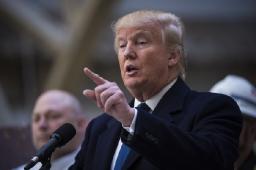
That’s the clear message that emerges from a big piece the New York Times published today that reports on how GOP elites lost touch with GOP voters’ economic concerns, resulting in them getting caught off guard by Trump’s rise . The piece features Republican observers acknowledging a phenomenon we’ve repeatedly discussed in this space: Trump is succeeding in part because he’s offering economically struggling GOP voters something more than the promise that free markets and limited government contain the keys to their economic salvation.
As the Times piece reports, Republicans are realizing that the GOP elite donor agenda can no longer be sold to GOP voters: The Republican elite “abandoned its most faithful voters, blue-collar white Americans, who faced economic pain and uncertainty over the past decade as the party’s donors, lawmakers and lobbyists prospered.”
But this one anecdote captures this whole phenomenon as perfectly as any other that I’ve seen. Last March, GOP lawmakers met privately to figure out how to sell the Trans-Pacific Partnership trade deal, which GOP elites support, to Republican voters who were suspicious of it:
For help, the lawmakers turned to Frank Luntz, the Republican messaging guru. For two decades, Mr. Luntz had instructed Republicans on how to talk about thorny issues. Do not say “estate tax.” Say “death tax.” Do not privatize Social Security. “Personalize” it.
Few issues were now as dangerous to them as trade, Mr. Luntz told the lawmakers, especially a trade pact sought by a president their voters hated. Many Americans did not believe that the economic benefits of trade deals trickled down to their neighborhoods. They did not care if free trade provided them with cheaper socks and cellphones. Most believed free trade benefited other countries, not their own.
“I told them to stop calling it free trade, and start calling it American trade,” Mr. Luntz said in an interview. “American businesses, American services — American, American, American!”
Most of the ingredients paving the way for the rise of Trump are on display here. GOP lawmakers, faced with the problem that economically struggling GOP voters might not believe freer trade would help them, asked for guidance on how to better message it. Luntz also personifies longtime Republican efforts to sell the GOP drive to end the estate tax ( a boon mostly to wealthy families ) and the longtime GOP drive to reform Social Security. Broadly speaking, the GOP elite agenda has included free trade deals, tax changes that would deliver windfalls to top earners, and entitlement reform that would reduce benefits, and for many years, Republicans have messaged these things as good for American workers.
[ Eugene Robinson: Donald Trump’s shocking ignorance, laid bare ]
(Yes, many Democrats also have supported free trade deals, including the Obama-backed TPP, and yes, the Dem establishment is currently paying for that in the form of the Bernie Sanders challenge.)
But GOP voters don’t appear to believe this messaging any longer, if they ever did. A national poll of Republican voters conducted recently by political scientist Alan Abramowitz found that majorities of them favor raising taxes on the wealthy and oppose cutting Social Security and Medicare. The poll showed an overlap between Republicans who hold those positions and support Trump. Exit polls have also shown GOP voters are suspicious of trade deals.
Trump appears to have exploited this disconnect. He does not reflexively defend free trade and vows not to touch entitlements. Now, Trump is peddling GOP voters a bill of goods: While he conveys the impression that he’d go after the favorable tax treatment of top earners, his tax plan would actually shower them with large windfalls. He oversimplifies the effect of trade deals on American workers and does not meaningfully detail policies that might actually help them . And Trump’s con job relies heavily on persuading struggling GOP voters that the way to remove a major economic threat to them is to carry out mass deportations.
But as James Pethokoukis points out , Trump at least seems to speak to these voters’ desire for a proactive agenda to address challenges arising from globalization and technological change. Yet when Paul Ryan was directly asked about this disconnect, he responded with more of the same 1980s-vintage rising-tide-lifts-all-boats dogma. There is a lot of talk about how Ryan and Trump now represent warring opposites inside the GOP , and that’s true. But if anything, what this polarity really illustrates is the paralysis of GOP elites in the face of Trumpism’s appeal. Not even clever Luntzian messaging may be able to bail them out this time. Trump is peddling a scam, but at least it’s a new scam.
Tags
Who is online



97 visitors
Now, Trump is peddling GOP voters a bill of goods: While he conveys the impression that he’d go after the favorable tax treatment of top earners, his tax plan would actually shower them with large windfalls. He oversimplifies the effect of trade deals on American workers and does not meaningfully detail policies that might actually help them . And Trump’s con job relies heavily on persuading struggling GOP voters that the way to remove a major economic threat to them is to carry out mass deportations.
Trump is peddling a scam, but at least it’s a new scam.
He is just better con artist then the GOP leadership is/was.