
Beyond Dylann Roof: inside the hunt for domestic extremists in the digital age


Whether you call it terrorism or not, law enforcement officials say they are aware of home-grown threats around the globe. The question now is how to stop them.

In the wake of last weeks shooting rampage in Charleston, South Carolina, top US government officials are pointing to what they consider a rising global security threat: isolated, maladjusted people who latch on to extremist ideologies through the internet and air what might have been strictly personal grievances by committing mass murder.
Security experts in and out of the Obama administration say this trend which transcends national boundaries and even specific ideologies of violence requires a major overhaul of their counter-terrorism strategies, not just debates about gun control or the Confederate flag flying over the South Carolina state house .
Before, it was personal, said John D Cohen, until recently the top counter-terrorism coordinator for the Department of Homeland Security. Someones boss or father would get killed. Now were seeing people with similar behavioural traits gravitating to an ideological cause and going to tactics once reserved for terrorist organisations.
Cohen pointed to Anders Breiviks killing spree in Norway in 2011, the 2012 shootings at a Sikh temple in Wisconsin, the Boston marathon bombing of 2013, the coffee-shop siege in Sydney last December and now the rampage in Charleston allegedly orchestrated by 21-year-old Dylann Roof as examples of what he and other leading counter-terrorism voices expect to be a growing problem for law enforcement in the digital age.
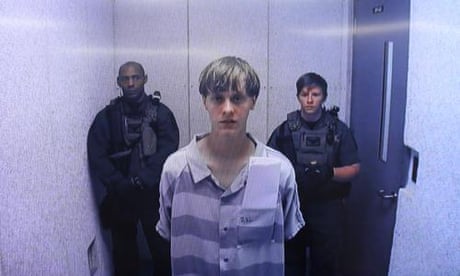
The psychological and behavioural profile is consistent, even if the ideological mindset differs, Cohen told the Guardian. We may have thousands of people predisposed to committing acts of violence. They are deriving resonance from these ideologies but, independent of any group, they are going to develop a plot walk into churches, synagogues, crowded places and kill as many people as possible.
The warning comes at a time when the United Statess counter-terrorism initiatives are under scrutiny for what many former officials and security experts say are inadequate and misplaced resources, political pressure placing too much emphasis on the foreign jihadi threat alone, too little monitoring of US citizens before they commit crimes and bureaucratic red tape around illegal weapons imposed by the power of the gun lobby.
Many rank-and-file police officers worry that too little attention is paid to domestic extremists, who often threaten them personally and have, in many jurisdictions, become their top public safety concern.
But a growing number of leading law enforcement officials question whether there is a meaningful divide between foreign-inspired attacks and those fuelled by white supremacist or anti-government ideologies.
The more important distinction, Cohen said, may exist between serious political actors, acting on behalf of larger organisations, and individuals who talk in ideological terms but whose motivations are rooted in their own personal experiences.
These are all people who are disengaged from the community, he said. They have a history of criminal activity, theyre antisocial, not a lot of friends They bounce from one failed experience to another, then find a connection with Isis or white supremacy. Their understanding and knowledge is very shallow, but it gives them sense of self-value and connectedness. It makes them feel the fight is bigger than them.
Law enforcement agencies in the United States are generally reluctant to police what people think, because of the first amendment and because of specific prohibitions on intelligence-gathering imposed on the FBI by the Department of Justice.
For that reason, Cohen says, the response has to go beyond law enforcement to family members, friends, teachers, sports coaches, religious mentors and mental health professionals who all require training to spot what the secret service terms stressors triggers that will turn violent words into action.
This is, however, far from a settled viewpoint in a Washington bureaucracy still operating under policy changes introduced after 9/11. Barack Obama made no specific mention of domestic threats when he introduced a White House summit on countering extremism in February, opening him up to the accusation that his administration has no interest or political resolve to look at the issue, in the words of one former Homeland Security official charged with tracking domestic extremists.
While the FBI has, in recent years, shown reluctance to slap the terrorism label on attacks like the one in Charleston that appear to be the work of lone individuals, many security professionals argue that is a mistake, worrying that domestic attacks are being underreported and underestimated as a result.

One typical clash began over the weekend, as a racist manifesto linked to Roof came to light and FBI director James Comey said he did not view the killings in South Carolina as overtly political . The White House refused to back up Comey on Monday, then Lindsey Graham, the hawkish Republican presidential candidate, on Wednesday compared Roof outright to Mid-East hate .
The attitude of Comey, Cohen and others infuriates analysts like Daryl Johnson, who wrote a controversial 2009 report on the rise of domestic extremism for the Department of Homeland Security and now works as a private security consultant.
Johnsons report was withdrawn after running into a firestorm of political criticism , especially from conservatives offended that he would discuss the radicalisation of military veterans. According to Johnson, his old department has since been reduced to three people buried in work and he blames the Obama administration for bowing to political expediency instead of following through on his research.
The definition of terrorism has nothing to do with whether you belong to a group, or your mental state, Johnson told the Guardian. People are doing a disservice by putting qualifiers on these events to minimise or dismiss the threat rather than recognising it.
To which Cohen, who left his government post last summer to co-lead a research project at Rutgers University on violence directed at faith institutions, responded: Theres a tendency to place things in neat little boxes that fit a preconceived structure. Thats a very federal way of thinking.
To me, Cohen added, its not so important what we call it but that we understand it and stop it.
The definition of terrorism has nothing to do with whether you belong to a group, or your mental state
Daryl Johnson
The domestic threat is certainly clear to rank-and-file police officers. A survey conducted last year by two academics from North Carolina showed that officers across 382 federal, state and local law enforcement agencies now view home-grown extremists as a greater threat than militant Islamists. And statistics compiled by the New America Foundation confirm that domestic anti-government militants and white supremacists have killed more Americans since 9/11 than those inspired by al-Qaida and similar groups.
Seamus Hughes, a former senior staffer at the National Counterterrorism Center who serves as deputy director of the program on extremism at George Washington University, agreed that analysis of extremist threats is important because analysts have much greater leeway than FBI agents to track individuals and their online activity before they commit crimes.
The budget for countering violence and extremism is minuscule compared to the overall counter-terrorism budget, Hughes said. Two years ago it was just $4m next to the billions spent on counter-terrorism overall.

In many of its regional offices, the FBI has a specialist team tracking domestic extremism and works closely with local law enforcement. The effectiveness of the bureaus efforts remains open to question, however, because it has no systematic way to track extremist websites and often finds itself breathless to keep up with cases and the avalanche of incendiary material online.
Heidi Beirich, who leads the Southern Poverty Law Centers intelligence project, says the FBIs record is spotty at best compared with its European counterparts. She pointed to the discovery by two Twitter users of a website registered in Roofs name in February as an example of why federal agents dont have themselves together on this issue.
The way they found the website was that someone ran a domain tool reverse search on this guys name, she said. It wasnt rocket science, but where were the feds?
Where once US law enforcement agencies were notorious for failing to share information a big theme in the runup to 9/11 security experts say the bigger risk these days is information overload. Much more gets forwarded, they say, so nobody can later complain it was not, but not necessarily with any sense of urgency.
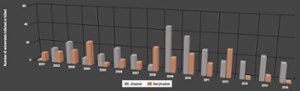
Extremists charged in the US between 2001 and 2015. Photograph: New America
Three hours before gunmen opened fire on an event last month focusing on cartoon caricatures of the prophet Muhammad in Garland, Texas, the FBI sent a perfunctory bulletin to local police saying that the alleged chief perpetrator, Elton Simpson of Arizona, was interested in the event. News reports have suggested the Garland officers who handled the incident never saw it. The FBI later said it had no way of knowing what Simpson had in mind, despite his criminal record and long history of interest in Islamist extremism.
That is of a piece with the struggles the FBI has faced in confronting its extremist dilemma. And other, less powerful agencies have struggled just as much, if not more.
The Bureau of Alcohol Tobacco, Firearms and Explosives (ATF), whose remit to track illegal weapons has historically put them on the hunt for many neo-Nazis and other domestic extremists, has been steadily hollowed out over the last decade in part because the very existence of the agency riles pro-gun conservatives in Congress.
The ATF is in a long and losing war with the FBI over its ability to deal with extremist cases, said Mark Pitcavage, the director of the center on extremism and investigative research at the Anti-Defamation League. They dont even have an analyst specifically devoted to extremism and they are unable to get permission from Congress to do a number of things that would be common sense.
ATF agents are no longer able to keep records from gun dealers, in the way financial investigators would hold on to bank records, thanks to lobbying of Congress by the National Rifle Association . Institutionally, they are hobbled on all sides, Pitcavage said.
According to a California county sheriffs deputy whose job is to run intelligence operations inside jails to sniff out information about possible extremist attacks, there is plenty more that law enforcement could be doing to stop future Dylann Roofs.
In every one of these cases, theres always a connection to a jail, the deputy, who asked not to be named for reasons of professional sensitivity, told the Guardian. In Roofs case, there was his buddy who was on probation who took the kids gun but was scared to contact law enforcement and gave the gun back. These are the people that need to be cultivated.
According to Pitcavage, such intelligence operations in jails are becoming more common. Federal prisons, for example, have been keeping a closer eye on their inmates since the case of Jose Padilla , the would-be al-Qaida dirty bomber who was believed erroneously to have been radicalised in prison as a young gang member.
The real problem, the sheriffs deputy said, is that government is resistant to trying new things. Often, local law enforcement knows whats going on but the people in Washington are clueless Theres no aggregation of the intelligence and no structure.
Cohen offered a similar but more measured assessment. We are making some progress now, he said. The way we thought about these problems after 9/11 is going through a period of recalibration. These types of threats are evolving the same way that our global society is evolving.
Unfortunately, we have a tendency at the federal level to focus on problems as they are written into law and prosecuted, and thats not enough.
- Additional reporting by Oliver Laughland in New York
Tags
Who is online


69 visitors
I agree that it has little or nothing to do with what you call it (personally I think what Roof did was White Terrorism), but how do we find these twisted type before the kill again. I have little hope that we will and that there will be a lot more massacres before we come up with a plan to stop more of them.
Apparently he is saying it is terrorism if there is more than one victim ?
The Bureau of Alcohol Tobacco, Firearms and Explosives (ATF), whose remit to track illegal weapons has historically put them on the hunt for many neo-Nazis and other domestic extremists, has been steadily hollowed out over the last decade in part because the very existence of the agency riles pro-gun conservatives in Congress.
That is inexcusable to allow pro-gun groups to gut a needed federal agency! It's despicable that any congressperson would make budget vote based on if the NRA was going to like it or not! FUCK THE NRA AND THE CONSERVATIVE CONGRESSMEN THEY OWN!!
Actually "terrorism" has never been clearly defined-- or at least in a definition that most people , organizations, or countries agree on. (The UN tried to find a definition, which got nowhere)
For a while, if a terrorist attack was a result of organization planning, execution etc by a terrorist group (or a member of that group). it was considered terrorism. But if the same act was done by an individual not affiliated with a terror organization, many people did not consider it to be terrorism.
Recently however, at least in the west, terror attacks are less often carried out by terror groups. Rather, the perp is more often unaffiliated with any group, and acts completely on his own (but may be motivated by a group's propaganda he sees online).
But be careful, Robert G.
For all we know, he may actually be a double agent!
I blame it on Janet Reno ... not the GOP .
I blame it on Janet Reno ... not the GOP .
Pillow talk?
I guess I know better than to expect a serious question . But since you asked a question I'll give an answer . Reno is responsible for the debacle in Waco , Tx . That's what prompted the cutback of funding to BATFE .
DavidKoresh and only DavidKoresh was responsible for what happened in Waco. Only him. No one else. Everything else is just a dull-headed right wing conspiracy theory that Timothy McVeigh used as an excuse to slaughter nearly 200 people on OKC. The blood in Waco was completely on his hands as the cult leader.
Anything else is 100% pure lying bullshit and anyone who says it was not Koresh's fault is a filthy fucking liar and they know it.
The freedoms we demand and enjoy in America come at a price. This is but one example.
I can't think of any measure that we as a country can take to stop this sort of thing that isn't just short of being Gestapo or KGB like in tactics, or will turn the entire country into a weapons escalated wild west. In short, I think that this sort of thing is going to remain commonplace, and there are no solid ways of fighting it that the majority of Americans are going to agree to.
Homeland Secretary Janet Napolitano warned in 2009 about a rise in extreme right wing terrorism being a big danger to the United States and the right wing lost their fucking minds. Turns out she was right and they were just fucking stupid and wrong. Right wing and White terrorism are on the rise and have killed more Americans since 9-11 then all Islamic attacks combined.