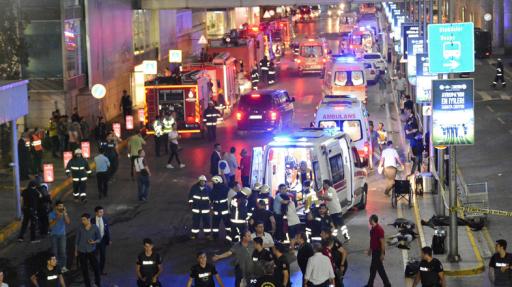
Paramedics help casualties outside Turkey's largest airport, Istanbul Ataturk, Turkey, following the blast on June 28, 2016. (Reuters)
It was an attack that echoed the carnage earlier this year at the Brussels airport, down to the taxi that carried the men to their target: Inciting panic and then taking lethal advantage, three suicide attackers unleashed a deadly tide of bullets and bombs at Istanbul’s Ataturk Airport, leaving 42 dead.
Authorities blamed ISIS for the blood bath late Tuesday, a coordinated assault on one of the world’s busiest airports and on a key NATO ally that plays a crucial role in the fight against the extremist group.
One attacker detonated his explosives downstairs at the arrivals terminal, one went upstairs and blew himself up in the departure hall, and the third waited outside for the fleeing crowd and caused the final lethal blast, two Turkish officials said, speaking on condition of anonymity because they weren’t authorized to speak about the investigation publicly. None of the attackers were Turks, a third official said.
As the chaos unfolded, terrified travelers were sent running first from one explosion and then another. Airport surveillance video showed a panicked crowd of people, some rolling suitcases behind them, stampeding down a corridor, looking fearfully over their shoulders.
Other surveillance footage posted on social media showed one explosion, a ball of fire that sent terrified passengers racing for cover. Another showed an attacker, felled by a gunshot from a security officer, blowing himself up seconds later.
(LINK)



Although the government quickly blamed the ISIS, there was no immediate claim of responsibility by the extremist group, which did not mention the bloodshed on its social media sites Wednesday. However, an infographic released to celebrate the second anniversary of its self-proclaimed caliphate claimed to have “covert units” in Turkey and other countries.
ISIS, however, rarely claims attacks in Turkey. One possible reason is a reluctance to be seen as killing fellow Muslims, said Anthony Skinner, director of the analyst group Verisk Maplecroft. Another is its desire to exploit the violent rift between Turkey and Kurdish rebels, he said.
“It very clearly meets ISIS’s strategic objectives to leave this ambiguity,” Skinner said.
Yildirim, the Turkish prime minister, also suggested the attack could be linked to steps Ankara took Monday toward mending strained ties with Israel and Russia. Late Wednesday, he told the Turkish public the authorities were increasingly convinced that ISIS, also known as Daesh, was responsible for the ghastly attack.