
Chicago's Police Union Forces Department to Back Down on Use of Force Policy



By Don Babwin
Format Edit - Jerry Verlinger
The Chicago Police Department appears to be backing down after a confrontation with its police union over new use of force policies
Police union fears teaching officers to prioritize de-escalation would endanger their lives.
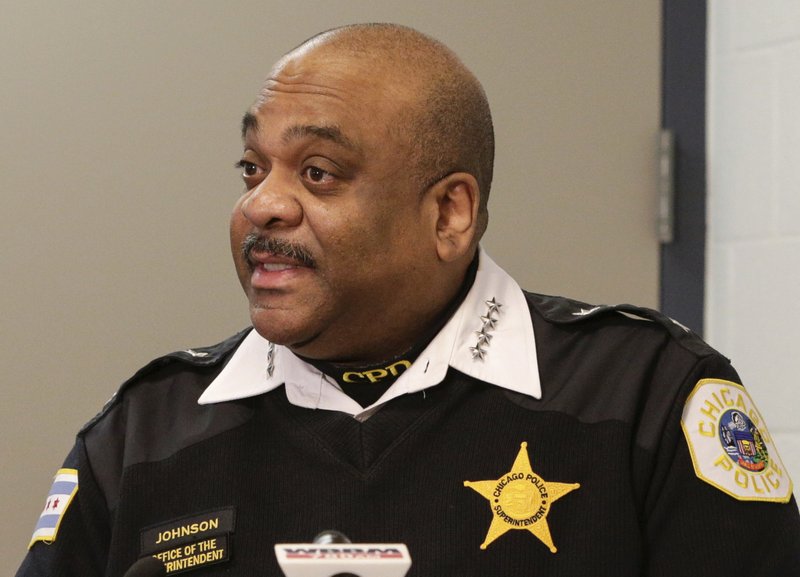
FILE - In this Feb. 1, 2107 file photo, Chicago Police Superintendent Eddie Johnson speaks at a news conference in Chicago. A draft of a new Chicago Police Department use-of-force policy released Tuesday, March, 7, 2017, would give officers more latitude in deciding when to fire their weapons, backing off an earlier proposal that the police union had said was too restrictive and could have put officers in danger. Johnson rejected any suggestion that either he or the department is backing away from implemented needed reforms but suggested that changes were needed to protect police officers. (AP Photo/Teresa Crawford File)
Chicago is struggling to forge a new police policy that balances the need for officers to do their work amid a wave of shootings, while restoring community trust following public anger over the shooting of black teenager Laquan McDonald in 2014.
The new draft backs off a suggestion in October that officers not use force unless "all other reasonable alternatives have been exhausted." That prompted concern from the police union that it was "too restrictive and would endanger officers who need to protect themselves in various situations."
The proposal now says that officers are required to use de-escalation tactics only when it does not put their personal safety at risk.
"The requirement that officers apply de-escalation principles does not mean officers must endanger themselves,' according to the latest draft.
Fraternal Order of Police President Dean Angelo Sr., told the Chicago Tribune that the changes since October show the department paid attention to union concerns.
"It's not like we look forward to utilizing force or we look forward to firing our weapon," he told the newspaper.
But others said that latest proposal was troubling in the context of a history of Chicago police condoning and using excessive force.
"Nobody wants a cop to be shot or hurt but they haven't demonstrated good judgment as when to use (lethal force) and when not to," said Alderman Howard Brookins Jr. "I am concerned about giving them more authority and more latitude toward (the use of) lethal force."
Police Superintendent Eddie Johnson rejected any suggestion that either he or the department is backing away from implemented needed reforms but suggested that changes were needed to protect police officers.
"It is important that we balance public safety with officer safety so we are trying to get it right and we are trying to be transparent..." he said after an unrelated event at a school on the city's West Side.
Chicago's police department has been under intense pressure since a video was released in 2015 showing a white officer shooting McDonald 16 times. Public outrage led to calls for Mayor Rahm Emanuel to step down, forced out the police chief and led to the election defeat of a prosecutor who had not moved for months to charge the officer.
The U.S. Justice Department in the waning days of President Barack Obama's administration concluded in a scathing report that the Chicago department had a long history of civil rights violations and excessive force. But it is unclear if President Donald Trump's administration will follow through on those conclusions and push Chicago for reforms.
Emanuel and the police department are also under scrutiny following a sharp increase in homicides concentrated in poor neighborhoods. Chicago had 762 murders in 2016, the most killings in the city in nearly two decades and more than New York and Los Angeles combined.
Tags
Who is online
122 visitors
Chicago is struggling to forge a new police policy that balances the need for officers to do their work amid a wave of shootings, while restoring community trust following public anger over the shooting of black teenager Laquan McDonald in 2014.
I have a feeling that is going to be difficult to achieve such a balance unless both sides quell their anger.
This articles has been posted in the NewsTalkers Group Police Brutality & Misconduct . Use the link to go to the group page to see more articles regarding this topic. If you're not already a member of the group, please sign up and help us find more articles like this.
The new draft backs off a suggestion in October that officers not use force unless "all other reasonable alternatives have been exhausted."
I would have thought that deadly force would always be the last resort? If it becomes too easy to reach for the gun first or too soon then people are going to get killed who shouldn't an there will never be a way to build trust with the community. Which is really one of Chicago's biggest police problems.
The new draft backs off a suggestion in October that officers not use force unless "all other reasonable alternatives have been exhausted."
I would have thought that deadly force would always be the last resort?
I thought the same thing when I read that comment. But I'm not sure they were referring to "deadly" force in that suggestion.
I think they were referring to when verbal persuasion and commands are ignored by an offender. At that point the suspect or offender needs to be forcibly retained.
I was under the impression a police officer should not pull their weapon unless they feel their lives are threatened. However today many police pull their weapon way too early in an encounter, making it more likely they will use it prematurely and unnecessarily cost people their lives.