
Out of the Past - Even With Obamacare, 29 Million People Are Uninsured


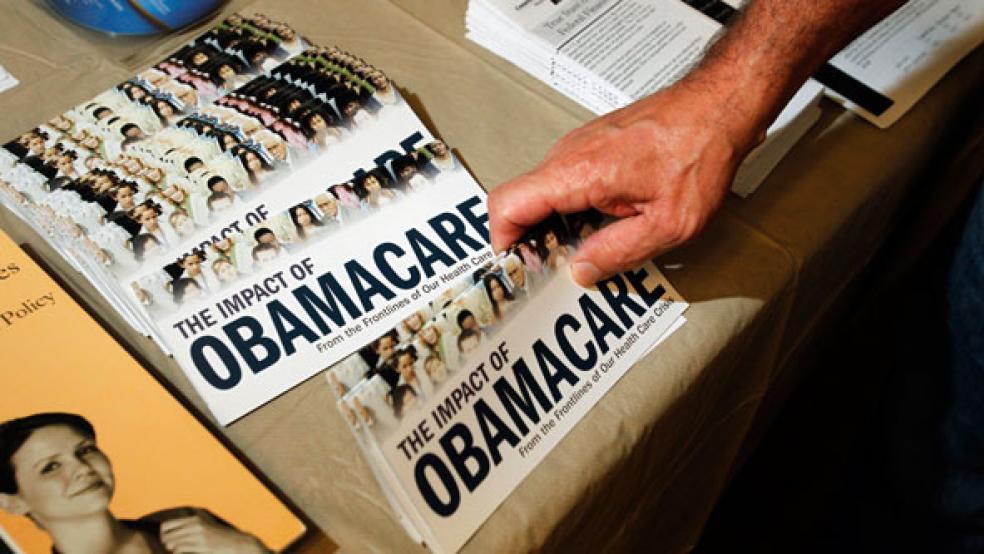
An estimated 20 million people have gained insurance since health care reform was signed into law in 2010, but in the six years since, a significant group of Americans remain uninsured.
Estimates vary, but as many as 29 million Americans – about one in 10 – lack coverage. Why is that?
One of the biggest factors is cost, which still hinders many Americans from purchasing insurance. It may seem obvious, but the data shows many of the uninsured can’t afford coverage, even after reforms were passed.
The vision of affordable health insurance for all Americans continues to be far from reality. The data journalists at HealthGrove examined numbers gathered from ACASignups.net to help shed some light on the matter.
ACASignups is curated by web developer Charles Gaba, who has collected health insurance data on Obamacare throughout the years. That data has been cited in numerous publications for his health-care-related investigation and analysis. Gaba supports the law, but his data have been used as talking points for media outlets on both sides of the political aisle.

The red bar above illustrates that about 10 percent of the country’s population is still uninsured.
Employer-sponsored coverage is the most popular way people get insurance. Next are those covered by Medicare , the federal insurance program that primarily serves Americans over 65 years old.
Medicare should not be confused with Medicaid , a program run by both federal and state governments that helps pay medical costs for people with limited incomes. People covered by this program make up the third-largest categorization.
So with about 87 percent getting covered by their employer, Medicare or Medicaid, and another four percent covered by the health care exchange or other means, who makes up the uninsured remainder?
This group is largely made up of three significant categories: people who haven’t signed up for insurance whether they qualify for tax credits or not, people who qualify for Medicaid but haven’t enrolled, as well as undocumented immigrants.
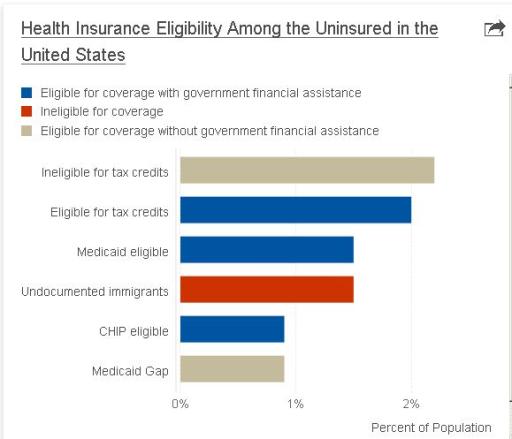
Gaba described people in the first category this way. “Some don’t know they’re eligible for help,” he told HealthGrove. He added that others should be eligible but aren’t because of the “ family glitch ”– a loophole that occurs when families don’t receive financial assistance to help pay for marketplace insurance.
“For the rest, either the financial help is still not enough, or [insurance is] just too pricey without it,” he said.
Five million people are eligible for Medicaid, but not signed up. Another 13.5 million people are split between eligibility and ineligibility for tax credits.
About 4.7 million people in the uninsured group are in the U.S. illegally and do not qualify for Medicaid or for subsidies to help them purchase their own insurance. A bill has been put forward in California, seeking federal permission to allow undocumented immigrants to purchase insurance through a state exchange.
About 3 million of the uninsured are children who qualify for the Children’s Health Insurance Program – identified as CHIP in the visualization – but are not enrolled.
There’s a fourth group noted – representing 2.8 million uninsured Americans – that falls into the “ Medicaid Gap .”
With their 2012 ruling, the U.S. Supreme Court made Medicaid expansion optional to states . To date, 31 states have chosen to expand, covering more low-income residents than previously would have qualified. But many states have not expanded coverage — including those with large numbers of uninsured citizens, like Texas and Florida .
Most of the South hasn’t expanded Medicaid, as a large swath of red on the map below shows.
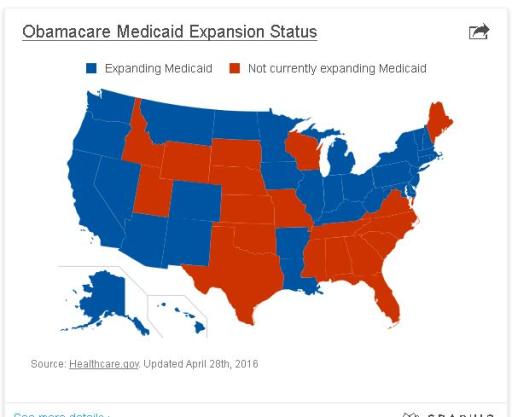
Two states – Louisiana and Arkansas – stand out as notable exceptions in the Southern portion of the map.
That’s because Louisiana’s Gov. John Bel Edwards signed an executive order that would expand Medicaid in that state, the 31st to expand the program. The law would allow more than 300,000 people to have insurance, and state officials have said the move will save Louisiana $1 billion over the next decade.
At the end of April, Arkansas Gov. Asa Hutchinson vetoed a provision that would have ended Medicaid expansion for more than a quarter-million low-income residents at the end of the year.
Political will isn’t the only barrier for the uninsured.
Most people who lack health insurance say that costs are the main reason they don’t have it, according to a report commissioned by the Robert Wood Johnson Foundation .
The visualization below shows the states that have seen premium changes for plans on the Obamacare marketplace, detailing prices for the silver plan, which is used as the benchmark when calculating subsidies.
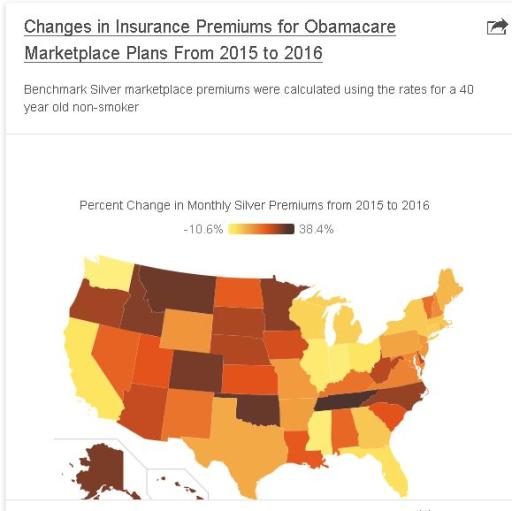
Looking back, there’s no doubt the passage of the health care law expanded coverage for millions of Americans. The large influx of people getting coverage for the first time may be leveling off , however, with smaller declines seen in recent years.
Without significant steps to increase enrollment or control costs, the remaining uninsured may stay that way until more changes take place.
Tags
Who is online
92 visitors
Now here is a comment I made on an article 10/4/2015.
Largest Obamacare Healthcare Co-op to Close
~Link~
In case you have forgotten before Obamacare the claim was that 40 million were without insurance and now only 33 million with Obamacare are without insurance. I know it's the conservative governors who didn't expand Medicaid as I've heard you say before, but the promised savings of $2,500 per family has now changed to forget the $2,500 reduction like Obama said. And forget he knew he was lying when he said it. And now the new price tag is over $4800 more than what it was before Obamacare. That's over $7800 more than what it was going to be per family.
This is the percentage of increase of the number of people who now have insurance who didn't have it before. We don't want to forget the cost of setting up these exchanges, the fact the original bill is twice what they said it was going to be as well.
I understand some who didn't have insurance before have been helped, but the objective of Obamacare was never intended to provide coverage, it was to control the people just like the main author of Obamacare said. Let me restate that. He said Obamacare was never about healthcare.
Don't forget to look at the link above in this comment.
I for one would like to know every human being in this country doesn't have to worry about healthcare when they need it. Now that may have been one of the things that kept me leaning to the left on Jefferson's (Left - Right) test he put up some time ago. I don't think it is a right except it is a moral right to make sure no one has to worry about healthcare when they need it.
That doesn't mean they won't have to lose their homes. That would be nice, but I don't believe we should be totally responsible for every aspect of everyone's lives.
Just because you get the healthcare you need doesn't mean you won't have expenses other than healthcare. I'm not for carrying everyone every step of the way. It may be hard hearted to some, but I realize there is only so much we can do.
I'm also in favor of everyone putting something in the pot. Unless you can't do something, anything to help yourself, then you should be required to do something for yourself. I probably wouldn't feel this way if I didn't see people in better shape, at least physically, every day that I feel could do something for themselves, but it is too easy to let someone else do it for them.
I keep hearing all these people who have signed up, but the difference in now and 10/4/2015 is only a few million and almost everyone of them pay nothing.
The insurance companies are wanting 20% or more than what they are getting. It seems most of them are getting out of it. We definitely need to do something. It is not going to get any better for anyone as it is.
When President Obama first entered the WH he had an entire Democratic majority in Congress. The ACA was put through immediately. The fact is it doesn't serve all the people of the U.S.
Case... my son was temporarily out of work, but not when he joined obamacare. He could no longer receive this coverage once he was unemployed and our state did not extend Medicaid, so, he had no coverage whatsoever.
There has to be an answer, but I don't know what it is.
I'm not sure what you are trying to prove here, Six. Or perhaps you just meant this to be informative. The article you seeded is quite neutral in tone -- only your own Comments are critical of Obamacare. I'm not going to waste much time because if you think it's OK that people must lose everything befire they get medical treatment, then you and I probably don't have much common ground...
Even in Europe, where "universal" healthcare has existed for more than half a century, there are some uninsured. They are very much like the Fiscal Times's description of uninsured Americans: mostly people who are in fact qualified, but for one reason or another are not enrolled. The European uninsured rate is somewhat lower than the American, but IMHO the American rate is not unreasonable, considering how recent Obamacare is.
That looks pretty good to me...
As for costs... the promise was never to lower premiums. The promise was to slow down the then-skyrocketing increases. Obamacare has fulfilled that promise:
Obamacare needs improvement, as does any major new program, after a few years of real-world operations. Intelligent improvement is only possible if we start with lucid and accurate critiques.