
San Diego's Experiment With Higher Minimum Wage: 4,000 Fewer Restaurant Jobs


https://reason.com/blog/2017/04/11/san-diegos-experiment-with-higher-minimu
San Diego's Experiment With Higher Minimum Wage: 4,000 Fewer Restaurant Jobs
San Diego's restaurant recession is another data point suggesting that making it more expensive to employ people causes fewer people to be employed. Shocker.
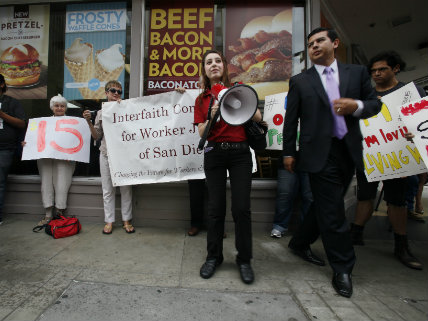 Peggy Peattie/ZUMA Press/Newscom California is hiking the statewide minimum wage to $15 per hour by 2023, and San Diego is getting a head start on the higher wage mandate—and, maybe, the consequences of it.
Rather than inch upward from $10 per hour to $10.25 per hour in January 2016, as the rest of the state was doing, San Diego jumped its minimum wage to $11.50 per hour. In the year and three months since then, the number of food service jobs in San Diego has dropped sharply, with perhaps as many as 4,000 jobs lost, or never created in the first place.
"If job growth in the restaurant sector had just kept pace with the state's performance … the industry could have created 5,200 jobs instead of the 1,300 that took place," Lynn Reaser, chief economist of the Fermanian Business & Economic Institute at Point Loma Nazarene University, told Dan McSwain, a columnist with the The San Diego Union-Tribune .
Economists say the restaurant industry is a good barometer for the consequences of minimum wage increases because those businesses rely heavily on low wage workers, operate on small margins, and have high rates of turnover (that is, restaurants tend to pop-up quickly in some areas and go bust just as quickly in others).
That seems to be what's happening in San Diego. While the growth of food service jobs in California has slowed since the higher wage mandates went into effect in 2016, McSwain reports, those jobs have actually dipped into negative growth within the borders of San Diego.
"San Diego's head start, which places many of its employers at a temporary disadvantage, makes the city a test bed for competing theories about whether the overall economy is harmed or helped by large increases to wage floors," McSwain writes.
So far, that test is going about as you'd expect. Restaurateurs are raising menu prices and laying off workers to keep revenue ahead of expenses. McSwain's whole piece is worth a read as it does a fantastic job of breaking down the arcane economic math into real world consequences for small business owners and their employees.
San Diego might be the latest real life test case for the consequences of hiking the minimum wage, but it's hardly alone. Thanks to progressive activists, we're getting a real life economics experiment on a grand scale. In addition to Washington, D.C., local officials in Seattle, Los Angeles and New York have approved laws mandating $15 per hour. Whole states are following suit, with measures already passed in California , New York and Oregon .
It's no secret what will happen after these laws take effect.
"Economically, minimum wages may not make sense," admitted California Gov. Jerry Brown just moments before putting his name on a bill that could cause disastrous economic consequences for the already-impoverished rural parts of his state . "A $15-an-hour national minimum wage would put us in uncharted waters, and risk undesirable and unintended consequences," wrote Alan Krueger, a former chairman of President Obama's Council of Economic Advisers, in the New York Times last year .
San Diego's decline in restaurant jobs might be a blip based on a small sample size or caused by some other factor, but there's no doubt that it's part of an emerging trend in cities where minimum wage hikes have been enacted.
Like Washington, D.C., where restaurants shed 1,400 jobs during the first six months of 2016 , following an increase in the city's minimum wage. Meanwhile, restaurants in the Maryland and Virginia suburbs added 2,900 jobs during the first six months of the year.
"Despite what we hear from unions, the Fight For 15 crowd and other minimum wage advocates, the evidence from D.C.'s restaurant industry—an industry often considered as 'ground zero' for minimum wage effects—demonstrates that demand curves for low-skilled workers actually do slope downward," Mark Perry, an economist at the American Enterprise Institute, a free market think tank based in D.C., told me at the time, referring to the basic law of economics that says demand for a product or service will decrease as the cost increases.
Perry took to Twitter this week to highlight a sharp decline in restaurant jobs across the whole country.
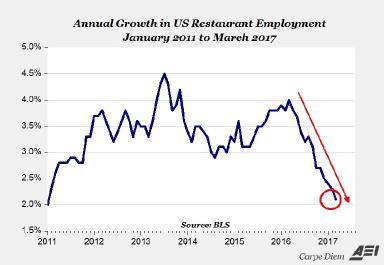
Even if it's only a small part of the reason, the economic data should start to worry city and state officials who have backed radical minimum wage hikes over the coming years.
Perhaps more officials will do what Baltimore Mayor Catherine Pugh did earlier this month. Though she had supported a higher minimum wage during last year's campaign, Pugh decided to veto a proposal to set a $15 per hour minimum wage in Baltimore, citing concerns raised by businesses and nonprofits in the city.
The Wall Street Journ al reports this week that four municipalities in Cook County, Ill., have opted out of the county government's move to raise the minimum wage in the Chicago suburbs to $13 an hour by 2020. Iowa Gov. Terry Branstad, a Republican, approved legislation in March to roll back higher minimum wages already approved in four counties. In Flagstaff, Ariz., council members just amended a minimum-wage increase approved by voters in November to slow the pace of increases.
The populist left led the push for upping the minimum wage—initially calling for $10.10 per hour, which quickly ballooned to $15 per hour—during the latter half of the Obama administration. Minimum wages going up, though, is pushing employment opportunities down.
San Diego's restaurant recession is another data point suggesting that making it more expensive to employ people causes fewer people to be employed. Sometimes it's really that simple.
For every action there is a reaction. Just as the unions priced themselves out of the marketplace minimum wage hikes are doing the same.
Another predictable consequence ignored in favor of ideology.
Most predictable result ever.
I was travelling from WNY to New Brunswick and back in March, on the way home, we stopped in Quebec at a McDonalds. There were two people working the counter (and were very pleasant, slight language barrier) but out in that area, there was also a touchscreen kiosk where you could order the exact same things without the language barrier. They are perfecting the automation......McDonald's was a starting point for kids/ending points for older citizens for several decades. Now we are trying to make these jobs careers....I have friends that are paramedics and they make about that. Shouldn't the highly trained person saving your life while choking on a McNugget make more money than the person that dropped those nuggets in the fryer? What motivation is there to do something better if the pay is the same?
Point Loma Nazarene University is the official university of the Southwest Educational Region of the Church of the Nazarene . A Board of Trustees, composed of an equal number of ministers and laypersons, oversees the affairs of the university. Board members are nominated from 11 districts in the region and elected to the Board to serve on the self-perpetuating body.
The relationship of the university and the Church of the Nazarene is characterized by a mutual commitment to the doctrine and mission. In this relationship, the university provides quality leaders for Christian service within social, civic, business, and church communities.
The Church of the Nazarene is an international Protestant denomination in the holiness tradition. The Church is firmly Wesleyan in doctrine and evangelical in mission. Its polity is representative. Emphasis is given to the conversion of sinners, the entire sanctification of believers, and the spreading of the gospel to every person. The Church is a member of the Christian Holiness Partnership and the National Association of Evangelicals.
You can search our Christian resources for more information.
From the San Diego Union Tribune article which was kinda sorta hijacked to create this puff-piece:
I’ll hasten to add that Reaser draws no sweeping conclusions from a relatively short period of economic data. For one thing, restaurants in the region still employed 126,000 people in February, and many of them are enjoying higher wages because San Diego increased its minimum from the statewide $10 an hour in June to $11.50 inside the city as of January.
Yes the two articles compliment each other and show the harmful effects of the increase.
“If job growth in the restaurant sector had just kept pace with the state's performance … the industry could have created 5,200 jobs instead of the 1,300 that took place.” Last month growth turned negative, as the sector actually lost jobs.
If my Grandmother...
I do hope you're being a jerk, Dean, and that your reading comprehension isn't actually this bad...
Great example of Fake News, Dean!
Is anyone besides Bob surprised by this?
Is anyone besides Bob surprised by this?
There isn't a single reputable economist today who still thinks that a decent minimum wage crowds out employment.
Some people just don't get it. If I am a restaurant, I hire servers making $2.15 per hour plus tips. I am not a full time employee.....part time and I am subject to the scheduling each week. I may work 10 hours one week and 3 the next week. I can get a second part time job, but my employer has to work with me. Not usually the case. So, if the servers are making a good salary it cuts down on the number of employees that the restaurant hires. Hence, the loss of workers. However, those lucky enough to have these jobs mean that they can bring home a decent pay. It is a very good thing.
Servers are usually not hired as full time employees. It cuts down on employers' responsibilities toward his workers. Perhaps, not $15.00 per hour, but at least $10.00 per hour. And, then, we get into those in the kitchen....pitiful what they are paid. Yet, they are the ones who prepare your food, follow health guidelines so that you are served a dish to your liking.
Some balk at this, but will go and spend hundreds of dollars for a new hairdo or workout place. It goes back to "serve me"!!!!
I am not talking about "flipping hamburgers"! I am talking about restaurants NOT fast food joints. Yes, full time employment! They can still run through the student working part time to fill in. Obviously, you are not properly acquainted with those who work in the culinary industry.
Let the market set the wages. If the restaurant doesn't pay enough to retain quality help they will go under. The free market knows the actual value of the labor.
I like this......
Basic Law of Economics: When the price of something goes up, people buy less of it.
Are you saying that if your burger goes from $9 to $9.25, you won't buy any more burgers? Seriously?
Of course, raising prices immoderately will depress demand: I may not buy that burger at $15. But we're not talking about kicking burger prices up astronomically.
And once again: there is solid data on this question, and it is clear: even a significant raise in the minimum wage does not crowd out employment.
like this......
Basic Law Of Economics: When The Price Of Something Goes Up, People Buy Less Of It.
Employers buy their employee's labor. If the cost of that labor goes up, they will buy less of it, no different than the cost of having someone cut your grass. If he doubles his price you will probably have your grass cut less often.
If the pay is more than the actual value, it will be wasted money that could be used more efficiently somewhere else.
I'm afraid you didn't look at the video Bob.
Are you saying that raising a sales price from $100 000 000 by one penny will block all future sales?
Of course not. So your "rule" should have much more wiggle room: "A significant rise in sales price will tend to reduce demand."
A $15 minimum wage does NOT reduce demand significantly. There's plenty of literature on the subject. Read it.
How you got that out of what I said is beyond me, Bob.
You said
When The Price Of Something Goes Up, People Buy Less Of It.
You expressed it as an absolute rule. I tried to demonstrate that it is not.
I'm still trying to figure out how someone can live in San Diego while working in any restaurant.
They can't. They have to commute from a considerable distance.