


North Korea is no stranger to provoking its southern neighbor and, by extension, the United States, which has quite a few troops stationed in the South. And for the most part, the U.S. has been exceptionally cautious in responding, in large part because another war on the Korean peninsula has always been considered something of a lose-lose proposition.
American firepower would ultimately win the day, but North Korea, despite having one of the world’s larger armies, has always seemed much more like an annoyance than a real threat. Plus, the last Korean War cost the lives of nearly 37,000 American soldiers , a scenario no one wants to repeat.
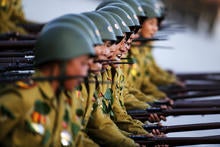
Soldiers shout slogans as they march past a stand with North Korean leader Kim Jong Un and other officials during the parade celebrating the 70th anniversary of the founding of the ruling Workers’ Party of Korea, in Pyongyang Oct. 10, 2015.
Now that North Korea seems well on its way to eventually building a nuclear-capable ICBM that could reach U.S. territory, however, experts agree that another Korean War is far from impossible .
On that front, the regime unveiled what appeared to be a never-before-seen ICBM during a massive military parade on Saturday, marking the anniversary of the birth of founder Kim Il Sung. The anniversary is the most important national holiday in North Korea, and American officials had worried that the country may have used the occasion to carry out another rocket launch or nuclear test.
Here are a number of times North Korea has provoked the U.S. -- and what we did in response.
The USS Pueblo incident
In 1968, the North Korean navy captured an American spy ship, the USS Pueblo, off the northern coast of the peninsula. Pyongyang insisted that the ship had strayed into its territory, while the U.S. government said the ship was in international waters.
It was an act of war, but the U.S. was embroiled in an increasingly unpopular conflict in Vietnam, meaning the Johnson administration had little appetite to respond. The 82 American sailors were taken prisoner by the regime of Kim Il Sung, North Korea’s first leader and Kim Jong Un’s grandfather, and subjected to torture.
The North Koreans released propaganda photos and videos that showed a number of the captured sailors raising the middle finger to the camera as a sign of protest. They told their captors, who were unfamiliar with the gesture, that it was a “Hawaiian good luck sign.”

In this photo released by the U.S. Navy, crew members of USS Pueblo pose while in captivity in North Korea in 1968.
The 82 remaining crew members (one had been killed during the initial engagement) were eventually freed after 11 months of negotiations. The U.S. government issued a written apologies for spying, although it was preceded by a verbal disavowal, saying that they were only apologizing to get the sailors back.
The USS Pueblo, which is still a commissioned U.S. Navy vessel, is now parked in Pyongyang , where it has become something of a tourist attraction.
The axe incident
The demilitarized zone (DMZ) between the two Koreas is, rather ironically, the most militarized border in the world. North and South Korea never signed a formal peace treaty and remain in a technical state of war.
On August 18th, 1976, a group of American and South Korean officers decided a poplar tree that partially blocked the view from a UN observatory post should be trimmed. A work force went to go and do it, but were turned away by North Korean soldiers, who said the tree had been planted by Kim Il-sung himself.
Ten days later, a UN force was dispatched to trim the tree. It included two American officers and eight enlisted soldiers, along with some South Korean soldiers and workers. They were in turn met by a larger group of North Korean soldiers, who ordered them not to touch the tree.
 http://cbsnews1.cbsistatic.com/hub/i/r/2017/04/13/776d643b-6370-4e19-a630-86b4779b0ca8/thumbnail/760x480/1078ed13137021eea76c45ebf655c7b2/0413-en-northkorea-tracy-1290923-640x360.jpg 2x" alt="Satellite images show activity at North Korea nuclear site " height="240" data-srcset="http://cbsnews1.cbsistatic.com/hub/i/r/2017/04/13/776d643b-6370-4e19-a630-86b4779b0ca8/thumbnail/380x240/8421cb000efcca08e7031090fabd16b2/0413-en-northkorea-tracy-1290923-640x360.jpg 1x, http://cbsnews1.cbsistatic.com/hub/i/r/2017/04/13/776d643b-6370-4e19-a630-86b4779b0ca8/thumbnail/760x480/1078ed13137021eea76c45ebf655c7b2/0413-en-northkorea-tracy-1290923-640x360.jpg 2x">
CBS Evening News
Satellite images show activity at North Korea nuclear site
A U.S.-based watchdog group says North Korea is "primed and ready" to conduct its sixth nuclear test. There are telltale signs of activity at the...
The tree-trimming force ignored them and went about the trimming. Then, according Wayne Kirkbride, an American soldier stationed along the border at the time, the ranking North Korean officer “took off his watch and wrapped it in a handkerchief, which was the signal to attack.”
“He said ‘kill the Americans,” Kirkbride told an American military newspaper in 2006. “That force immediately attacked and the two American officers were the target. [The North Koreans] chopped them to death with the axes they brought to trim the tree.”
The Americans and South Koreans retreated. Given the always-precarious situation on the peninsula, it was decided that the only response would be to cut the tree down with a much larger force that included South Korean special forces personnel. The action was called “Operation Paul Bunyan,” and included and overwhelming show of force that caused the North Koreans to stand down. The tree was successfully trimmed.
The spy plane shoot-down
Arguably the closest we came to a second war between the U.S. and North Korea was just months after the Pueblo crew had returned home.
On April 15th, 1969 – Kim Il Sung’s 57th birthday – an EC-121 spy plane flying over international waters was shot out of the sky by a pair of North Korean MIG fighter jets . It was unarmed and on a routine mission to collect signals intelligence from Soviet and North Korean targets.
 http://cbsnews3.cbsistatic.com/hub/i/r/2017/04/14/506f1348-ec5e-405b-b6dc-3e620f5ea85a/thumbnail/760x480/41a3db4563d8c7addcaae2089d1f1204/0414-ctm-northkoreatension-tracy-1291271-640x360.jpg 2x" alt="North Korea threatens pre-emptive nuclear strike " height="240" data-srcset="http://cbsnews1.cbsistatic.com/hub/i/r/2017/04/14/506f1348-ec5e-405b-b6dc-3e620f5ea85a/thumbnail/380x240/0fc8e671e1bee81d7a1d5aa33cf47485/0414-ctm-northkoreatension-tracy-1291271-640x360.jpg 1x, http://cbsnews3.cbsistatic.com/hub/i/r/2017/04/14/506f1348-ec5e-405b-b6dc-3e620f5ea85a/thumbnail/760x480/41a3db4563d8c7addcaae2089d1f1204/0414-ctm-northkoreatension-tracy-1291271-640x360.jpg 2x">
CBS This Morning
North Korea threatens pre-emptive nuclear strike
North Korea says it is "on the brink of war" because of the U.S. In an interview with CBS News, one of the country's top officials accused the Tr...
The flight crew of 31 Americans were all killed. And President Richard Nixon became so enraged that he may have considered responding with nuclear weapons. “Nixon became incensed and ordered a tactical nuclear strike... The Joint Chiefs were alerted and asked to recommend targets, but Kissinger got on the phone to them,” CIA officer George Carver reportedly said in 1969, according to The Guardian. “They agreed not to do anything until Nixon sobered up in the morning.”
The attack was perhaps more of a surprise than it should have been. “The North Koreans had long been sensitive to ships and aircraft operating off their coasts,” former U.S. Naval Intelligence officer Richard Mobley in his analysis for the CIA’s Center for the Study of Intelligence in 2003.
The lumbering spy plane was unarmed and without fighter escort, making it any easy kill for the North Korean jets, which quickly sped back to base. The order to down the plane almost certainly came from the top echelons of the North Korean government. “Pyongyang had a history of tight control, which would discourage local military initiatives, and the preparations and coordination…suggests central direction,” Mobley wrote.
According to Bruce Charles, a U.S. fighter pilot on duty in South Korea at the time, the order came to prepare for war. “When I got to see the colonel, it was very simple. He described the shooting down of the EC-121 about a hundred miles at sea. And that he had a message, which he showed me at that time, saying to prepare to strike my target,” Charles told NPR in 2010.
As part of a contingency plan in case of nuclear war with the Soviet Union, Charles’ target had already been determined: an air base in North Korea. And the weapon his F-4 fighter jet was carrying was nuclear – one 20 times larger than the bomb dropped on Hiroshima.
Hours later, he was given the order to stand down. “The order to stand down was just about dusk, and it was not a certainty. The colonel said, ‘It looks like from the messages I’m getting, we will not do this today. I do not know about tomorrow,’” Charles recalled.
Morton Halperin, who worked at the National Security Council at the time, told NPR that he knew nothing about preparations for a nuclear strike. But he says Nixon did order an aircraft carrier to the area, and had initially decided that the airbase from which the MIGs were launched should be destroyed.
That order never came. Nixon gave a press conference two days after the attack, which indicated that he had decided against responding militarily. The spy flights resumed, however – this time with escorts.
We've been on the brink with North Korea before.
In addition to the three instances named in the article, in 1994 under Clinton we came very close again.
I've heard several top military people-- as well as others in spy agencies, etc talk about the external threats facing America-- and there are several. But when asked if there's one that really gives them serious nightmares-- they all say North Korea.
I've read that Obama told Trump that his biggest problem will be North Korea.
I've also heard some senior military people express the same thing.
The thought of a war it that area of the world is frightening to say the least.
I think another war on the Korean Peninsula would be worse then the last one. It would be bloodier then Vietnam for both sides and if the North Koreans manage to push their way into Seoul, they are just fanatical enough to set off a nuclear device there and blow themselves up with it for the "Dear Leader" who is not much short of a God to them.
In think the situation re: North Korea is unique-- because it really seems that there's no solution to the problem. (And they keep developing better rockets-- I wonder how long it will be 'till they are capable of hitting the West coast of the U.S.?
It does seem that there is no good solution to the Korean problem, Krish.
It's only a matter of time before he does have a weapon that will reach the WC.
There was an article from a Chinese paper/group that stated that there is a bottom line for China when it comes to NK. If NK reaches that line, China will step in and put an end to NK for good.
I have no idea if this is valid or if the source is legit.
Link to article..
The Axe Incident
The demilitarized zone (DMZ) between the two Koreas is, rather ironically, the most militarized border in the world. North and South Korea never signed a formal peace treaty and remain in a technical state of war.
On August 18th, 1976, a group of American and South Korean officers decided a poplar tree that partially blocked the view from a UN observatory post should be trimmed. A work force went to go and do it, but were turned away by North Korean soldiers, who said the tree had been planted by Kim Il-sung himself.
Ten days later, a UN force was dispatched to trim the tree. It included two American officers and eight enlisted soldiers, along with some South Korean soldiers and workers. They were in turn met by a larger group of North Korean soldiers, who ordered them not to touch the tree.
Amazing-- history repeats itself! (What is it about trimming trees on dangerous borders?):
2010 Israel-Lebanon Border Clash
The 2010 Israel–Lebanon border clash occurred on August 3, 2010, between the Lebanese Armed Forces (LAF) and Israel Defense Forces (IDF), after an IDF team attempted to cut down a tree on the Israeli side of the Blue Line , near the Israeli kibbutz of Misgav Am and the Lebanese village of Adaisseh .
A high-ranking IDF officer was killed and another wounded, when LAF snipers opened fire on an Israeli observation post after receiving authorization from senior Lebanese commanders. IDF soldiers returned fire and responded with artillery shelling and airstrikes on Lebanese positions, killing two Lebanese soldiers and Al Akhbar correspondent Assaf Abu Rahhal and wounding five soldiers and one journalist.
This was the most serious escalation on the border since the 2006 Lebanon War .
The Lebanese Army asserted that it opened fire on Israeli soldiers to contravene the attempt of Israelis to intrude through the border of Lebanon in violation of the internationally recognized border between Israel and Lebanon. Israel claimed that it only crossed over a fence on its side of the Blue Line.
The United Nations Interim Force in Lebanon (UNIFIL) confirmed Israel's position, adding that Israel had informed them of the border work beforehand.
[There are a lot more details in the article HERE ]
North and South Korea never signed a formal peace treaty and remain in a technical state of war.
Another interesting similarity between the two countries I mentioned in regard to a border tree cutting incident:
On the eve of its independence (1948) five Arab countries attacked Israel in an attempt to "Push the Jews into the Sea". (They failed).
Israel requested peace negotiations on several occasions-- the Arab countries refused-- so the 5 Arab countries didn't recognize Israel for many years. (Eventually Egypt was forced to, as that was the only way Israel would give back an huge piece of Egypt-- the Sinai-- they had gained in war). And later Jordan recognized Israel.
But currently, Iraq, Syria, and Lebanon still refuse to negotiate a peace treaty for the 1948 war-- so these 3 Arab cpuntries are still officially in a stechnical tate of war with Israel.
Of course the difference ends there-- those Arab countries dare not attack Israel again-- even if several joined together.
An amazing coincidence, Krish.