
Senators Turn to Health Care Bill and They Have Issues


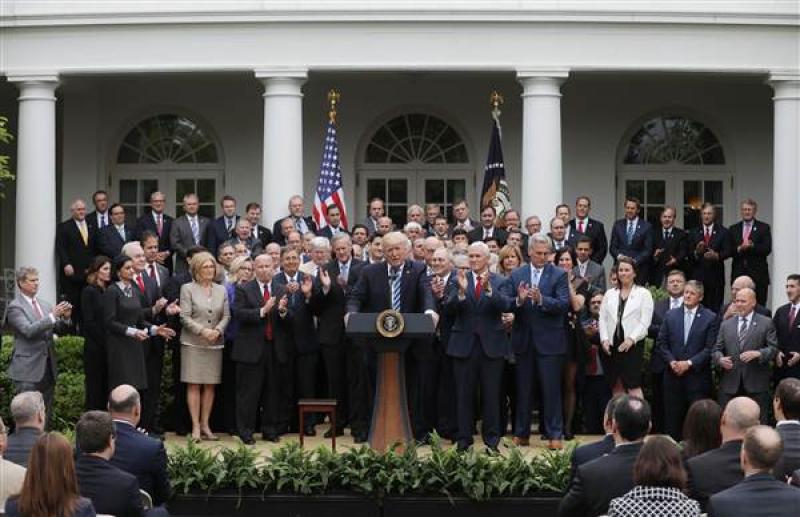
House Republicans passed their health care bill at a whirlwind pace, pushing it through as soon as they had enough votes lined up without holding hearings on its impact or waiting for a report on how much it will cost.
Now it's the Senate's turn, where things tend to move at a more genteel pace. Having largely sidestepped this week's House contentious debate, members say they'll need plenty of time to look things over and some have already expressed concerns about the plan's substance.
"We're not under any deadline, so we're going to take our time," Sen. John Cornyn (R-TX), the majority whip, told reporters.
Senate Majority Leader Mitch McConnell (R-KY) has assembled a working group to try to find a consensus.
Sen. John Thune (R-ND), a member of the leadership team, noted to reporters that "the margin for error is a lot less over here" given that Republicans have a 52-seat majority and can only lose two votes. That also means a bill could take more time to work out, since any individual member could potentially derail a compromise.
An indication of the trepidation in the Senate was clear when President Donald Trump said at a Rose Garden gathering with House GOP members after their bill passed that the Senate was "eager" to get to work on the legislation — some House members actually laughed out loud.
"They are!" Trump said in response to the chuckles.
Several Senators have stressed not to expect the kind of rapid flurry of action that characterized the House's final vote.
Sen. Lindsey Graham (R-SC) criticized his House counterparts for rushing forward without waiting for a Congressional Budget Office analysis or giving members a chance to add amendments or even time to examine the bill's text, which was only finalized on Wednesday evening.
"I'm not so sure this is good civics here," he said.
Unlike the House, the Senate rules won't allow them to push through a vote without waiting for a Congressional Budget Office score. They can't formally take up the House bill until the CBO finishes its analysis, which could take one to two weeks, and have it reviewed by the Senate parliamentarian.
That process carries some pitfalls of its own. It's possible some of the most important items that the House Freedom Caucus negotiated , including allowing states to opt out of Essential Health Benefits and protections for pre-existing conditions, will run afoul of rules requiring reconciliation bills to stick to items that concern the budget and not regulations.
"Anything that makes it impossible for us to do under reconciliation we'll have to either try to do it a different way or do it at a later time," Sen. Roy Blunt (R-MO) said.
Some members, including Blunt and Sen. Chuck Grassley (R-IA), indicated the Senate might write its own bill from scratch rather than making a few tweaks to the House bill and sending it back.
"I congratulate the House on passage of its bill," Sen. Lamar Alexander (R-TN), chairman of the Committee on Health, Education, Labor and Pensions, said in a statement. "The Senate will now finish work on our bill, but will take the time to get it right."
Others said the House could serve as a reference point, but the measure would likely require significant changes.
"It's the skeleton, but it's definitely still not the final product," Sen. James Lankford (R-OK) told reporters.
He predicted it would take at least six weeks to advance a bill, given the longer process for submitting and scoring amendments compared to the House.
As was the case in the House, there are moderates, conservatives, and members with personal concerns to placate. Some were highly critical of the House's first failed attempt to pass a bill, though they mostly held their tongues during the most recent negotiations. Now those issues will return to the spotlight and the slower pace means there will be more time for think tank studies, activist campaigns and constituent calls to influence their votes.
Sen. Shelley Moore-Capito (R-WV) told reporters she was "absolutely" concerned with the House bill's cuts to Medicaid, which could disproportionately affect her state. Sen. Rob Portman (R-OH), whose state also expanded Medicaid under Obamacare, announced Thursday he could not support the bill over the issue, which he feared could undercut state efforts to treat opioid addiction.
Several more moderate Senators, including Graham, Moore-Capito, and Sen. Johnny Isaakson (R-GA), are co-sponsoring a bill authored by Sen. Bill Cassidy (R-LA) and Sen. Susan Collins (R-ME) that takes a dramatically different approach than the House bill and could potentially expand coverage beyond Obamacare. It would allow states to either keep the current law's framework or opt into a new program that automatically enrolled people in a catastrophic insurance plan paid for with tax credits.
Cassidy and Collins have argued Trump could come around to their approach since it better fulfills his promise to provide "insurance for everybody."
"I just think that if you're going to accomplish President Trump's goals, then you got to lower premiums and the way you lower premiums is to make your risk pool bigger," Cassidy said.
A number of Senators expressed concerns in March about an earlier CBO finding that showed the average 64-year old with an income of $26,500 would see their annual premiums shoot up $12,900 under the House bill. Sen. Bob Corker (R-TN) said there would be renewed work on an effort led by Thune to provide more aid to low-income customers.
"I know there are changes we're gonna want to make and I know one of those is the Thune amendment, but it's still being developed," Corker said.
On the right, Sen. Rand Paul (R-KY) reiterated Thursday that he had deep philosophical concerns with the House's approach even as he lauded the House Freedom Caucus for improving the bill. It's possible he won't vote for any legislation that subsidizes health insurance, which the House bill does via tax credits and funding for states to stabilize their insurance markets.
"One of our objections to Obamacare is that we didn't really think it was the role of the federal government to buy insurance for people," Paul said.
For their part, House members sounded content to let the Senate alter their bill, with some describing it as only a starting point. Even Rep. Mark Meadows (R-NC), Freedom Caucus chairman who negotiated the compromise that won over recalcitrant conservatives, said he was flexible.
"We're already working on potential amendments with both moderate and conservative senators," Meadows told NBC News on Wednesday. "We understand that it will change."
http://www.nbcnews.com/politics/congress/senators-turn-health-care-bill-they-have-issues-n755061
Some salient comments:
Sen. Lindsey Graham (R-SC) criticized his House counterparts for rushing forward without waiting for a Congressional Budget Office analysis or giving members a chance to add amendments or even time to examine the bill's text, which was only finalized on Wednesday evening.
"I'm not so sure this is good civics here," he said.
allowing states to opt out of Essential Health Benefits and protections for pre-existing conditions, will run afoul of rules requiring reconciliation bills to stick to items that concern the budget and not regulations.
"Anything that makes it impossible for us to do under reconciliation we'll have to either try to do it a different way or do it at a later time," Sen. Roy Blunt (R-MO) said.
Some members, including Blunt and Sen. Chuck Grassley (R-IA), indicated the Senate might write its own bill from scratch rather than making a few tweaks to the House bill and sending it back.
"It's the skeleton, but it's definitely still not the final product," Sen. James Lankford (R-OK) told reporters.
Several more moderate Senators, including Graham, Moore-Capito, and Sen. Johnny Isaakson (R-GA), are co-sponsoring a bill authored by Sen. Bill Cassidy (R-LA) and Sen. Susan Collins (R-ME) that takes a dramatically different approach than the House bill and could potentially expand coverage beyond Obamacare. It would allow states to either keep the current law's framework or opt into a new program that automatically enrolled people in a catastrophic insurance plan paid for with tax credits.
And on and on and on. The House Bill was a waste of time, is DOA in the Senate and accomplished nothing except that it allows some GOP Congressmen to go home and get blasted by their own constituents for the monstrousity they aborted out.
Going to bed so locking the column. Will unlock it tomorrow.
Unlocked
No CBO review and pushed through without much thought going into it. Wonderful
By law the Senate has to wait for a CBO score, which should be the same for the House. Also they have to wait for a ruling from the Senate Parliamentarian to tell them if all of the parts of this bill can be passed via budget reconciliation. It's not likely that she (Elizabeth MacDonough) will rule that allowing states to opt out of Essential Health Benefits and protections for pre-existing conditions are a part of the budget. So those will require 60 votes.
On the right, Sen. Rand Paul (R-KY) reiterated Thursday that he had deep philosophical concerns with the House's approach even as he lauded the House Freedom Caucus for improving the bill. It's possible he won't vote for any legislation that subsidizes health insurance, which the House bill does via tax credits and funding for states to stabilize their insurance markets.
"One of our objections to Obamacare is that we didn't really think it was the role of the federal government to buy insurance for people," Paul said.
One wonders if a person like Rand Paul has the capacity for empathy. Their goal is to hurt as many people as possible. To take help away from as many people as possible. To do the opposite of helping others as possible. I am an atheist, but even I have a form of a soul in that I care for other people in a moral way. There are a few other people here on NT, we all know who they are, who constantly applaud the idea of "Good, just so they don't take any money out of my pocket" like they are Scrooge. Don't they have a heart? Empathy? A soul? How does a person become so hateful, because it is not just that they don't care, it really is hate for their fellow human beings.
The Congress men and women in the picture attached in this article. How do they sleep at night. Sure they don't think that what they voted for will actually go through the Senate the same as if they voted for it, but what if it did? What about the 20-24 million men, women, children and babies who would lose there insurance? Under their plan if a person who had cancer lost their job and it took longer then 60 days for them to find another then an insurance company could legally charge them $140,000 a year for insurance. $140,000 a year!!! Of course they could not afford it and that is the reason why, so they would die of their cancer. How do the people who voted for that go home and look at their children or parents and go to Thanksgiving or open Christmas presents do so without dissolving into tears of horror and guilt? They sure as fuck should.