
Has AEI turned against Trump?


 We have seen articles in the main-stream media about the growing schism between Trump and the party. It appears that at least one "traditional" conservative bastion has decided to actively dispute the President's positions.
The American Enterprise Institue has been a go-to conservative think-tank for a few decades, with close ties to many conservative lobbying organizations, such as ALEC. David Koch is on the National Board.
Over the last few days, there has been a spray of anti-Trump articles on the AEI website:
- "Stop bashing the CBO, Republicans"
- "For Trump, self-pardon would equal self-immolation" John Yoo is a jurist, author the justification for torture during the Bush administration.
- "The sovereignty delusion"
=============================================================================
Stop bashing the CBO, Republicans
A word to the wise from a fellow conservative: Expert analysis isn't your problem; bad legislation is
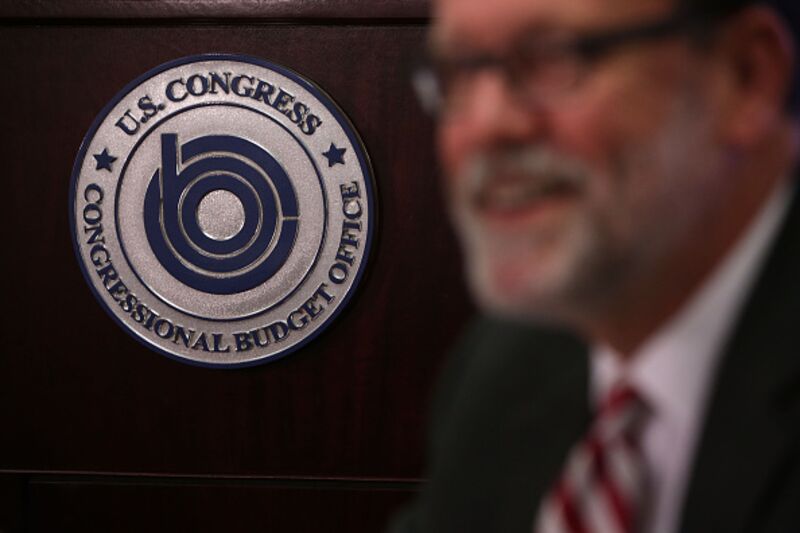
Experts aren't the enemy
Alex Wong/Getty Images
The Congressional Budget Office is under fire
The nonpartisan agency, which is responsible for producing impartial analysis for use by Congress, was the subject of a bizarre attack ad by the White House last month. Mick Mulvaney, President Donald Trump’s budget director, has publicly questioned whether “the day of the CBO” has “come and gone.” Former House speaker Newt Gingrich recently advocated : “Abolish CBO. It is totally destructive. It is totally dishonest.” Last week, members of the House Freedom Caucus authored amendments that would cut the CBO’s funding in half and eliminate the division responsible for producing cost estimates of legislation.

This is all ridiculous.
It is normal (if less than utopian) for politicians to exaggerate the benefits and understate the costs of policies they support. Part of the CBO’s job is to lay out those costs and benefits in an objective, impartial manner. It is therefore par for the course -- and often healthy -- for CBO analysis to be criticized. What is not normal is the attempt to discredit the agency itself.
The current campaign to do so has been motivated by the CBO’s estimates of the effects of various Republican efforts to repeal and replace Obamacare. The agency poured cold water on GOP health-care proposals with its estimates that millions fewer would be covered by insurance if those plans were enacted.
Conservatives are right to question these estimates. In my view, CBO’s analysis has some missteps. Most significantly, its assumption that Obamacare’s “individual mandate” is extremely effective, responsible for many millions of Americans being insured, is much too strong, which means CBO’s estimates of the increase in the number of uninsured if the individual mandate were repealed are much too large.
But CBO’s basic assessment of the GOP replacement plans is correct: They would result in a large increase in the number of Americans who do not have health insurance. The problem with the GOP’s Obamacare replacement plans has not been the CBO. It has been the plans. Rather than trying to tear down CBO’s legitimacy, the GOP should focus on crafting better legislation.
The GOP is unwise to delegitimize the CBO even out of pure political self-interest. The agency frequently produces analysis that Democrats could live without. When President Barack Obama wanted to raise the minimum wage, CBO estimated that hundreds of thousands of jobs would be lost. CBO analysis finds that Obamacare reduces employment. It finds that reducing Social Security benefits is better for economic growth than raising Social Security taxes, and the agency frequently discusses the negative economic impact of higher marginal tax rates. CBO’s 1994 analysis of President Bill Clinton’s health-care proposal played a role in its ultimate failure.
Republicans are in power now, but they won’t be forever. When Democrats are back in charge, they are likely to exaggerate the benefits and understate the costs of policies they champion. Republicans will be grateful then for a fully intact CBO, producing analysis the rest of Washington believes to be credible.
Delegitimizing the CBO also puts more power in the hands of the White House and executive departments. CBO analysis and information is produced at the request of Congress, for use by Congress. A discredited CBO would lead Congress to rely on the executive branch for information and analysis of legislation. CBO was created as part of a broader battle over the balance of power between Congress and President Richard Nixon. Congress shouldn’t tilt that balance more toward the president.
Attacks on the CBO are additionally concerning because they are part of a growing hostility towards expertise. From vaccines to the benefits of free trade to the safety of genetically modified food, expert opinion seems not to matter as much as it should. Conservatives should not contribute to this problem by discrediting the public-policy expertise offered by the CBO.
Of course, experts can be wrong. I often find myself thinking a particular CBO analysis is a little off base, that I would have used different assumptions, or done the analysis differently. There is often significant uncertainty in analysis as ambitious as that frequently produced by the CBO. And it would be good for the CBO to be more transparent about its analysis and with its models.
But models and analysis cannot be, and are not intended to be, gospel truth. Among all government agencies, CBO consistently produces the most useful, most impartial, highest-quality nonpartisan analysis of public policy issues and proposals. Questioning the CBO’s integrity and professionalism is absurd. It’s time to stop attacking the umpire, and refocus on throwing strikes.
-------------------------------
Original article https://www.bloomberg.com/view/articles/2017-08-01/stop-bashing-the-cbo-republicans by Michael R Stain, Bloomberg http://www.bloomberg.com/ , reprinted on AEI.org http://www.aei.org/publication/stop-bashing-the-cbo-republicans/
There may be links in the Original Article that have not been reproduced here.
==========================================================
For Trump, self-pardon would equal self-immolation

President Trump during a Make America Great Again rally in Ohio.
CAROLYN KASTER / ASSOCIATED PRESS
In the wake of accounts that independent counsel Robert Mueller has turned his investigation to the first family, President Trump tweeted last weekend that he has the “complete power to pardon.” His aides and lawyers suggested that the president might pardon not only his son Donald J. Trump Jr. and Jared Kushner, his son-in-law, but himself too.
Criticism rained down from legal scholars and commentators. Noted liberal Harvard law professor Laurence Tribe argued that “the Constitution embodies [a] broad precept against self-dealing.” Many critics rely on a brief, three-paragraph analysis by Richard Nixon’s Justice Department. On Aug. 5, 1974, it concluded the president could not pardon himself because of “the fundamental rule that no one may be a judge in his own case.”
The constitutional text and history shows that Trump has the Constitution, if not the politics, about right. Article II declares that the president “shall have Power to grant Reprieves and Pardons for Offences against the United States, except in cases of Impeachment.” This text shows that the Framers knew how to make exceptions to the pardon power. They forbade a president from issuing pardons for impeachments, and they restricted them to federal crimes only. If the Framers had wanted to prevent presidents from pardoning themselves, they had only to add another exception.
Admittedly, a self-pardon would not advance the core purposes of the constitutional provision. As Alexander Hamilton explained in Federalist 74, the Constitution creates a pardon power “out of humanity and good policy” to allow for “mitigation from the rigour of the law.” Opponents of the Constitution responded, however, that the power ought not rest in the hands of the president for the very reasons raised today by Trump’s critics. They claimed that the legislature should hold the pardon power, because in cases of treason, “the connivance of the chief magistrate [i.e., the president] ought not to be entirely excluded.” In other words, the Anti-Federalists seemed to argue that the president should not have the pardon power because he might pardon himself and his coconspirators in a plot to commit treason.
Tellingly, Hamilton did not respond that the president could not pardon himself. He did not raise the claim that the Constitution silently adopted the rule that no one could be a judge in his own case. Instead, Hamilton argued that the benefit of vesting the power in the president alone outweighed the costs of possible abuse. Only a single man could act quickly in times of crisis to use pardons to break up a conspiracy. “In seasons of insurrection or rebellion, there are often critical moments, when a well-timed offer of pardon to the insurgents or rebels may restore the tranquility of the commonwealth,” wrote Hamilton.
Tribe and other critics retreat to the natural law principle that forbids a man from serving as a judge in his own case. We welcome their newfound eagerness to read the natural law into the Constitution, an idea over which they and a Democratic Senate attempted to roast Clarence Thomas during his confirmation hearings. In any event, the Constitution regularly grants a branch the power to judge itself. Congress decides its own salaries and whether to oust its own members. The judiciary decides the extent of its own jurisdiction and hears cases involving attempts to curb judicial power. And the Constitution grants the president various powers with which an incumbent may shield himself, including the veto and the pardon.
Of course, exercises of presidential power have consequences. By pardoning himself and his associates, Trump will all but ensure that the public regards them as guilty. His family may escape jail time, but Trump may well go down as one of the handful of notorious presidents in American history, on a par with Nixon or Andrew Johnson, whom the Reconstruction Congress impeached.
Nor would a pardon stop the investigations. While we will not see Jared Kushner in prison garb any time soon, both the executive and the legislature will continue to investigate the Russia hacking episode, any connections to the Trump campaign, and any financial improprieties of the president and his associates. Even if Trump pardoned himself, Mueller could surely continue his investigation into Russian interference with the 2016 elections and any obstruction of justice. A pardon would only redouble congressional and executive efforts to find the truth of the matter.
A self-pardon will also shift the balance of power to Congress, which could strangle the Trump presidency in its infancy. As the constitutional text makes clear, pardons cannot extend to cases of impeachment. Even if Trump pardons himself, the House can still impeach him and the Senate can still vote — with a two-thirds majority — to remove him from office. A pardon only prevents Trump’s prosecution after he leaves office.
In a moment of rare bipartisanship, legislators of both parties could agree that they will impeach and remove any president who pardons himself. As Hamilton explained again in The Federalist, “high crimes and misdemeanors” encompasses “the misconduct of public men, or, in other words, from the abuse or violation of some public trust.” Members of Congress would be well within their rights to read “high crimes and misdemeanors” as including any president who pardoned himself.
The crucible for presidential self-pardons would come in the wake of a Trump ouster, by election or otherwise. If the next administration chose to ignore the self-pardon, it could prosecute Donald Trump, private citizen. At that point, Trump would produce the self-pardon and the courts would adjudicate this question of presidential self-help.
Trump clearly followed Nixon on the campaign trail by appealing to the silent majority to win the 2016 elections. But it is time for him to close the Nixon playbook. Unless he wants to meet the same fate as Nixon — impeachment or resignation — he should put aside talk of pardons and turn his attentions to the problems facing the nation.
John Yoo is a law professor at the University of California, Berkeley, a visiting scholar at the American Enterprise Institute, and a former Bush Justice Department official. yooj@berkeley.edu
Saikrishna Prakash is the James Monroe distinguished professor of law and Miller Center senior fellow at the University of Virginia School of Law. sprakash10@gmail.com
-------------------------------
Original article http://www.aei.org/publication/for-trump-self-pardon-would-equal-self-immolation/ by John Yoo and Saikrishna Prakash, AEI.org, reprinted from the Philadelphia Enquirer http://www.philly.com/philly/opinion/commentary/for-trump-self-pardon-would-equal-self-immolation-20170727.html
There may be links in the Original Article that have not been reproduced here.
============================================================
The sovereignty delusion
National sovereignty is an article of faith among most conservatives in the English-speaking world. “Should Americans continue to govern themselves?” my colleague at AEI John Bolton asks in his endorsement of John Fonte’s 2011 book, Sovereignty or Submission, which makes a strong case for the repatriation of decision-making authority from supranational institutions, which often lack transparency and democratic accountability.

@tcboncore via Twenty20
Bringing sovereignty – in the sense of ultimate legal authority – from Brussels to Westminster was perhaps the most compelling among the arguments put forward by those who advocated the UK’s departure from the EU ahead of the June 2016 referendum. “Restore the primacy of national constitutions, and much follows,” promised one of the intellectual leaders of the Brexit campaign, Daniel Hannan.
Yet this focus on who has the ultimate power – domestic politicians or bureaucrats in supranational bodies – is largely misplaced. It distracts from the far more important questions of the institutional specifics of how, and under what constraints, that power is exercised. Most worryingly, a preoccupation with sovereignty has led some conservatives to embrace agendas and political leaders directly inimical to free markets and limited government.
Of course, it does matter whether we are governed by politicians whom we have elected and can vote out of office, or by faceless international bureaucrats sitting in a distant place. But it is not the only – or even the most important – thing that matters. Neither is sovereignty an either-or question. After all, modern democracies delegate many decisions to unelected officials and bodies – central banks or utilities regulators are just two examples among many.
Champions of sovereignty, however, argue that supranational institutions, such as the EU, are different in nature. The legal authority enjoyed by national bureaucracies can be always taken back by elected representatives of the people. The EU, in contrast, is the source of a new layer of rules, which can potentially trump those existing in its constituent states. Through the European Court of Justice, the EU is also in a position to enforce its decisions, reducing nation-states into mere provinces of a European superstate. Conservatives have directed similar criticism at many other supranational judicial bodies, including the International Criminal Court (ICC), identified by Mr. Fonte as “systemically adversarial to American interests and values”.
But how much power do institutions like the ICC really have? Ultimately they depend on the compliance of individual states. And, notwithstanding its sometimes byzantine powers, the EU is a paper tiger too, with no means of enforcing its decisions other than the voluntary cooperation of member states. When Central European countries such as Hungary, Poland, and Slovakia refused to implement the agreed-upon refugee relocation scheme, nothing happened. Even the more egregious attacks on the rule of law in Poland prompted no effective response beyond a rhetorical slap down from Brussels The EU is not a jail of nations – if a country does not like the rules, it is free to leave.
As the recent kerfuffle over a prospective US-UK trade agreement and rules over chlorinated chicken demonstrates, the idea of full sovereign control of a country’s laws by a legislature is a chimera. The real choice, unless you are North Korea, is always between different forms of international entanglements: joint rules, mutual recognition and so on, each of them limiting the discretion of democratically elected representatives in different ways.
Of course, upon leaving the EU, the UK can liberate itself from myriad European regulations, including its food safety rules. But if it rushes to conclude a trade agreement with the US to make up for the losses involved in leaving the single market, it will likely acquiesce to sanitary and phytosanitary rules written by US regulators – and not voted on by MPs in Westminster.
There is no escaping the rules that shape globalised markets without ever being voted on in national parliaments. Take transnational private regulation – the standards set by bodies such as International Organisation for Standardisation (ISO) and International Electrotechnical Commission. Such rules have come to dominate the world not by edict but on their own merits and because of the benefits common standards they entail. But if one is to take the sovereignty argument seriously, don’t these rules infringe on the primacy of national political institutions too? Why aren’t conservative railing against them?
Or consider NATO. Under Article 5, member countries are committed to come to the defence of any of their allies, no questions asked, sacrificing lives if necessary. As Margaret Thatcher put it, the alliance thus imposed obligations that were “at least as far reaching as those under The Treaty of Rome,” adding that “almost every major nation has been obliged…to pool significant areas of sovereignty so as to create more effective political units”.
One root of the excessive focus of US and British conservatives on national sovereignty has to do with the distinct histories of English-speaking peoples and continental Europeans. The experience of America, a continental empire, or Britain, not invaded since 1066 and centralised to a degree unmatched anywhere else in Europe until 19th century, are both outliers within the Western world.
Hardly any other country had the luxury of being an island unto itself in a similar way. Since the fall of the Roman Empire, continental Europe has been shaped by efforts to create a workable form of political “unity in diversity.” In its long history, the notion of a sovereign nation-state of the late 19th and early 20th century appears like a fleeting episode – and one that furthermore led to very bad outcomes, with two world wars and the fallout of the Great Depression.
Historic experience thus suggests that the obsession with national sovereignty is not only wrong but also dangerous. Recently some conservatives have come to the defence of the authoritarian governments of Hungary and Poland – largely because they saw them as standing up to Brussels. But that is a grave, categorical mistake. The real threat to free societies in Central Europe is not from EU bureaucrats but from their own political leaders, busy dismantling checks and balances, suppressing free media, civil society organisations, and private universities, and renationalising large swathes of the economy.
Both in the US and the UK, the desire to “take back control” has also led many conservatives to advocate policies that will diminish the global influence that the two leading free societies have in the world.
None of this is to suggest a Panglossian view of “global governance”. There is indeed a lot that has gone wrong with the EU, and with the United Nations and its alphabet soup of agencies populated by overpaid international civil servants. Conservatives are right to scrutinise how such bodies use the power given to them, the international rules by which governments have agreed to abide and the frequent mission creep of organisations that have outlived their original purpose.
However, one needs to be careful not throw the baby out with the bathwater. The efforts to restore control in the name of national sovereignty are a fool’s errand. The seeming entanglements between national and international rules and various forms of multilateral cooperation often exist for good reasons.
Worse, when the efforts to restore sovereignty and scrap the fabric that holds liberal democracies together come from the two countries that are meant to underwrite the institutional structures behind globalisation and the peaceful international system that the West has enjoyed since 1945, they risk doing lasting damage to the future of limited government, free markets, and free societies across the world.
-------------------------------
Original article http://www.aei.org/publication/the-sovereignty-delusion by Dalibor Rohac, AEI.org http://www.aei.org/
There may be links in the Original Article that have not been reproduced here.
Tags
Who is online
88 visitors
How very strange... I almost never agree with AEI... but these three are pretty good.
trump isn't a conservative he isn't even a republican, he joined the party to hijack it.
In addition to the AEI comments it should be noted that republican senators see to be going their own way, disregarding Trump and his directives.