
Under Trump, Made in America Is Losing Out to Russian Steel


Under Trump, Made in America Is Losing Out to Russian Steel
An oligarch-owned steel company is winning pipeline contracts, and foreign steel imports are up 24 percent this year.
By Margaret Newkirk and Joe Deaux
October 25, 2017, 4:00 AM EDT October 25, 2017, 6:01 PM EDT
Four days after his inauguration, Donald Trump signed a handful of executive memos to advance the Keystone XL pipeline and revive the U.S. steel industry. He invited builder TransCanada Corp. to reapply for a permit denied by Barack Obama and ordered up fast-track rules forcing not only Keystone but also all new U.S. pipelines to be made from American steel. “From now on, we’re going to be making pipeline in the United States,” he said.
Made-in-America Keystone was a stunt. Most of its pipes had already been manufactured, a fact the White House grudgingly admitted when it exempted the project from any new Buy American rules a few months later. While some of Keystone’s pipes were made in the U.S., at least a quarter of them came from a Russian steel company whose biggest shareholder is an oligarch and Trump family friend. The company, Evraz North America, supplied Keystone from its steel plants in Canada and for years has lobbied in Washington against Trump-style protectionism.
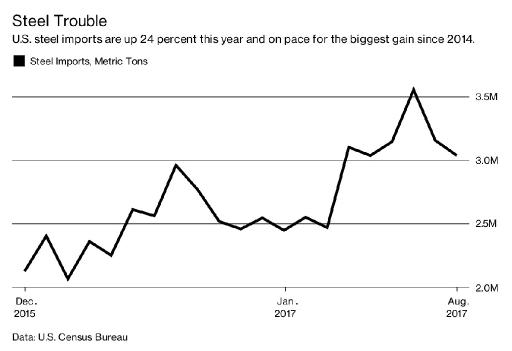
Ten months after his Keystone event, Trump has yet to deliver on his pledge to boost the fortunes of American steel. Two self-imposed deadlines for trade action, one in June and one in July, have come and gone. Meanwhile, the prospect of tariffs has led to a surge of cheap foreign steel into the U.S., with imports rising 24 percent in 2017, the fastest increase in years.
As federal and congressional investigators probe Moscow’s interference in the 2016 U.S. election, Evraz North America shows that Russians are also involved in pressing against one of Trump’s main campaign promises. The company is a wholly owned subsidiary of Evraz Plc, Russia’s second-largest steelmaker. It has two factories in the U.S., in Colorado and Oregon, and four in western Canada, where it produces steel and large-diameter steel pipe. The company’s top shareholder is Roman Abramovich, a billionaire who owns 31 percent of Evraz’s stock. In 2005 he was the first oligarch allowed to sell his oil company to the state, taking in $13 billion in a deal approved by Vladimir Putin.
Abramovich’s ties to the Trumps stem from a decade-long friendship between Ivanka Trump and Abramovich’s wife, Dasha Zhukova, from whom he announced a separation in August. Jared Kushner and his brother, Joshua, invested in Zhukova’s art collection business. The Russian couple hosted Ivanka and Jared in Russia in 2014, when they shared a table at a fundraiser for Moscow’s Jewish museum. Zhukova went to the 2016 U.S. Open tennis tournament with Ivanka and attended Trump’s inauguration as Ivanka’s guest.
Evraz won its share of the Keystone XL business in 2009 and hired a Washington lobbyist named John Stinson the next year, according to disclosures collected by Bloomberg Government and Open Secrets, a nonprofit that tracks money in politics. Over the next seven years, Stinson lobbied the House, Senate, U.S. Department of Commerce, and Office of the U.S. Trade Representative, earning $2.2 million for representing Evraz’s interests. He fought Buy American language in federal spending bills for transportation, water infrastructure, and defense, as well as in a bill specifically about Keystone in 2015—the same year Obama denied its cross-border permit.
According to federal disclosures, Evraz paid Stinson $100,000 in the first half of 2017 to persuade Congress and the Commerce Department to exclude its Canadian products from Trump’s steel import crackdown. Stinson declined to comment. Christian Messmacher, the company’s vice president for development, says its lobbying efforts are typical for the industry. “We, like all other North American companies, work to provide public officials with our insights on issues that affect us and our ability to provide good North American jobs,” he says.
In late May, Evraz won a contract with liquefied natural gas company Cheniere Energy Inc. to supply the steel pipe for a 200-mile pipeline to bring natural gas from Oklahoma to the Gulf Coast. The contract, worth an estimated $100 million, was expected to go to a Florida-based company, Berg Steel Pipe Corp., according to the American Line Pipe Producers Association. The association put out a press release in June arguing that Evraz was undercutting U.S. companies. It asked the Trump administration to act quickly on new rules and stop “Russian-owned Evraz” from “aggressively” seeking U.S. contracts ahead of any new tariffs or quotas on imports.
The Cheniere contract shows how hard it is to differentiate between foreign and U.S.-made steel. While losing out to Evraz cost Berg 216 jobs, or 42 percent of its workforce, company Vice President Jonathan Kirkland told the Mobile, Ala., Press-Register in June, Berg makes pipelines using steel from Germany and France. U.S. steel supplies aren’t reliable enough, Chief Executive Ingo Riemer told the U.S. International Trade Commission last year.
In September, Commerce Secretary Wilbur Ross said the administration will defer a decision to impose tariffs on foreign steel so it can focus on tax reform. The industry is getting impatient. Steel executives have been meeting with administration officials. More than 60 steelworkers met with members of Congress on Sept. 21 to tell them of their growing frustration with the White House’s delays. “The president makes his policy decisions based on what is best for the American people,” says White House Deputy Press Secretary Lindsay Walters. “Moreover, to place unrelated information about his daughter’s social engagement with the ex-wife of one of a company’s shareholders in a story about actual policy is incredibly irresponsible and misleading.”
Given the promises Trump made in the campaign, there may be political blowback if he doesn’t deliver. Although the United Steelworkers union endorsed Hillary Clinton, many of its members voted for Trump, helping him to narrow victories in states across the Midwest. “Those workers absolutely won’t forget if they are empty promises,” says Dan Simmons, president of Steelworkers Local 1899 in Granite City, Ill. “Like Elvis says, we want a little less talk and a little more action.”
https://www.bloomberg.com//news/articles/2017-10-25/under-trump-made-in-america-is-losing-out-to-russian-steel
Tags
Who is online
79 visitors
An oligarch-owned steel company is winning pipeline contracts, and foreign steel imports are up 24 percent this year.
Ten months after his Keystone event, Trump has yet to deliver on his pledge to boost the fortunes of American steel. Two self-imposed deadlines for trade action, one in June and one in July, have come and gone. Meanwhile, the prospect of tariffs has led to a surge of cheap foreign steel into the U.S., with imports rising 24 percent in 2017, the fastest increase in years.
So if there is Russian steel being used, it was contracted during the period Clinton was SecState.
Okay, but this article is about the promises made by this Administration.
Two self-imposed deadlines for trade action, one in June and one in July, have come and gone.
I imagine the Steele Workers are very familiar with what was promised, when it was promised, what they've been given, and what competitors have received.
Read the headline of the article you linked. It is clearly making a false reference about Russian steel, import, etc. and implying that Trump opened the flood gates. They were already wide open. He is guilty, thus far... of not slapping tariffs on imports.
Okay - thanks for engaging me. So, aside from the article's title, you find the delay in the tariffs a little worrisome but nothing to be overly concerned about, correct?
Are there any other areas you think we should be doing more in for the Steele Workers?
Thanks
Trying to address this without starting a trade war is important, although I am not opposed to that type of war. However, I understand what the ramifications might be regarding inflation.
As to the steel workers, they have an industry that still exists... unlike many other industries that have left the U.S.
Ahh yes, Bloomberg.com No bias there...
Hey the plants making most of this steel are US/Canadian plants. I'm sure the Steelworkers unions are aware of that. Also the imports are coming from the Canadian plants. Canadian steel falls under two designations local business and foreign imports....
The whole russian angle is more biased political hackery....
And when it comes to biased political hackery? The most guilty are always the ones shouting the loudest....
It is union workers that are getting paid to produce that steel of which most of it is produced in the US and Canada. At prevailing wages I may add.
So the wholesome Hooray for USA angst is phony.
AS phony as a two and a half dollar bill.
I'm going to be honest and admit that I never really knew what sources were considered right or left until I came here. I learned from the posts of members. I still don't know where all the sources lean or fall so I'll take your word that the article's source is left leaning.
With that said, what in the article are you disputing.
I'm disputing the articles premise that Russians are taking advantage of the steel markets in the US with the aid of the president....
I mean crap, US steel has been the best in the world for decades and decades, but it is also the most expensive steel in the world... In the 70's US Steel Corp was the largest steel producer in the world...
But as labor and production costs soared other companies took over the claim as the largest steel producers and some Japanese companies took over the title of producing the best steel.
US steel was eventually bailed out twice by the US government and was eventually sold off to interests that broke it up....
Market forces dictate where materials are purchased and at what price....
Doesn't matter who makes a political promise, market forces will dictate and eventually win out in the end.
Trying to allude to collusion between the president and Russian oligarchs is pure politics and bears no relation to jobs or where the steel is produced but has every relation to where the profits are going.
And when your arguing profits going somewhere improper, like to billionaire oligarchs through politics, generally that is a liberal complaint.
And lets ignore the fact that not one American job has been lost they are getting prevailing wages, and no overseas steel has been brought here...
The article is a political hatchet job....
Yes, I agree the title is inflammatory and there is definitely a liberal leaning in how the information is being laid out. Also, you make valid points about the market. And let's not forget the pipes had already been produced and were waiting to be used.
Setting that aside, do you think President Trump is keeping his word to the Steele Workers? Are there things he could be doing to try and keep the promises he made during the campaign?
Are you saying that Russia has not or that no country has brought steel into the U.S.?
Ok, now we are discussing the validity and veracity of political campaign promises.....
Acknowledging that validity and veracity of campaign promises is an oxymoronic concept no matter who makes it. (no such thing as a truthful campaign promise)
Did President Trump lie in getting elected? yes he did, and so has every modern American presidential campaigner. Seldom does a president get a congress that is so favorable that he can fulfill a campaign promise.....
The last one to have such a situation was President Obama and he only managed to bring forth one campaign promise into any actual legislation. (accepting that what he brought forth didn't accomplish anything he promised except one thing to fundamentally change the medical insurance industry)
All T-rump can hope for is that congress provides something that he can spin into fulfilling his promises, and that looks highly doubtful given the internal war going on inside the republican party.
So to answer your questions.....
Too soon to say and way too much depends on things he has no control of.
There are lots of things he could suggest, but again it is entirely incumbent on others to bring it forward to something he can agree with...
So far he is forcing Congress to do it's job, and as painful for some as that might be, it is the only way to get the government off it's ass.
The greatest presidents do not make such specific promises, experienced politicians know this and avoid the issue altogether. But they lead others to ideals that make a difference and improve the lot of everyone. And that is a judgement about T-Rump as president I'm withholding at this point in time, it is way too early to make such a conclusion....
If anything, T-rump doing nothing is better for the whole nation than trying to ram things down everyone's throats like the last two presidents have done.
Actually NWM, I was just trying to have a discussion with you. I made no reference to lies or anything else derogatory about the president. I agreed with you on practically everything you said. This is exhausting......
not saying that at all Kav.
Quite the contrary lots of foreign steel has been brought into the nation, particularly if it is the same quality and cheaper that locally produced. One would be foolish to argue different.
The steel for the pipeline is specifically what is under discussion, and that was sourced in the US and Canada. No imports that I am aware of.
Steel sourced in Canada would be imported steel.
Canada is the largest importer of steel to the U.S.
I understand that Pj, I'm trying to respond in like manner, no accusations you didn't mention lying at all.
But what you aimed your question at is surrounded by his campaign process and promises, which were a lie.
Which are a lie for every presidential candidate since the forming of political parties. It is the only way I can see to answer the question and stay within the outline of the original posting... So before I answer the question I explain my understanding of it...
Not trying to be tedious but as clear as possible....
And I addressed that in my original answer. In one aspect it is counted as local in the other it is imported...
No denial of this...
But what it does do is illustrate the chart of growing imports of steel which would be expected in this situation isn't telling the whole story.
In fact it is being used to illustrate a non-fact... (but one that is used to support a political position rather than a factual one)