Baidu's self-driving buses enter 'mass production'

 S E E D E D C O N T E N T

 Image copyright GETTY IMAGES
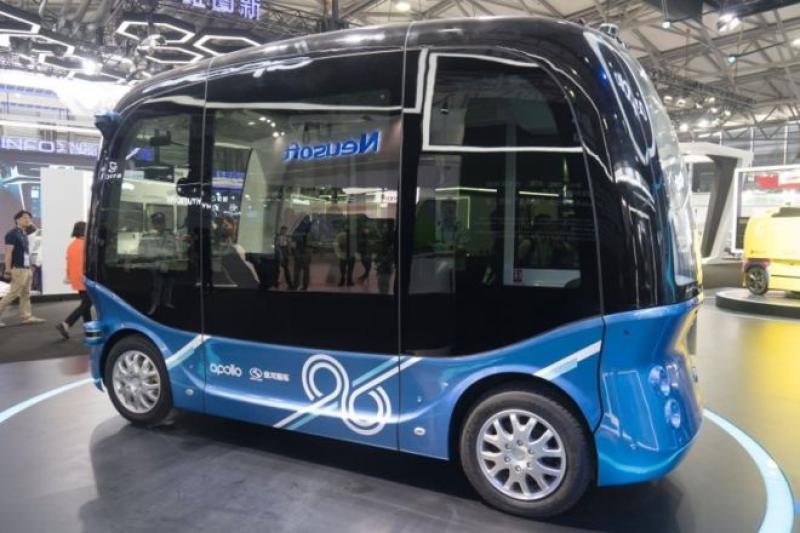
Image caption The Apolong buses are not fitted with a steering wheel
One of China's biggest technology companies has declared it has begun mass production of a self-driving bus.
Baidu made the announcement after building its 100th Apolong vehicle at its factory in the country's south-eastern Fujian province.
It said the vehicles would initially be put to commercial use within Chinese cities but added it was also targeting foreign markets.
The company is one of several competing to sell "level-4 autonomy" buses.
The classification - set by the transport engineering body SAE International - refers to highly automated driving systems that can cope with most driving conditions, even if a human fails to respond appropriately to a request to intervene.
It is one step below the maximum level-5 tier, which extends to all driving scenarios, including dirt roads and unusual weather conditions.
Baidu's chief executive, Robin Li, detailed its plans at the company's annual artificial intelligence developer conference in Beijing.
 Image copyright BAIDU
Image caption The Apolong is about a third of the size of a normal bus
He said: "2018 marks the first year of commercialisation for autonomous driving.
"In the past, China exported cheap commodities to the world. In the future, China will export AI technology to the world."
Softbank deal
The Apolong bus can seat up to 14 people, and has been developed with a local vehicle manufacturer.
It has no driver's seat, steering wheel or pedals.
It runs on electric power and can travel up to 100km (62 miles) after a two-hour charge, at up to 70km/h.
Baidu envisages it being used for "last-mile" drop-offs within enclosed areas, such as airports and tourist sites.
The company said partners would soon put it to use in Beijing, Shenzhen, Wuhan and other Chinese cities.
 Image copyright SOFTBANK
Image caption Softbank says it intends to run the Apolong buses on Tokyo's public roads
It added that a deal with Japan's Softbank Group could also bring the vehicle to Tokyo's roads.
In a separate Japanese-language press release, Softbank said it intended to start using 10 Apolongs for "demonstration tests" within Japan by early 2019.
Softbank's self-drive subsidiary, SB Drive, had previously bought several self-drive shuttle buses from a rival operation - the French start-up Navya.
It demonstrated their use in level-3 mode - where a human is expected to take control if required - at Tokyo's Haneda Airport in February.
 Image copyright SOFTBANK
Image caption Softbank tested a bus it had bought from Navya at an airport earlier this year
Navya's self-drive buses have also been put to use by others at Paris's Charles de Gaulle airport, London's Queen Elizabeth Olympic Park, and the streets of Las Vegas.
Other companies, including France's Easymile, Australia's Intellibus and South Korea's KT, have developed autonomous buses of their own.
One academic suggested that in the near-term, such vehicles had a greater chance of public acceptance than self-drive cars.
"Any vehicle that can be deployed in a well-organised and controlled environment and that can be controlled and regulated by authorities... is more likely to be the starter for this sort of technology, than ones which will be provided to [a single] member of the general public, who would not necessarily be closely monitored," said Prof Natasha Merat, from the University of Leeds' Institute for Transport Studies.
Tags
Who is online
82 visitors
I would agree with that statement. It is going to be interesting to see how this works, as it could well be in China and Japan in short order.
Still wouldn't trust them.
In my opinion they would be a menace to regular drivers.
Or regular drivers would be a menace to them...
Eventually this is transportation of the future. I think that in a controlled environment as spoken about in the article there is a good chance that this will be a real stepping stone for advancement of driver less vesicles.
Gives a new meaning to cruise control.
LOL, it sure does.
Well i think this auto bus would need its own lane and circuit. In small applications it might be a positive impact but on a large scale i think there are stupid people that no matter what they did in safety signs and warning lights and controlled intersections cant be prepared for those type folks.
i am not against them but i dont think society is at a point where deploying these could have a positive impact with out other changes in society as a whole (tube trains, people movers )
in my head for any of this self driving stuff to be safe , humans would have to have proximity alarms attached to them and on those vehicles so they wouldn't get mowed down. I cant imagine ANYONE is ready to put that crap on themselves just to go out side.
humm time will tell!
Yes it will. As you stated there are drawback and humans are one of the biggest. Having spend a lot of time in Asia and actually driving in some of the countries, it can give a whole new meaning to ''WTF'' happenings...