
Footage of sole survivor of Amazon tribe emerges

 S E E D E D C O N T E N T

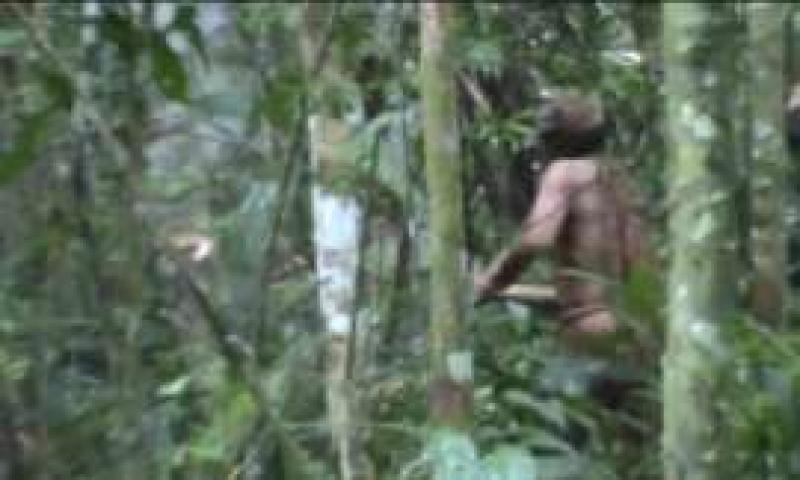
Remarkable footage has been released of an uncontacted indigenous man who has lived alone in an Amazon forest for at least 22 years.
Semi-naked and swinging an axe vigorously as he fells a tree, the man, believed to be in his 50s, has never been filmed so clearly before and appears to be in excellent condition.
“He is very well, hunting, maintaining some plantations of papaya, corn,” said Altair Algayer, a regional co-ordinator for the Brazilian government indigenous agency Funai in the Amazon state of Rondônia, who was with a team who filmed the footage from a distance. “He has good health and a good physical shape doing all those exercises.”
Known as the “indigenous man in the hole”, he is believed to be the only survivor of an isolated tribe. He hunts forest pigs, birds and monkeys with a bow and arrow and traps prey in hidden holes filled with sharpened staves of wood. He and his group were known for building holes and his hammock is strung over one in his house.
Loggers, farmers and land grabbers murdered and expelled indigenous populations in the area in the 1970s and 1980s, and this man is believed to be the only survivor of a group of six killed during an attack by farmers in 1995. He was first located in 1996 and has been monitored by Funai ever since. A glimpse of his face filmed in 1998 was shown in Brazilian documentary Corumbiara.
Funai has a policy of avoiding contact with isolated groups and has protected his area since the 1990s. The indigenous reserve of Tanaru was legally set up in 2015. Axes, machetes and seeds traditionally planted by indigenous people have been left for the man to find, Algayer said, but he clearly wants nothing to do with mainstream society.
“I understand his decision,” said Algayer. “It is his sign of resistance, and a little repudiation, hate, knowing the story he went through.”
Fiona Watson, research and advocacy director of Survival International, a non-profit group that works to protect indigenous peoples, described the footage as “extraordinary” given that the 8,070 hectares of protected forest the man lives in is completely surrounded by ranches and farms.
“Funai has a duty to show that he is well and alive,” she said. “The crucial thing is Funai has managed to keep his territory.”
Survivors of other indigenous groups in the region have described how farmers shot at their backs when they fled raids on their villages, she said. In 2005, she joined a Funai mission to the reserve and saw the holes the man has dug around his territory, his house and his plantations – though she did not see the man himself.
“ The fact he is still alive gives you hope, ” she said. “He is the ultimate symbol, if you like.”
Funai specialists believe there are 113 uncontacted tribes living in the Brazilian Amazon – of which 27 groups have been confirmed – and one tribe living outside. There are also 15 uncontacted tribes in Peru, Watson said, and others in Bolivia, Ecuador and Colombia. Tribes hunt with blowpipes and bows and arrows and while their languages belong to linguistic groups, or “trunks”, they can also differ wildly from each other.
Some tribes are nomadic hunter gatherers and fishers – like the Awá, in Maranhão state on the eastern side of the Amazon, who like the “indigenous man in the hole” live in smaller reserves that are essentially oases of forest surrounded by deforested land. Others, including some living on the Amazon’s western fringes, plant bananas, corn, potato and other crops. In these areas near the Peruvian border, it is believed that isolated groups could have fled a rubber boom a century ago, when many indigenous peoples were enslaved and avoided contact ever since. More groups have become discovered as the Amazon is progressively destroyed.
“The irony is we are finding out there are more of these isolated people than we thought. But it’s also worrying that their cover is being blown,” said Watson.
Tags
Who is online

112 visitors
Both fascinating and sad at the same time.
Result of a 500 yr mindset.
The killing of indigenous people continues...It didn't stop in the 1970 or 80's it is still going on today, 2018.
Who are the savages.
Out of greed and ignorance yes it does continue, it's a shame. With luck and effort the ignorance is curable, greed I'm pretty sure is forever.
Greed and gold Freefaller.
They themselves are often the savages.
The Yanomami people have a history of acting extremely violently not only towards other tribes, but towards one another. [15] Men generally initiate this violence , and women are often victims of physical abuse and anger. Inter-village warfare is common, but does not too commonly affect women. When Yanomami tribes fight and raid nearby tribes, women are often raped , beaten, and brought back to their shabono to be kept in their tribe. During the raids, Yanomami men capture and bring back the other women in hopes of marrying them. Although capturing women is not the focus for these raids, it is seen a secondary benefit. [16] Wives are beaten on a regular basis, so as to keep them docile and faithful to their husbands. [15] Sexual jealousy causes a majority of the violence. [1]
Women are beaten with clubs, sticks, machetes , and other blunt or sharp objects. Burning with a branding stick occurs often, and symbolizes a male's strength or dominance over his wife. [14]
No one is claiming the Native populations are without the common failings of humans in general.
However, as a rule we don't see them plundering for gold, in what ever form it may be, and then committing genocide and destruction of cultural heritage like we have seen since meeting Columbus.
So... They're just like us then?
Oh for goodness sake Dean, the indigenous people of south and central America have been killed for the land right up until 2018...It started with the Spanish in the 1500's...
Here are some links to the killing of Indigenous people in South and Central American, all in the last couple of years...I can supply you a hell of a lot more if need be.
Just the start Dean. So please spare me the ''they do it to'' bullshit.
These people groups don't need to be studied like some newly found animal species! Leave them in peace to continue their tribal cultural, free of any outside influence.