
The Only Mammals Reckless Enough to Eat Hot Peppers Are Humans and Tree Shrews

 S E E D E D C O N T E N T

IN THE KUNMING INSTITUTE OF Zoology, in Yunnan, China, there live about 2,000 long-nosed, inquisitive-faced tree shrews. Tree shrews make good animal models for studying human diseases: They’re more genetically similar to us than, say, a mouse, but they’re also smaller than most of our closest relatives, the primates. So researchers at the Kunming Institute keep a bunch of them around, in order to learn more about their evolutionary history, physiology, and molecular makeup.
But as these researchers learned recently, even the best models are full of surprises. “[We] were trying to find the favorite food of the tree shrew,” writes Kunming Institute biologist Shilong Yang in an email. As Yang and his colleagues detail in a recent paper in PLOSBiology , they were shocked by the answer: chili peppers.
Chilis are hot because of capsaicinoids, molecules that bind to receptors in our mouths and trick us into thinking we’re experiencing actual pain. In peppers, they likely evolved as a defense against bugs, fungi, and hungry animals.
 Most mammals don’t like chili peppers. ERIK FORSBERG/CC BY 2.0
Mostly, it worked: “In the context of mammals… only humans [have] been known to actively consume spicy chili peppers rich in pungent capsaicinoids,” writes Yang in an email. (Psychologists and philosophers argue about what accounts for this particular questionable decision—in 2010, one told the New York Times it might have to do with the thrill of “enjoy[ing] events that are innately negative.”) Birds aren’t affected by capsaicin, and tend to serve as important seed dispersers for chili plants . But almost all of our fellow mammals, including dogs and elephants , do experience spiciness, and prefer to keep things bland.
As this new research shows, though, tree shrews have found their own way around this limitation. When given the peppers in the lab, they “actively fed” on them, the paper reports. (You can watch one nibble enthusiastically here .) Researchers then went out to the field and found that, in the wild, tree shrews love to eat a particular pepper plant called Piper boehmeriaefolium , and vastly prefer it to other plants, including ginger and garlic.
Just to make sure, the researchers synthesized the particular capsaicinoid found in Piper boehmeriaefolium , and used it to make the shrews some snacks: spicy corn pellets, like a rodent version of Flamin Hot Cheetos. Mice hated the pellets, and barely touched them. But the shrews gobbled them right up. What’s more, adding more capsaicinoids—in other words, upping the hotness—“caused a slight increase in the food intake,” the researchers write.
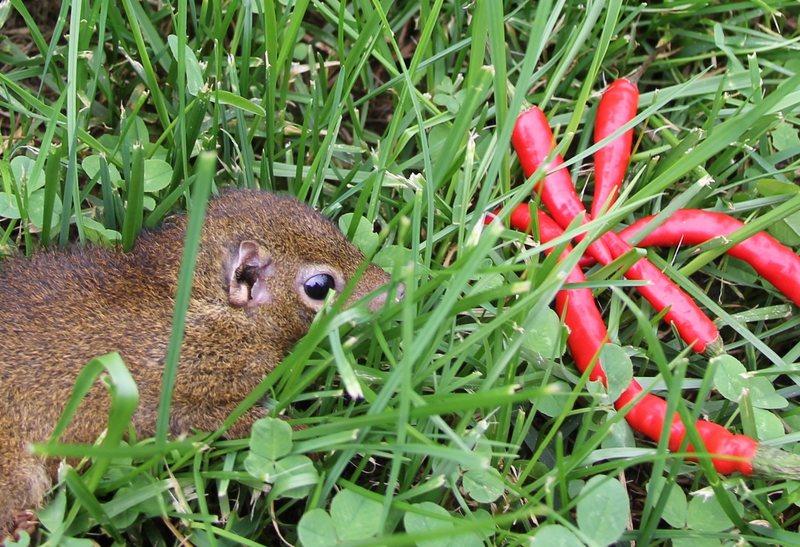
 A tree shrew enjoys a chili at the Kunming Institute. COURTESY KUNMING INSTITUTE OF ZOOLOGY
What accounts for this flaming of the shrew? As it turns out, in this regard, tree shrews are more like birds than humans. Rather than a rarified taste for pain, they have a mutation in a particular protein, the TRPV1 ion channel , which is colloquially known as the “capsaicin receptor.” This mutation lowers the shrew’s sensitivity to capsaicinoids, allowing them to munch on peppers with abandon.
Is this just the beginning? Will we find that jaguars love jalapeños, that schnauzers scarf scotch bonnets, that hamsters hanker for habaneros? Yang thinks not. “The common mammals have all been tested,” he writes. “We believe that the tree shrew is an exception.” Man has been knocked off yet another very specific pedestal
Tags
Who is online

119 visitors