
Trump's Art Of The (Trade) Deal: U.S.-EU Trade War Averted — For Now

 S E E D E D C O N T E N T

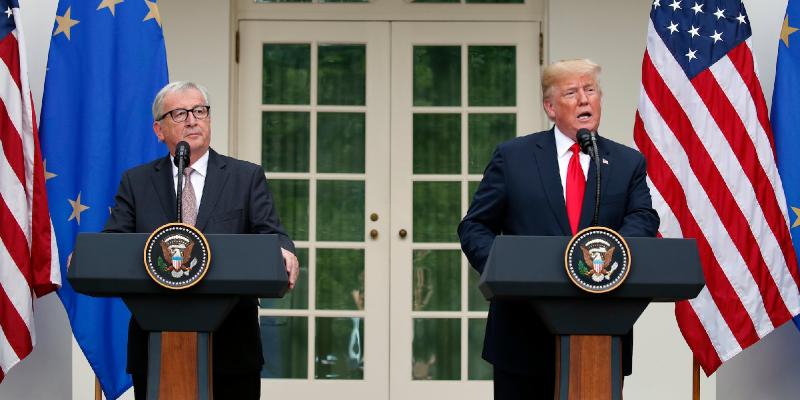
Trade War: EU officials and Donald Trump decided Wednesday to call off their costly trade war and instead do what Trump does best: Cut a deal on trade and go home. Don't ever underestimate Trump's negotiating chops.
Facing the possibility of the U.S. slapping 25% tariffs on EU-built cars, European Commission President Jean-Claude Juncker and his top trade official Cecilia Malmstrom " agreed to work with the U.S. administration to lower industrial tariffs on both sides , increase LNG exports and soy beans to Europe, and align regulatory standards to allow for medical devices to have better market access in Europe," an EU official said.
Late Wednesday, details of an agreement on autos were still being worked out.
Even so, the deal for now ends the possibility of a debilitating U.S.-EU trade war, which would affect some $718 billion in total trade — our largest trade relationship, even bigger than China — and would have had devastating impacts on a number of industries on both sides of the Atlantic.
But Trump emphasized again his concern over what he sees as the lopsided trade relationship between the U.S. and EU.
"Over the years, the United States has lost hundreds of billions of dollars to the European Union and we just want it to be a level playing field for our farmers, our manufacturers, for everybody," Trump told Juncker Wednesday.
Get the new IBD Politics & Opinion newsletter!
On Tuesday, Trump had offered a radical proposal for the EU: A zero tariff between the two trade partners . Even though the EU had essentially given such a deal to Japan recently, it feared being swamped by U.S. goods if it gave the same deal to the U.S. But Juncker promised to work toward that goal with the U.S., too, to avoid a U. S-EU trade war.
Trump didn't get that deal, and didn't expect to. But he did wring considerable concessions out of the EU.
If it leads to even lower trade barriers between the U.S. and Europe, will it have been worth it? You bet. Trump has promised repeatedly that he would seek "fair trade," in which U.S. and foreign goods get equivalent treatment.
It's by now a familiar pattern: Trump prods his reluctant negotiating partners with initial extreme demands, then moves to get a compromise favorable to the U.S. That's what appears to have happened with the EU.
And it may also be happening with Nafta, another big trade trouble spot for the U.S.
Reuters reported on Tuesday that Mexico's chief trade negotiator for the incoming administration, Jesus Seade, says a new Nafta deal — which Trump once threatened to abandon entirely — is inevitable .
"What I see ... to be a very feasible expectation is that we'll be concluding negotiation in the next two months if possible, or in the next few months a bit further down the road," Seade said.
And Seade, who previously served as No. 2 in the World Trade Organization, had words of praise for Trump.
"President Trump has a very personal style," he said. "He likes to appear chaotic. But the last thing he is is chaotic. I think he's a very intelligent man."
Our trading partners have come to understand Trump's idiosyncratic but effective bargaining style. It's a pity that many of his domestic critics, including many on the right, don't.
We've been as critical as anyone of Trump's tariffs . As any economist worth his or her salt will (correctly) tell you, tariffs aren't a tax on those who sell to us. It's a tax on us .
Trump's Tariffs: Just A Tactic?
Trump slapped $50 billion in tariffs on Chinese goods in March and then threatened to impose $200 billion more. And he imposed 25% tariffs on steel and 10% tariffs on aluminum in June, and vowed 25% tariffs on European car imports.
As economist Donald J. Boudreaux reminded us this week, "The U.S. economy is booming — but it depends on trade. Exports support 10 million U.S. jobs, imports support another 16 million, and every single one of us has a life that's full of items manufactured abroad."
We agree with Boudreaux and others on the benefits of free trade. And companies as diverse as GM, Coca-Cola, Harley-Davidson, Brown-Forman and Whirlpool say the tariffs will hurt business and profits , not help. Prices will rise for all.
We have no reason to doubt that's true. But if Trump uses the threat of tariffs and access to the U.S. market as a bargaining chip in order to get recalcitrant trade partners to remove or lower their trade barriers, is that bad? If it leads to more trade, not less, in the end, is that not a win?
Tags
Who is online
120 visitors
We are so ridiculously lopsided on trade with the entire world it isn't even funny. This ALONE speaks volumes:
What is so "radical" about we just sell each other stuff and quit all the games? I don't like his tariff idea but something has to be done about this with ALL our trading partners and if he has gotten major concessions from the EU than you can't argue with success.
European sources are reporting this rather differently. "Trump returns to Obama negotiating positions".
So basically... Trump made a lot of noise... Gesticulated... and then went back to "Go" without collecting $200...
Of course... the Unthinking Faithful TM applaud...
PT Barnum apocryphally said "There's a sucker born every minute".