
King's dream still relevant today

 S E E D E D C O N T E N T

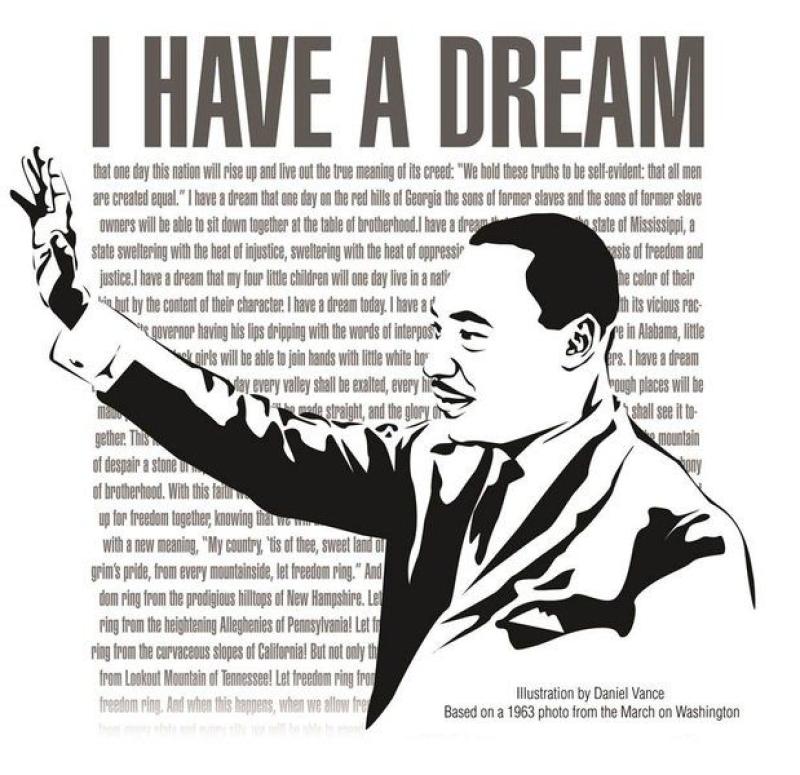
We are approaching the 55th anniversary of Dr. Martin Luther King Jr.'s famous "I Have a Dream" speech, delivered Aug. 28, 1963, in Washington, D.C.
Reading through the speech, it's hard not to be in awe, like those who stood and heard King then, by the greatness and truth of his words.
He captured with precision what America is about, what was wrong then, and what needed to be done.
And because timeless truth is what made that speech great, it is still relevant to today's considerable challenges.
This was not the speech of a political activist. This was a sermon of a pastor, enlightened and inspired by his God, to fix what was broken in America and lead us all to better world.
I see three great messages from King's speech that are important to grasp and apply today.
First, King said that they were in Washington that day to cash in and "demand the riches of freedom and the security of justice."
Second, he communicated that freedom and justice are of divine origin, as he quoted from the prophet Isaiah.
And third, of particular relevance and importance today, was King's appeal to not drink "from the cup of bitterness and hatred" and to "conduct our struggle on the high plane of dignity and discipline."
I doubt that there is anyone that would not recognize the widespread failure in today's America to honor this last appeal for civility. The level on which our national discourse is now taking place is disappointing.
And I would relate the widespread decline of mutual respect to the extent to which we have purged the presence of God -- as vital today as it was to King's message in 1968 -- from our nation's public spaces.
Looking over the last 55 years, there have been failures but also great successes regarding black life in America.
I think the successes tie to the extent to which black life has followed the principles that King laid out in the "I Have a Dream" speech, and the failures tie to departures from those principles.
A new study from the American Enterprise Institute in Washington, D.C., captures this.
The study, "Black Men Making It In America: The engines of economic success for black men in America," reports the good news that 57 percent of black men today have made it into America's middle class or higher, compared to 38 percent in 1960.
And that "the share of black men who are poor has fallen from 41 percent in 1960 to 18 percent in 2016."
What are the "engines of success" for black men, according to the study? In addition to higher education and full-time work, the study ties three institutions to successful black men -- military service, church attendance and marriage.
Fifty-four percent of black men who served in the military versus 45 percent who did not reached the middle class at midlife. Fifty-three percent of those who attended church at a young age, compared with 43 percent who did not, reached the middle class. And 70 percent of married black men, compared with 20 percent of never-married and 44 percent of divorced black men, are in the middle class.
Another critical factor is what the study calls "individual agency." This is the sense of personal responsibility for and control over one's life. Fifty-two percent of black men with a high sense of "agency," compared with 44 percent without, achieved at least middle-class status by age 50.
King did not lead a revolution. He led a national wake-up call. He pushed the nation to take responsibility for what it was and is -- a free nation under God.
And the justice he sought was that government secure life, liberty and property, in the name of freedom, for "all of God's children."
Tags
Who is online
88 visitors
King's 'I have a dream' speech did NOT 'appeal for civility'. I would suggest that the author and the seeder go read King's Letters from Birmingham for a better understanding of his position.
Be that as it may...one of the things that made King so famous was his insistence on non-violence. At the time there were many who were growing impatient and who really wanted to arm themselves and use violence "against the White man", (Of course if they did that there would be large massacres of African Americans-- a small minority of American against a YUGE and well armed police forces and the military).
There were many in the movement who advocated violence, and those who opposed violence. (They were for "civil disobedience" which is indeed breaking laws-- but doing it non-violently).
King's view prevailed-- and the Civil Rights act was passed. And it seems clear to me that that was why-- despite many other Civil Rights leaders-- King was the most prominent. And one of his main contributions to both the Civil Rights movement as well as the country as a whole was keeping it non-violent!
If King were alive today he'd be "taking a knee" on football Sunday to protest police brutality and the senseless murders of so many innocent black folks by cops.
And on the issue of non-violence King said this:
I was at UNC when Kennedy was assassinated. In fact my dorm was literally about a 2 or 3 minute walk from the statue of "Silent Sam"....which, ironically I notice was just torn down a day ago!
Police seek protesters who toppled Confederate statue in North Carolina
Reuters • August 21, 2018
About 300 demonstrators gathered on Monday evening for a protest and march at the base of Silent Sam, a memorial erected in 1913 to soldiers of the pro-slavery Confederacy killed during the Civil War. Protesters pulled the statue down with rope, cheering as it lay face down in the mud, its head and back covered in dirt.
The university system's board chair, Harry Smith, and president, Margaret Spellings, denounced the toppling of the statue in a joint statement.
At the time I was heavily involved in the Civil Rights movement (and in fact I did meet Dr King himself on one occasion).
The day JFK was assassinated, I had just walked out of my dorm building. Suddenly a cheer went up-- from all the dorms in the quad. I had often heard that sort of thing-- loud cheering all over campus whenever one of our sports teams scored a goal or basket (Interestingly, our football team didn't have a really big following-- but at UNC it was all about basketball).
But then I realized-- it was a weekday afternoon , and sporting events took place on weekends. I asked someone what the cheering about-- it was cheering at the death of RFK!
Which may give people here a sense of what the atmosphere was like at my school in 1963.
Dr. King (and Bobby Kennedy) were assassinated much, much later-- by that time I was no longer at Chapel Hill, and had turned my attention away from political activism.
Many people today don't understand his position. Yes, he understood the frustration of American Blacks (heck, he was one himself), And he understood why many wanted to use violence. However, on numerous occasions (particular addressing demonstrators before we went out to march), while he constantly mentioned he understood frustration and the urge to use violence, the use of violence was wrong. And it would sabotage our goals. And he repeated it over and over against to activists...
As time went on, and especially later in his life, frustrations grew-- and there were a good number of African Americans who sincerely felt that violence was necessary-- and in fact many didn't like King because he was so strongly against violence (and his POV won the arguments).
He preached Civil-disobedience-- which was indeed breaking the law. (For example sitting in at a whites only restaurant-- that was illegal). However, many poorly informed people today assume civil disobedience (deliberately breaking the law-- laws that were unjust) meant being violent. It does not-- just the opposite. Actually it was used as an alternative to violence, instead of violence.
One of King's contribution to the Civil Rights Movement-- perhaps even his single greatest contribution-- was putting the movement on a non-violent path. (had we instead used violent tactics, we would've failed....)
Then the accolades should go to Bayard Rustin since he was the one that conceived the idea of non-violent resistance and the SCLC, brought in King and counseled King on Ghandi's tactics.
JFK in 63.....RFK in what, 67 or 68. Either way, intolerable violence, regardless of who did it.
There's always been a debate within any civil rights movement as to what tactics are appropriate for any given circumstance, but note that the conservatives who oppose those rights will whine no matter what tactics are used. We see that today with their demonization of BLM.
For those who are interested, this video does an amazing job of capturing what it was actually like (the times and the Civil Rights Movement):
These people were taking a huge risk-- including risking their actual lives!
(Yes there was a lot of violence-- but please note who was perpetrating the attacks-- and who, despite all that-- remained non-violent!)
As it was then and as it is now, the conservatives and especially the right wing, thwarted, sabotaged and attacked everything Martin Luther King stood for.
"The decline of mutual respect," is the goal of divide and conquer right wing extremism. Its success is clearly evident for anyone who cares to look.
This 'seed' is puzzling.
This 'seed' is puzzling.
I've been participating in online discussions for many, many years. And over time I've noticed that with a few rare exceptions, all that most people care about is advancing their own personal political agenda! And in most cases its advancing their agenda...truth be damned! (which is why so much of what's posted on Internet discussion sites sucks...bigtime
I was in Vietnam when King and Kennedy were assassinated.
I was at UNC when Kennedy was assassinated. In fact my dorm was literally about a 2 or 3 minute walk from the statue of "Silent Sam"....which, ironically I notice was just torn down a day ago!
Police seek protesters who toppled Confederate statue in North Carolina
Reuters • August 21, 2018
About 300 demonstrators gathered on Monday evening for a protest and march at the base of Silent Sam, a memorial erected in 1913 to soldiers of the pro-slavery Confederacy killed during the Civil War. Protesters pulled the statue down with rope, cheering as it lay face down in the mud, its head and back covered in dirt.
The university system's board chair, Harry Smith, and president, Margaret Spellings, denounced the toppling of the statue in a joint statement.
At the time I was heavily involved in the Civil Rights movement (and in fact I did meet Dr King himself on one occasion).
The day JFK was assassinated, I had just walked out of my dorm building. Suddenly a cheer went up-- from all the dorms in the quad. I had often heard that sort of thing-- loud cheering all over campus whenever one of our sports teams scored a goal or basket (Interestingly, our football team didn't have a really big following-- but at UNC it was all about basketball).
But then I realized-- it was a weekday afternoon , and sporting events took place on weekends. I asked someone what the cheering about-- it was cheering at the death of RFK!
Which may give people here a sense of what the atmosphere was like at my school in 1963.
Dr. King (and Bobby Kennedy) were assassinated much, much later-- by that time I was no longer at Chapel Hill, and had turned my attention away from political activism and toward my academic studies.
Best comment of the day. Thanks, Krishna.
It was rather enjoyable to watch that and there's no doubt it pissed off a bunch of Trump voters.
Many conservatives like to claim MLK as one of their own while misconstruing what he said and stood for, and they do so despite the fact that conservatives frequently condemned MLK as a communist and a racial provocateur. I think he captured that dishonesty in conservatives here:
Yeah. Conservatism claims a lot of things. Explains nothing. Forgets everything. Blames anything and everyone for everything it fails to do.
White America does not delude itself. White America has allowed itself to be deluded.
"National discourse is disappointing." ? ? Of course. And thank the legitimization of Birtherism for that. Right into the White House.
Indeed. This 'seed' is puzzling.
I realize that most people on NT want to turn everything into proselytizing their political agenda. But if you read the part you quoted carefully, it deliberately does not say "conservatives"-- it talks about "White Americans". It refers to the majority of white Americans-- which means people of various political preferences-- both conservative and liberals.(Not extremists on either side-- but most Americans).
Many people today think the Civil Rights Movement of the 60's was about pressuring business (& governments) to desegregate. In some cases it was-- for example applying pressure on businesses in Atlanta to press the local gov't to desegregate bu applying pressure on them-- by a simple non-violent tactic. Blacks merely boycotted those business and they started to lose money...
That was applying a kind of pressure. But that's not the only thing the movement did. In fact, IMO, the main thing the movement was was-- was a giant PR stunt! ("Public Relations"). Its hard to believe today, but the vast majority of Whites outside the South back then actually didn't know how bad things actually were for Southern Blacks! So when King and other leaders insisted on complete non-violent actions such as peaceful marches, even peaceful sit-ins, he knew they would be met by horrible violence by the police. And that Revolution was televised. Northerners and other saw a certain type of scene unfold before their very eyes-- right on their TV. (Most people today don't have a good idea of what happend-- what people saw on TV. )
If you want to get a good idea, here's the best video I've found ).
60 years ago it was white Americans, today it's largely just conservatives who are the biggest impediment to civil rights. Of course there's still a great deal of overlap between the two groups like the fact that the vast majority of white men and the majority of white women voted in 2016 for a bigot who is clearly a racist, a misognynist, a homophobe, a transphobe, a xenophobe and an Islamophobe. Several post-election analyses show that white racial anxiety was the primary factor in a vote for Trump.
That's a myth. The studies after the election show that white racial anxiety was the leading factor and that economic issues were far down the list.
That's not surprising given that the racist King of the Birthers built his campaign on pandering to racists and xenophobes. Here's the latest study published in April of this year:
It must be tough to see that scientific studies consistently show racism is at the core of Trump voters' values, eh? No wonder they're so opposed to basic civil rights for all kinds of minorities from blacks to LGBT folks to refugees. It seems not much has changed about conservatives in the past 150 years other than their party affiliation.
And, fourth -
Despite the yearly celebrations of Martin Luther King Day and African American History Month, it is probably little known what the great freedom fighter had to say about the horrific mistreatment of Native Americans by the U.S. In his 1963 book, “Why We Can’t Wait,” writing about the origins of racism in this country, King strongly condemned the historic injustices inflicted on Native people. He wrote the following:
“Our nation was born in genocide when it embraced the doctrine that the original American, the Indian, was an inferior race. Even before there were large numbers of Negroes on our shores, the scar of racial hatred had already disfigured colonial society. From the sixteenth century forward, blood flowed in battles of racial supremacy. We are perhaps the only nation which tried as a matter of national policy to wipe out its Indigenous population. Moreover, we elevated that tragic experience into a noble crusade. Indeed, even today we have not permitted ourselves to reject or feel remorse for this shameful episode. Our literature, our films, our drama, our folklore all exalt it.”
Woefully, Dr. King’s words still ring true to this very day in so many respects. But King’s poignant words on the tragic history of Native Americans are largely unknown in mainstream society.
Dr. King had many things to teach us - sadly though, most of the teaching never reaches those that need it most.