
Billionaires v teachers: the Koch brothers' plan to starve public education



 S E E D E D C O N T E N T
A rizona has become the hotbed for an experiment rightwing activists hope will redefine America’s schools – an experiment that has pitched the conservative billionaires the Koch brothers and Donald Trump’s controversial education secretary, Betsy DeVos, against teachers’ unions, teachers and parents. Neither side is giving up without a fight.
With groups funded by the Koch brothers and DeVos nudging things along, Arizona lawmakers enacted the nation’s broadest school vouchers law, state-funded vouchers that are supposed to give parents more school choice and can be spent on private or religiously affiliated schools. For opponents, the system is not about choice but about further weakening the public school system. A half-dozen women who had battled for months against the legislation were angry as hell.
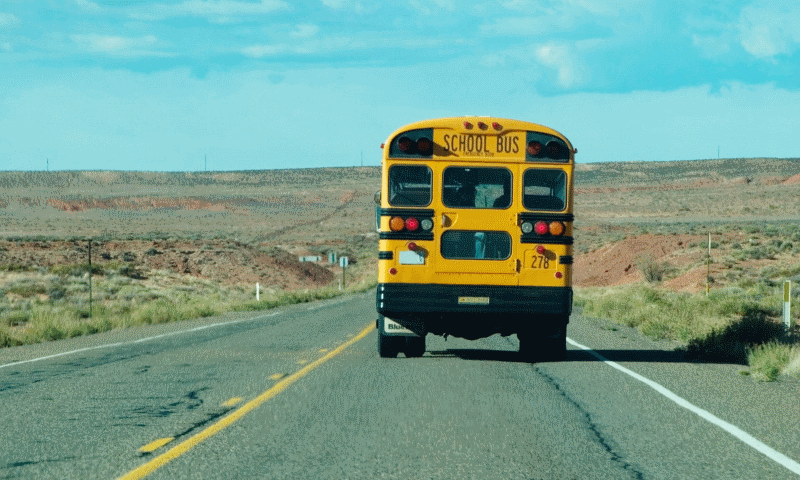
where 90%-plus of students go,’ according to the Arizona teachers’ union. Alamy
Convinced that the law would drain money from Arizona’s underfunded public schools, these women complained that Arizona’s lawmakers had ignored the public will and instead heeded the wishes of billionaires seeking to build up private schools at the expense of public schools.
“We walked outside the Capitol Building, and we looked at each other, and said, ‘What now?” said one of the women, Dawn Penich-Thacker, a mother of two boys in public school and a former army public information officer. “We had been fighting this for four months. We realized that there’s something we can do about it. It’s called a citizens’ referendum. We said, ‘Let’s do it.’”
Little did they know the challenges ahead. They would need 75,321 signatures to get their referendum on the ballot to overturn the law. They formed a group, Save Our Schools, and set out to collect the needed signatures. Opposing lobbyists sneered, saying no way could they do that.
The six women inspired a statewide movement and got hundreds of volunteers to brave Arizona’s torrid summer heat to collect signatures – in parks and parking lots, at baseball games and shopping malls. Their message was that billionaire outsiders were endangering public education by getting Arizona’s legislature – in part through campaign contributions – to create an expensive voucher program.
“We knew something was rotten in the state of Arizona,” said Beth Lewis, a fifth-grade teacher who is president of Save Our Schools. “We drew a line in the sand. We said, ‘We’re not going to let this happen.’” Lewis said Arizona’s schools are so underfunded that some classes have 40 students and her school needs to ask a private citizen to donate money when a teacher needs a set of books for her class.
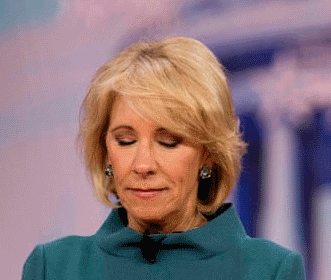
is a firm proponent of school vouchers.
Jim Watson/AFP/Getty Images
One study found that Arizona, at $7,613, is the third-lowest state in public school spending per student, while another study found that from 2008 to 2015, school funding per pupil had plunged by 24% in Arizona, after adjusting for inflation – the second-biggest drop in the nation.
Upset that the vouchers law would funnel money toward private schools, Lewis said: “We can’t fund two different school systems. We can hardly afford one.”
Save our Schools submitted 111,540 signatures to the secretary of state in August 2017, but the Koch brothers’ political arm, Americans for Prosperity, sued to block the referendum. A judge dismissed the lawsuit and approved the referendum for 6 November – it’s called Proposition 305 . The vote will be closely watched by people on both sides of the debate as the Kochs and DeVos hope to spread the voucher scheme and opponents look to Arizona for clues on how to stop them.
Arizona’s state supreme court declared an earlier voucher law unconstitutional in 2009 because it earmarked state money for private and religious schools. Two years later, the Arizona legislature enacted a variant on vouchers, called Empowerment Scholarship Accounts, that gave prepaid bank cards to parents who transferred their children from public schools to home-schooling or private or religious schools. The cards paid for tuition, tutoring, textbooks and education therapies. That 2011 law limited eligibility to children with disabilities, children of veterans, children on tribal lands and children attending schools that received D or F ratings.An Arizona appellate court upheld those accounts, known as ESAs, ruling that they did not violate the state constitution because the money went to parents and was not “preordained” for private or religious schools.
But many Arizonans see the ESAs as vouchers in disguise. “It’s money laundering,” said Penich-Thacker, who teaches English at Arizona State University. “Instead of handing those tax dollars to private schools and religious schools, the government loads the money on to a debit card, hands it to individual parents, and however you use this, we’re looking in the other direction.”
In April 2017, with Penich-Thacker, Lewis and many other champions of public schools objecting, the Arizona legislature enacted a law that expands eligibility so that any of the state’s 1.1 million public school students can qualify for an ESA. Some lawmakers feared it would cause a devastating exodus from Arizona’s public schools, so, in a compromise, the legislature capped the number of ESAs at 30,000 students.
Kim Martinez, spokeswoman for the American Federation for Children, a school choice group founded by Betsy DeVos, defended the law. “They’re not vouchers because the money is going to the families,” she said. “We’re trying to make it easier for families who cannot afford school choice to have access to it. What happens if low-income families can’t afford private school, but their child [in public school] is failing or falling through the cracks or being bullied or, for whatever reason, they’re not doing well.”
Martinez said critics are wrong to assert the law’s purpose is to drain funds from – and weaken – public schools. “We’re for higher teacher pay. We’re for proper school funding, and equally important is having whatever option families need, regardless of the income level of the zip code they live in, to get their kids the best education and meet their needs.”
Ramona Carrasco, a supervisor at a cleaning company, said the ESAs have been a blessing, enabling her to send Byanca, her nine-year-old daughter with Down syndrome, to a private school. Byanca had gone to public school for two years, but “it broke my heart when I saw her playing by herself. I couldn’t take it,” Carrasco said. She said Byanca is much happier and learning far more at her new school, Pleasantview Christian elementary school in Phoenix.
“I think all families should have the same choice that Byanca has because we want our kids to succeed,” Carrasco said.
Governor Douglas Ducey is also eager to preserve the ESA law. He told a gathering of Koch donors : “I didn’t run for governor to play small ball. I think this is an important idea.”
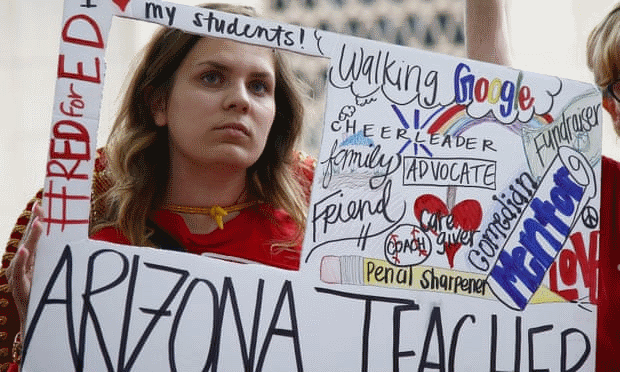 Striking teacher Taylor Dutro listens at the Arizona Capitol on 1 May in Phoenix. The teachers’ union back Saves Our Schools effort to overturn the voucher law. Photograph: Ross D Franklin/AP
The teachers’ union strongly backs Save Our Schools’ effort to overturn the law. “The Koch brothers and DeVos are trying to do everything they can to divert money that should go to the public-school system, where 90%-plus of students go,” said Joe Thomas, president of the Arizona Education Association. Last April, tens of thousands of Arizona teachers went on strike for six days to demand higher pay and school funding. Ducey promised them a 20% raise by 2020, but convinced that he did not put enough money into the budget to finance those raises, the teachers’ union got a second referendum on the ballot that would increase income taxes on richer households to raise over $600m a year for education.
The Arizona Supreme Court threw it off the ballot last Wednesday, with the union calling it a Ducey-backed “low blow” that cheats voters out of the opportunity to increase education funding.
Lily Eskelen Garcia, president of the National Education Association, said what has happened in Arizona is part of a scheme to undermine public education. “We know exactly how the plan goes,” she said. “You underfund the kids who need the most. You starve the public schools. You take away the funding so they can’t deliver quality services, and then when things get so bad that nobody wants to work in the schools, the voucher salesmen, the vultures, swoop in and do this nice little bait and switch. Instead of fixing the schools, they say let’s make sure you have the same program as wealthy kids at private schools.” But vouchers, she said, don’t begin to deliver on that promise.
Americans for Prosperity argues that the Arizona law isn’t draining money from public schools. Its officials note that the average ESA is about $4,500 – roughly the tuition at many private schools in Arizona – leaving public schools with extra money because the $4,500 is thousands of dollars less than the average those schools spend per student.
The Koch-funded Americans for Prosperity and the DeVos-backed American Federation of Children have pushed for vouchers in many states. They helped get an Arizona-like education savings account law passed in Nevada in 2015, but that state’s supreme court ruled it unconstitutional. In 2007, Utah voters voted 62% to 38% to repeal a vouchers law.
Victor Riches, president of the Goldwater Institute, a conservative thinktank in Phoenix, denied that ESAs were foisted on Arizona by outside billionaires. “School choice is an issue that we’ve been extremely supportive of – we started working on it many years ago,” Riches said. “It’s important that parents have as many educational options as possible so they can create the best possible education for their children.”
Save Our Schools notes, with dismay, that the Goldwater Institute has said it hopes to eliminate the 30,000 cap and greatly expand the ESA law. That fear has fueled the repeal effort.
“We set out to do something that everybody said is impossible,” Lewis said. “The women on our team are very tenacious.”
Tags
Who is online
124 visitors
Well... of course!
Why shouldn't DeVos and the Koch brothers do as they please? The country belongs to them, after all....
Sadly the DeVos and Koch of the world seem to forget that the public school system is one of the reasons that American is as great as it is.
IMO, one of the great disadvantages of the current source of funding for our public school system is that the money comes from property taxes. That in itself creates a have and have not system of public schools.
Allowing these vouchers to be used with religious schools, is IMO, unconstitutional as can be.
Why would they think that?
Their children don't attend public schools.
Why, its their property tax dollars as well ....
It's also my property tax dollars on each piece of property that I own...
As it is with them .....
Meh. I'm not a voucher supporter, but I don't think there is a constitutionality issue. You can use a Pell grant or a TEACH grant at Baylor or Texas Wesleyan or Emory or Notre Dame, so there is certainly precedent for using public money to pay for private, religious education.
That doesn't make it necessarily a good idea at the K-12 level.
To my knowledge the voucher for religious schools has not been used at the K-12 level.
School vouchers for religious schools was declared unconstitutional in Florida around 2006.
IMO, there would be numerous lawsuits if this voucher program for religious schools was instituted.
The John Birch Society tag team dumped a bunch of cash into my state 3 years ago trying to save the bible thumping scum on 2 school board recalls in 2 [deleted] counties in the metro area [deleted] had majorities on both boards and decided to break the law by having school board meetings without notifying the other board members or parents. They thought that would be the easiest way to discontinue college history and science AP classes in high schools and fund some religious based charter schools. Luckily, the conservative voter majorities in both counties were able to utilize death threats against the rogue Koch backed board members and their children that attended school in those districts, making their election campaign appearances scarce. Ultimately every [deleted] was recalled and they and their defective spawn moved out of the school districts to get in on the charter school bankruptcy scams somewhere else more receptive to having teavangelical madrasas instead of public schools. I was briefly very proud of those Republican voters.
[deleted]
totally worth it. bwah ha ha
I think it will certainly do that, and that's probably a good thing. The fact that a voucher system could do that speaks to the vulnerability and inadequacy of the public school system. With no competition, public schools need only be "good enough" to survive. There are no market forces driving them to excel. If it were truly the best option for the most kids, there would be no problem. I.e., parents would choose public schools. As it happens, the public schools in our local district are outstanding and so I have little thought of putting the kids in private schools.
I hear a lot about preserving the public school system and funding. What I don't hear from voucher opponents is how much better public school is than alternatives. I have to assume that's because it's not true.
Charter schools at best do no better and often more worse in terms of achievement testing than regular public schools in their areas:
Add to that the many cases of charter school corruption:
and then the fact that the idiot who runs the DoEd, DeVoss was a product of elite private schools and is dumber than a bag of hammers and it's really another case of a massive failure of social engineering, rightwing style.
Or....actually.....many of them do much better.
More than twice as many do worse and this is your take-away? No wonder you think a class A moron and kook like DeVos is just right for the job.
My takeaway is that you're once again regurgitating a predictable, tedious, party-approved opinion..... while citing a source that directly contradicts your own assertions.
You have now followed that up with another utterly predictable, tedious, so unoriginal it could be copied from the "College-Freshman-Who-Knows-Everything Playbook" assumption about what I must believe.
Issues are never binary, people are not caricatures, and life is not a giant cliche. There are more things in heaven and earth than are dreamt of in your philosophy.
Translation: I hate it when someone puts up facts
Translation: I hate it when someone uses math
Here's the difference between the two approaches. Enemies of the voucher system don't want to subsidize any alternatives to public schools because those alternatives are only better some of the time. Conversely, proponents of vouchers want to make them available to all so that all choices are on the table for parents. Here is an issue that actually is about choice and the leftists want to eliminate choice in favor of the government program.
And consider those numbers:
That means 63% (17+46) of charter schools performed about as well or better than public schools. Isn't that worth encouraging?
Tracking "charter schools" doesn't even get into many of the private schools - secular and religious - (charter ≠ all the private schools) and we know they often do better than public schools.
How I love to get a rightwinger into an arithmetic debate. I raise your 63% of "about as well or better" to 83% (37+46) of voucher schools perform only as well or worse than public schools (see how arithmetic works, Tacos?). Education is not about "giving parents what they want." That's what home schooling is for. Taking money away from public schools just because a bunch of new agers or holy rollers want to control what their kids get to learn is theft of public resources.
Right, but I'm talking about sharing resources and giving people choice based on the numbers. That's in line with our values of free market competition and choice. By contrast, you want to force your way on everyone, not sharing resources, and your feeble excuse is "some do worse."
My way is about freedom and giving all options the chance to do their best for our kids. Your way is totalitarian and is about protecting government institutions while discarding options that will work for some, and rejecting a system that will promote excellence. Your way also keeps in place a system where only the rich have access to the very best education and the poor will be forced to attend failing public schools, cleaving to the government teat dispensing sour milk. (Oooh, I'm poetic today!)
We're on another one of these situations where you've messed up your argument and been caught...this time contradicting your own citation.
I realize you'll never admit that, and your personal attacks are as predictable as your party line playbook.
And charter schools are losing propositions on both counts. The charter system was never a choice to have net worse outcomes than public schools yet that's what it's produced. If people want the choice to educate their kids poorly they can do it at home and not at the expense of the public. But here's what could be done: automatic shut-down of all under-performing and "good as" charter schools but allow the small percentage that do out-perform public schools remain. Any new charter school has just two years to show it better, not just "as good," results on standardized testing and the loss of its charter if not. A 37% failure rate is intolerable (except to rightwingers for some "reason").
Sounds like you're advocating for pulling funding from poorly performing public schools and you want to force parents in those neighborhoods to educate their kids at home. Isn't that the logical consequence of what you just said? Or does this "excel or die" policy only apply to charter schools? Why should that be? Why does the crappy government school get an automatic pass?