
Trump says response to Puerto Rico storm 'underappreciated'

 S E E D E D C O N T E N T

Trump says response to Puerto Rico storm 'underappreciated'
 JONATHAN LEMIRE and LAURIE KELLMAN, Associated Press 1 hour 21 minutes ago

WASHINGTON (AP) — President Donald Trump said Wednesday the government is ready for massive Hurricane Florence and insisted that his administration's response to the devastation in Puerto Rico last year was an "underappreciated great job."
In a series of morning tweets as Florence bore down on the Southeast U.S. coast, Trump bristled over criticism of the response to Hurricane Maria, in which 3,000 people died in Puerto Rico.
"We got A Pluses for our recent hurricane work in Texas and Florida (and did an unappreciated great job in Puerto Rico, even though an inaccessible island with very poor electricity and a totally incompetent Mayor of San Juan). We are ready for the big one that is coming!" Trump tweeted.
His next dispatch warned people about Florence, predicted to dump massive amounts of rain on the already-soggy Southeast later this week.
"Hurricane Florence is looking even bigger than anticipated. It will be arriving soon. FEMA, First Responders and Law Enforcement are supplied and ready. Be safe!"
The administration's efforts in Puerto Rico received widespread criticism, and he battled with Mayor Carmen Yulín Cruz. But after visiting the island last September, Trump said that Puerto Ricans were fortunate that the storm did not yield a catastrophe akin to the havoc wreaked by Hurricane Katrina along the Gulf Coast.
All told, about 1,800 people died in that 2005 storm. Puerto Rico's governor last month raised the U.S. territory's official death toll from Hurricane Maria from 64 to 2,975. The storm is also estimated to have caused $100 billion in damage.
A day earlier, the president praised the response to the series of storms. "I think Puerto Rico was an incredible, unsung success."
The governor of Puerto Rico, Ricardo Rossello, seized on Trump's use of the word "successful" and said in a statement issued later Tuesday: "No relationship between a colony and the federal government can ever be called 'successful' because Puerto Ricans lack certain inalienable rights enjoyed by our fellow Americans in the states."
Rossello called Hurricane Maria "the worst natural disaster in our modern history" and said work still remained before they could move on to other stages of recovery. He also said he was still waiting for Trump to respond to a petition to help Puerto Rico complete work on emergency housing restoration programs and debris removal.
Trump, having long struggled to express empathy at times of national crises, sparked outrage when during his visit to the island he feuded with the mayor of San Juan and passed out paper towels to victims like he was shooting baskets.
While defending the handling of the previous storm, he urged caution in regards to the new one bearing down on North Carolina, South Carolina and Virginia.
"The safety of American people is my absolute highest priority," Trump told reporters in the Oval Office. "We are sparing no expense. We are totally prepared. We are ready. We are ready as anybody has ever been."
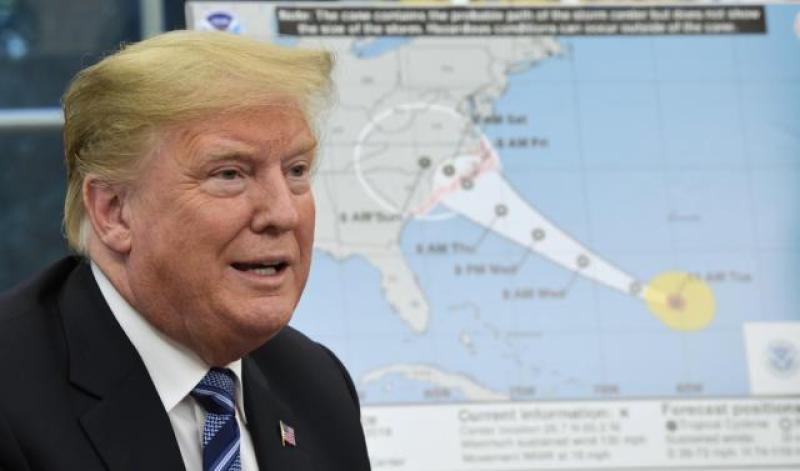
The president, flanked by maps of the storm and the heads of the Department of Homeland Security and the Federal Emergency Management Agency, said Florence was unlikely to change course before it is expected to make landfall with 130 mph winds and potentially ruinous rains in the coming days.
"They haven't seen anything like what's coming at us in 25, 30 years, maybe ever," Trump said of the states in the storm's path. "It's tremendously big and tremendously wet. Tremendous amount of water."
Florence was expected to blow ashore late Thursday or early Friday, then slow down and wring itself out for days, unloading 1 to 2½ feet (0.3 to 0.8 meters) of rain that could cause flooding well inland and wreak environmental havoc by washing over industrial waste sites and hog farms. North and South Carolina and Virginia ordered mass evacuations along the coast.
___
Associated Press writer Ken Thomas contributed to this report.
___
Follow Kellman and Lemire on Twitter at http://twitter.com/@APLaurie Kellman and http://twitter.com/@JonLemire
Tags
Who is online
119 visitors
The Federal Governments response to the natural disaster in Puerto Rico was pitiful and Trump giving himself an A+ for what happened after the hurricane was just a vile, grotesque thing to watch.
How Trump favored Texas over Puerto Rico
.
The U.S. Betrayal of Puerto Rico by the Numbers
Bwaaaaaaahadehaha.
From Splinter ..... a heavily left leaning propaganda outlet.
Splinters liberal a-go-go
Take that disingenuous data to the bank only if you are a worker drones from the hive and/or a total idiot.
I think it was George Orwell's 1984 ...... no, that was Groupthink ..... but it amounts to the same thing really.
You have conservative pundits on the mind apparently. [deleted]
Some folk really need to unstitch themselves from the Trump human centipede.
If you're not happy with the truth being brought to you by the two sources I linked earlier then, by all means, go straight to the GAO report that highlighted how much the Federal response was ANYTHING OTHER than a A+, unsung success that our buffoonish, Narcissist in Chief calmed it to be.
If the GAO pdf is too confusing here's a couple of links to summaries of the reports findings.
Federal report criticizes FEMA's response to Hurricane Maria in Puerto Rico
.
Watchdog Slams FEMA for Puerto Rico Hurricane Response
I guess you are okay with this line of off topic discussion on your thread eh? Okay ....
I'm sure you do but i wasn't talking about Nora Roberts novels. I thinking more in terms of classics like 1984. Although there isn't really any need to read that book today since we are actually watching much of it happen real time.
Maybe Florence will take a hard left and head north....to DC
The Trump Administration has taken $ 39 million from FEMA and the Coast Guard to fund ICE detention centers for more incarcerations of immigrant children and families.
These are the two entities most crucial in disasters like the one facing the Carolinas!
How many more lives will be ruined or lost because of Donald Trump?
Abolish the unconstitutional fema. That is a 10th Amendment issue