
Arms sales to Saudis leave American fingerprints on Yemen’s carnage


 S E E D E D C O N T E N T
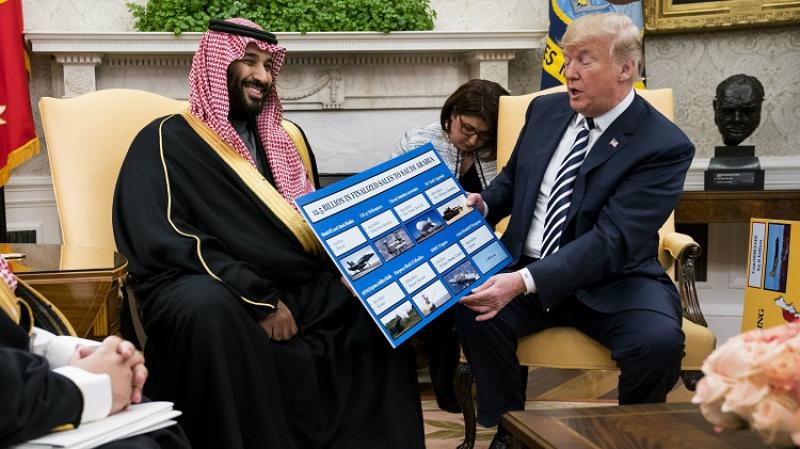
President Donald Trump discusses weapons sales during a meeting with Crown Prince Mohammed bin Salman of Saudi Arabia in Washington on March 20, 2018.New York Times News Service
When a Saudi F-15 warplane takes off from King Khalid air base in southern Saudi Arabia for a bombing run over Yemen, it is not just the plane and the bombs that are American.
American mechanics service the jet and carry out repairs on the ground. American technicians upgrade the targeting software and other classified technology, which Saudis are not allowed to touch. The pilot has likely been trained by the US air force.
And at a flight operations room in the capital, Riyadh, Saudi commanders sit near US military officials who provide intelligence and tactical advice, mainly aimed at stopping the Saudis from killing Yemeni civilians.
US fingerprints are all over the air war in Yemen, where errant strikes by the Saudi-led coalition have killed more than 4,600 civilians, according to a monitoring group. In Washington, that toll has stoked impassioned debate about the pitfalls of America’s alliance with Saudi Arabia under Crown Prince Mohammed bin Salman, who relies on US support to keep his warplanes in the air.
Saudi Arabia entered the war in 2015, allying with the United Arab Emirates and a smattering of Yemeni factions with the goal of ousting the Iran-allied Houthi rebels from northern Yemen. Three years on, they have made little progress. At least 60,000 Yemenis have died in the war, and the country stands on the brink of a calamitous famine.
For US officials, the stalled war has become a strategic and moral quagmire. It has upended the assumptions behind the decades-old policy of selling powerful weapons to a wealthy ally that, until recently, rarely used them. It has raised questions about complicity in possible war crimes. And the civilian toll has posed a troubling dilemma: how to support Saudi allies while keeping the war’s excesses at arm’s length.
In interviews, 10 current and former US officials portrayed a troubled and fractious American response to regular reports of civilians killed in coalition airstrikes.
The Pentagon and State Department have denied knowing whether US bombs were used in the war’s most notorious airstrikes, which have struck weddings, mosques and funerals. However, a former senior State Department official said that the US had access to records of every airstrike over Yemen since the early days of the war, including the warplane and munitions used.
At the same time, US efforts to advise the Saudis on how to protect civilians often came to naught. The Saudis whitewashed an American-sponsored initiative to investigate errant airstrikes and often ignored a voluminous no-strike list.
“In the end, we concluded that they were just not willing to listen,” said Tom Malinowski, a former assistant secretary of state and an incoming Democratic member of Congress from New Jersey. “They were given specific coordinates of targets that should not be struck and they continued to strike them. That struck me as a willful disregard of advice they were getting.”
Yet American military support for the airstrikes continued.
While US officials often protested civilian deaths in public, two Presidents ultimately stood by the Saudis. President Barack Obama gave the war his qualified approval to assuage Saudi anger over his Iran nuclear deal. President Donald Trump embraced Prince Mohammed and bragged of multibillion-dollar arms deals with the Saudis.
As bombs fell on Yemen, the United States continued to train the Royal Saudi Air Force. In 2017, the US military announced a $750 million programme focused on how to carry out airstrikes, including avoiding civilian casualties. The same year, Congress authorised the sale of more than $510 million in precision-guided munitions to Saudi Arabia, which had been suspended by the Obama administration in protest of civilian casualties.
Nearly 100 US military personnel are advising or assisting the coalition war effort, although fewer than 35 are based in Saudi Arabia.
US support for the war met stiff headwinds this Fall, when congressional fury over the killing of Saudi dissident Jamal Khashoggi combined with worries over civilian deaths in Yemen.
In response, the Trump administration ended American air-to-air refueling of coalition warplanes over Yemen in November but has otherwise continued to support the war. This month, the Senate voted to end American military assistance to the war altogether, a sharp rebuke to the Trump administration, but the bill died when the House refused to consider it.
The civilian toll is still rising. According to the Armed Conflict Location and Event Data Project, November was the most violent month in Yemen since the group began tracking casualties in January 2016. There were 3,058 war-related fatalities in November, it said, including 80 civilians killed in airstrikes.
“There was a belief that these countries wouldn’t end up using this equipment, and we were just selling them expensive paperweights,” said Andrew Miller, a former State Department official now with the Project on Middle East Democracy.
Then came Prince Mohammed bin Salman.
When the prince, then the Saudi defence minister, sent fighter jets to Yemen in March 2015, Pentagon officials were flustered to receive just 48 hours’ notice of the first strikes against Houthi rebels, two former senior US officials said. American officials were persuaded by Saudi assurances the campaign would be over in weeks.
But as the weeks turned to years, and the prospect of victory receded, the Americans found themselves backing a military campaign that was exacting a steep civilian toll, largely as a result of Saudi and Emirati airstrikes.
US military officials posted to the coalition war room in Riyadh noticed that inexperienced Saudi pilots flew at high altitudes to avoid enemy fire, military officials said. The tactic reduced their risk but transferred it to civilians, who were exposed to less accurate bombings.
Coalition planners misidentified targets and their pilots struck them at the wrong time — destroying a vehicle as it passed through a crowded bazaar, for instance, instead of waiting until it reached an open road. The coalition routinely ignored a no-strike list — drawn up by the US Central Command and the United Nations — of hospitals, schools and other places where civilians gathered.
Tags
Who is online
116 visitors