



From his perch behind sandbags on a last approach towards Mosul, Captain Ibrahim of the Kurdish Peshmerga lives and breathes his enemy.
Down the hill, around a mile across an open plain, Islamic State (Isis) gunmen hide in a partly-ruined village. At least a half dozen times a day, they drive a flatbed truck from a hiding spot and send a large mortar arcing towards the Kurds.
Theyre good, Ibrahim said with a wince, seconds after a shell thumped into the dirt just outside his outpost. Theyre very good. The Iraqis have taught them well.
In between the Kurds and their enemy, two dead gunmen lie in no-mans land. They tried to attack us last night, he said. The scent of death wafts on the breeze. They are Chechens. Terrorists from everywhere are being hosted in those villages, and theres only us to stop them.
We asked the UK for weaponry from Afghanistan. We were prepared to buy it, but it is sold elsewhere and denied to us
Kurdish leader Masrour Barzani
Beyond the village, at what the Kurds call Kiske junction, is the Isis heartland, a 12-mile stretch of farms and villages that spreads towards Mosul and then beyond into Anbar province and west into Syria.
One leg of the spring offensive touted by Washington to push the gunmen from Iraqs second biggest city will likely start from here, but those doing the bulk of the fighting now are far from convinced that they should also be the ones to go further.
What to do about Mosul looms as a seminal moment both in Kurdish history and in more recent faltering steps towards nation building - a fact that Kurdish leaders are adamant that its allies should acknowledge upfront.
We are not naive, said the chancellor of the Kurdish region security council, Masrour Barzani, from his position an hour or so away from the front lines. We are very careful not to take any Arab lands. We are not going to go into Mosul alone. We are not agents.
We asked the UK for some of their weaponry from Afghanistan, said Barzani. We were prepared to buy it, but instead we find it is being sold elsewhere and denied to us.
Britain has sent the Peshmerga 40 heavy machine guns and ammunition, but has denied other requests, insisting privately that will channel its deliveries through Iraqs central government.
Kurdish leaders seethe at the decisive weaponry sent to Baghdad in recent months, much of which is being used to replaced six divisions worth of trucks and tanks that were abandoned when the Iraqi army fled the north of the country in June.
Isis promptly looted more than 200 armoured troop carriers, more than 1,000 humvees and several dozen US battlefield tanks, and have used them ever since to menace Iraqs army and the Peshmerga.
Iraqs western partners fear that sending weapons to the Kurds could give real impetus to frequent talk of sovereignty at the expense of Iraq - the current borders of which they remain committed to, even as the post-Ottoman boundaries of the modern Middle East continue to wither.
Such a view is derided in Irbil and across much of the north. Were fighting a war for a country that we are not a part of, and that we have no future in, said Falah Fikri, a businessman in Irbil. We are in this state because the Iraqi army collapsed, and we are told to believe in them?
In six months of fighting against Isis, Kurdish leaders have already faced a series of reckonings: what to do about the contested city of Kirkuk, which they now control after the Iraqi army abandoned it in June; how to defend their seat of government, Irbil, which was nearly stormed by the jihadis two months later; and what the collapse of Iraq meant for their ambitions to etch a sovereign state from its ruins.
As US war planners tout plans for 25,000 men - 12 Iraqi brigades, three of them Peshmerga - to launch a final battle in April, Iraqs Kurds are trying to set their own rules of engagement.
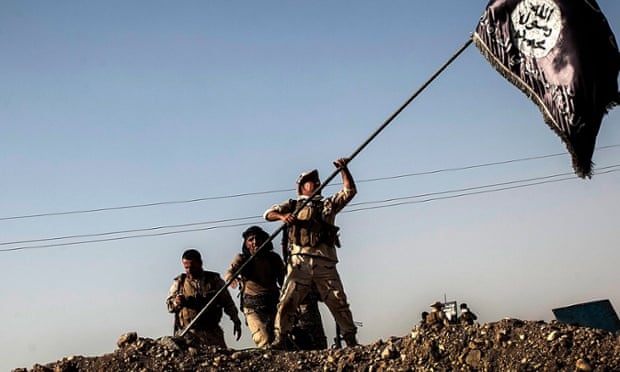
Kurdish border police take down an Isis flag after taking control of Yangija village in September last year. Photograph: Erin Trieb/Erin Trieb/Corbis
The Peshmerga have lost more than 1,000 members since August, with more than 4,500 others injured. The battle ahead will certainly add to that. Since early February, Kurdish forces have recaptured roughly 400 square miles of land seized by Isis, including the Mosul dam, which supplies water to most of Iraq. And what do you get for all of that? asked Barzani. We have redrawn the Kurdish borders with our own blood.
Kurdish advances have been secured by a US-led air campaign, which was particularly effective around the Mosul dam. From the giant waterway, built during the Saddam years, to the front lines, hundreds of concrete homes lie in ruins. Many have clearly been hit by air strikes, but others were dynamited as Isis retreated. Large yellow diggers gouge trenches from green fields, which will act as defensive positions if the jihadis try to reclaim their losses.
Much of the front line fighting appears to be a throw back to bygone eras of warfare. The Peshmerga have enough Kalashnikovs and ammunition, but their pleas for heavy battlefield weapons that could help them make more gains have been rejected by the US, Britain and other European allies.
Barzani bristles at the notion that the Peshmerga may use any new weapons to conquer Mosul, or lands closer to Kirkuk that are more central to the Kurds ancestral claims.
The east bank of Mosul is part of Kurdistan, but we are not claiming that, he said. We will go as far as we are welcomed into all those areas that are part of the greater Kurdistan. Anything above the Tigris river, we have taken it, but we are not aspiring to a greater Kurdistan. We are talking about Iraqi Kurdistan. We have to convince the countries that we live with that it is in the interests of everybody. We have to convince Baghdad through an understanding.
Kurdish Iraq has for too long been a taboo that we can not even talk about. For Iraq [the Kurdish north] is just an economic base. But we dont need Kurdistan for its economic value. This land is ancestral.
Waiting for the local forces to fight Isis is going to give them the option to grow, reorganise, recruit and be a constant threat to the region and the rest of the world. To defeat Isis requires a lot more engagement, to send troops and to give the right equipment to the forces who are defeating them, and that is the Kurds. There is no excuse not to arm the Kurds. No justification.
As bullets ping past the Kiske junction outpost, Ibrahim points to the skies. The roar of a jet comes into earshot. I called them a while ago, he said. They need to deal with that mortar. We dont have any trouble getting them to help, but we would rather do it ourselves.
We are operating in areas where we cannot trust the people. It is very hostile. The villages dont likes us, even though we are helping them, he said. Ill give you an example. When we arrived here we found a boy with a phone. He was telling [Isis] our positions. I told my commanders and they said to let him go.
A few weeks later, we went back to that village and were giving them food. That same boy was at the front of the line. We told the locals and they started throwing shoes at him. Maybe now they know were on their side, but we can never believe it.
Another Peshmerga unsheathed an Italian supplied rocket, part of a small cache sent by Rome several days earlier. This is what we need, he said. But it wont get us to Mosul.
Sipping a coffee in his dugout, brahim said: You know, were puzzled being out here with such a lack of support. Why is this happening? We like freedom. We are just like you. We want what you have.
The Kurds make a lot of good points in this article.
Find a way to get them heavy weapons. Just do it!!!!
Let them carve out their own area and declare sovereignty. Why not? At least they seem as though they would defend it to the death, not throw down their arms and run. If they are fighting ISIS, sell them the weapons... we seem to be selling them to just about everyone else.
''we seem to be selling them to just about everyone else.'' That is for sure Mimi. I found it interesting in the article that the Kurds offered to buy weapons from the British, but the Brit's would not sell them weapons, and in turn sold to others.
In just about every article I've read lately, the Kurds have been acknowledged as courageous fighters who have been holding their own against ISIS with weapons that are far outdated and have been nothing less than miraculous in their ability to do so.
We have sold weapons to rebels in Syria who watchers have said turned them on civilians, reporters, and prisoners. We sold weapons to Iraquis who threw them down and left them for ISIS to pick up and use. We gave weapons to our own soldiers who gave them over to the enemy who were running us out of a country our people have fought for and died in. We gave weapons and training to people who turned those weapons on us after pretending to be our allies.
The Kurds are fighting what the rest of the civilized world has said is the greatest threat facing all of us right now. Why can't they have the weapons to do it? They aren't asking for the ability to make nuclear missiles.... are they?
I think it is very short-sighted to NOT sell them weapons. I know we have rules about selling to only sovereign nations-- but let them fight and own their own country. They have been good allies, and we will help ourselves both now and down the road if we help them.
Now I know what our friend who owns a machine gun can actually do with it-- send it to them...
No, they are not asking for nuclear missiles Mimi.
They are more than holding their own against ISIS, they are winning many of the battles.
Excellent point about the rest of the world saying that IS is the greatest threat facing all of us right now. Yet the ground battle is mostly Kurds and Syrian Rebels doing all the fighting.
I agree Dowser, than are more than willing to fight, and have proven to be the most effective ground force there. Send them weapons.