
Israeli Company Wins Award, Grants for Creating Synthetic Fuels from Industrial Waste


January 17, 2015
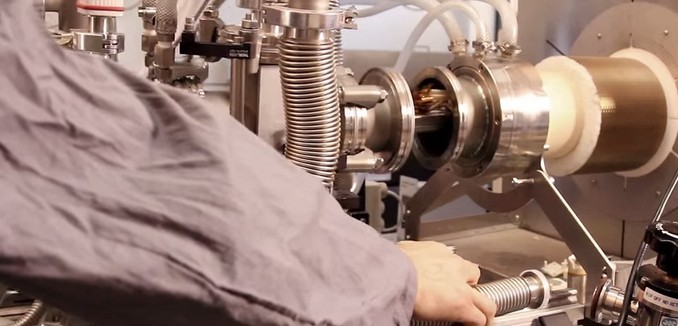
Heavy industries generate a lot of heat and emit a lot of CO2 to the atmosphere. An Israeli startup, NewCO2Fuels (NCF) turns these two streams of waste into profitable products and recently won an award and two major grants for its innovation.
For millions of years, plant life has been turning water and carbon dioxide (CO2) into energy. Today, many entrepreneurs are copying natural photosynthesis to find a good use for the dangerously excessive CO2 in our air. But these solutions arent widely adopted by industry without government incentives to offset their cost.
NCF has developeda technology that transforms industrial water and CO2 waste into a hydrogen-carbon monoxide synthetic gas or syngas for short. That syngas is then turned into profitable products such as liquid fuels, plastics and fertilizer.
Its not only an attractive business model but also sustainable, as the conversion process is fueled by concentrated solar energy or byproduct heat from the industries themselves.
There are a lot of industries using high-temperature heat to produce things like steel, glass and cement, by burning fossil fuel, explains CEO David Banitt. They waste a lot of heat and emit a lot of CO2 to the atmosphere. We take these two streams of waste and turn them into profitable products.
This unique advantage explains why the three-year-old company is so hot right now.
NCF won the only international prize in the corporate energy category at the 2014 World Technology Network Awards in New York, in association with Fortune and TIME. And the Australian government recently chose NCF syngas as one of 18 fuels of choice for the coming five decades.
The 15-person company has won a grant from the US Department of Energy for a collaboration with Alstom Power and Illinois Clean Coal Institute, as well as grants from the Israeli ministries of energy and economy, and a $1 million grant from BIRD (Binational Industrial Research and Development) Foundation one of only five projects selected in 2014 to receive funding under the BIRD Energy program.
Banitt has described the process his company has pioneered as reverse combustion.
Tags
Who is online

93 visitors
It is a similar technology that the US Navy developed to produce jet fuel from seawater.
The bitch is the energy input to output for both technologies. For the Navy, it makes sense as they don't need to make the fuel cost effectively, as their savings is in not having tankers to sail and maintain along with the periods of underway replenishment. Unfortunately I believe the congressmen from our oil producing states have come out against funding these systems. Any bets as to why?
Interesting technology none the less Six.
Thanks Fly. I'm all for new technology to reduce the need for fossil fuels. It seems at least on the ground electric seems the most viable at the moment to me.
Unfortunately we Americans love our "Yank Tanks", and the sound they make under heavy acceleration. Things will really have to get painful at the pump for Americans to really give electric any real sort of look. Hell, even clean diesel technology which is giving me almost 60MPG here in Germany is having a hard time making inroads in the states.
Hope you're well.
It will be interesting to see if this technology disappears, I am sure the Oil companies are already all over it.
Saw a movie long ago where a company bought this type of technology from a man who invented it and wanted to give it free to the entire world; the oil company who bought the technology from him killed him and destroyed his notes on the technology.
Yep, conspiracies abound in the fertile minds of novelists. It would be wonderful to stop destroying the environment for energy.
In 1994, Tom Clancy wrote of someone taking a heavy commercial aircraft and crashing it into the House of Congress during a State of the Union Address in an attempt to decapitate our federal government. Conspiracy, fertile mind, or premonition?
Not to brag but I seeded something a while back about a new technology that will utilize CO2 to replace steam in power production ... much more efficient .