
In Surprise Move, Supreme Court Takes On Fate Of Obamacare Again


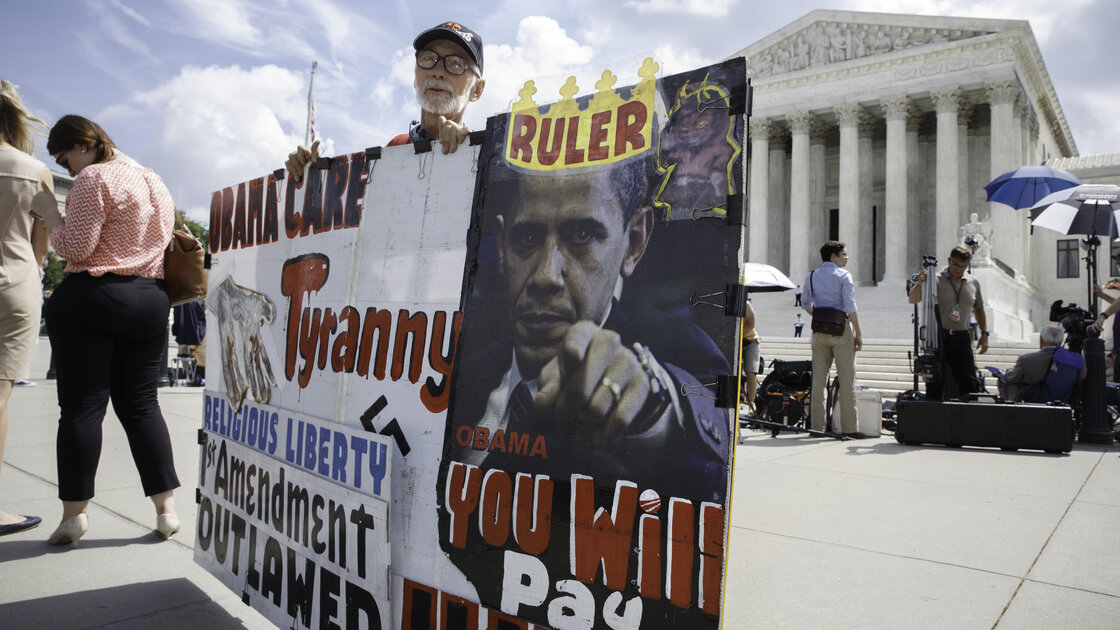
Time for a replay?: Protesters waited outside the Supreme Court for decisions in June.
Once again the Supreme Court will decide whether the Affordable Care Act lives or dies.
Defying expectations, the court announced Friday it has agreed to hear a case that challenges the heart of the law: subsidies that help people pay their insurance premiums. In about three dozen states, the federal government runs the online marketplaces (exchanges) where individuals can find health plans.
At issue is a phrase in the law stipulating that subsidies to help those with incomes under 400 percent of poverty are available only in "exchanges established by a state." The authors of the law argue that the rest of the statute makes it clear that subsidies are available not just in state-run exchanges but also in those where the federal government is doing the work of the state.
When the law was written, most people expected that states would want to run their own exchanges. It was a surprise when most opted to let the federal government do it instead.
A decision to strike down the subsidies in federally run exchange states could end up making insurance unaffordable for millions of people and threaten the viability of the law's entire health insurance program.
In a rare Friday afternoon notice following their closed-door conference, the justices noted with no further comment that they have agreed to hear King v. Burwell . That is the case in which a three-judge appeals court panel in Richmond ruled unanimously that Congress did intend to allow subsidies to be available nationwide.
The same day that the Richmond court ruled, a panel in the District of Columbia Court of Appeals ruled 2-1 the opposite way. But that case, Halbig v. Burwell, was vacated when the full appeals court agreed to rehear the case. That hearing is scheduled for December .
Because there are not yet contradictory decisions by appeals courts, most observers thought the Supreme Court would at least wait until the lower courts were finished considering the case before weighing in.
"We are disappointed that at least four justices decided to hear this case despite the lack of a circuit split and while this issue is still being actively litigated in the lower courts," said Doug Kendall of the Constitutional Accountability Center , which is representing the members of Congress who wrote the law. "But we remain very confident that the court will ultimately find that both the text of the ACA and the intentions of Congress mandate a ruling for the federal government."
Those who argue that the federal subsidies are illegal, however, say time is of the essence.
"In King there is a serious argument that it would be better to resolve the underlying question of statutory interpretation sooner rather than later," wrote Jonathan Adler, a law professor at Case Western University, in The Washington Post last week. "The resolution of this litigation will alter the calculus for many political and private actors considering how to respond to the PPACA, and the statute contains various deadlines and time frames that may become harder to navigate the longer this litigation drags on."
The White House press office released a statement that said, in part: "This lawsuit reflects just another partisan attempt to undermine the Affordable Care Act and to strip millions of American families of tax credits that Congress intended for them to have."
Tags
Who is online


102 visitors
I recently read about plans to add an even lower tier plan to Obamacare . Since we are forced to join it that might be a beneficial addition . The "copper" level plan would be more affordable than the current bronze plan .
What makes you think the republicans want subsidies in the law. Thats the wealth redistribution part of it conservatives hate. Removing the subsidies forces the deadbeats to carry their own weight.
Hospital ER's will continue to provide care regardless of payer ability; that is, 'till they themselves go broke and close their doors.
My largest concern for hospitals and ER's was initially the loss of subsidies for hospitals covering the uninsured; mostly, the loss of subsidies for caring for illegal aliens. This was supposed to take place gradually over time, to allow for the newly insured under the ACA to kick in and help pay for the uninsured. Now it looks as if the cluster-**** is in actuality, going topromote more losses for hospitals instead. Smaller rural hospitals, and over-worked/understaffed urban hospitals, will pay the price.
It's hilarious that a lawsuit asking the Court to enforce Obamacare is somehow seen as anti-Obamacare.
It's even funner that those are the same people who think efforts to change Obamacare are a waste of time because its perfect as written.
I have worked for smaller medical facilities in the Dakotas and Minnesota my entire career (almost 30 years) as has my wife for even longer. Those higher costs you refer to will indeed be ate by the hospitals, as the ACA does not cover reimbursing hospitals for uninsured illegal aliens. That cost is quite substantial, andit was intended that thecoverage by the newly insured would make-up for that loss. That is not happening , maybe it will, but so far it isn't anddoesn't appear that it will be capable of doing so.If you think that fat-cats run the hospital in smaller rural areas, then you are lying to yourself. Many, many of these smaller, but ultra necessary hospitals, run on an absolute shoe-string and are continuously juggling to try and pay the bills. There is no extra and very little waste. Did you know that most of the small rural hospitals in the upper Red River Valley, including my own employer, do not, and cannot even provide medical insurance for their own employees? Do not conflate, the issues that some larger facilities experience, with the general well-being of all American hospitals.