
Will Trump Pretend to Fix What He Broke?


Why you shouldn’t get excited about his “deals”

This is a couple days old - I've been busy.
Since declaring "Done Deal!!!" with the UK, despite having accomplished roughly nothing , Trump has also declared that a good conversation with China has led to a "complete reset" of American relations with that horrible, terrible, cheating, lying... oh, wait... that was China last week...
 S E E D E D C O N T E N T
In other words, this will be smoke and mirrors, an attempt to persuade the gullible that Trump’s tariffs are actually working. Markets — driven by small investors who seem desperate to believe that the people in charge have some idea what they’re doing — may briefly bounce on the announcement.
Trump, however, has already declared that the tariff that really matters right now, the prohibitive 145 percent rate on imports from China, won’t be coming down . That tariff has already caused a 30-40 percent drop in the volume of US-China trade, which, given the time it takes to ship stuff, guarantees a sharp increase in consumer prices and possibly empty shelves a few weeks from now.
But back to that UK “deal.” Nobody knows what will eventually come out of it, but we can be sure of one thing: It won’t lead to any significant opening of the British market to U.S. goods. Why? Because that market was already wide open before Trump stomped in.
The most important thing to understand about Trump’s trade war is that it’s an attempt to solve a problem that only exists in his imagination. He keeps insisting that other countries are engaged in unfair trade, but the reality is that most of our important trading partners impose very low tariffs on U.S. products:
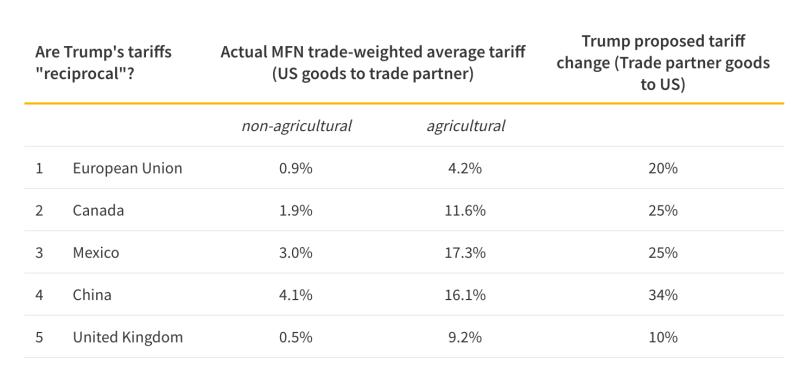
You could argue that China is less open to trade than the tariff number suggests, because the government plays such a large role in the Chinese economy. But for Britain, Canada and the European Union Trump’s tariffs are a huge, destructive attempt to fix something that wasn’t broken. These nations can’t stop doing bad stuff on trade because they weren’t doing bad stuff before Trump came along.
What about America’s trade deficit? As economists have repeated ad nauseam , this deficit doesn’t reflect unfair foreign trade policies. It is, instead, the flip side of large flows of capital into the United States , which historically reflected the fact that the U.S. was perceived as an attractive place to invest. Even if Trump manages to score some actual deals, as opposed to concepts of deals, they won’t change that logic. If his strategy does manage to reduce the trade deficit, it will do so only by destroying America’s attractiveness to foreign investors, which may be an achievable goal.
But let me go back to the point that Trump’s tariffs are a response to a problem that didn’t exist. That’s actually an observation that goes beyond trade policy. The Trump team likes to claim that it inherited an economy in terrible shape. Scott Bessent, the Treasury secretary, keeps claiming that the economy needs a “ detox .”
In fact, however, when Trump took over the U.S. economy was in very good shape. Unemployment was around 4 percent, while inflation was at most a fraction of a percentage point above the Federal Reserve’s target of 2 percent. Our productivity growth was the envy of the world. We had a trade deficit, but as I said, this mainly reflected America’s attractiveness as a place to invest.
It's true that Goldilocks now seems to be leaving the building, but that’s entirely — entirely — due to Trump himself. In discussing the Fed’s decision to leave interest rates unchanged, Jerome Powell repeatedly talked about “uncertainty,” but the only reason things seem much more uncertain now than they did a few months ago is the chaos Trump has created.
And stuff like this doesn’t help:

Actually, I’m baffled by the quotation marks around “eggs.”
Anyway, aside from the attempt to bully the Fed, you should be worried by Trump’s evident disconnect from reality. Prices are, in fact, going up, with a notable upturn in the inflation expected by businesses:
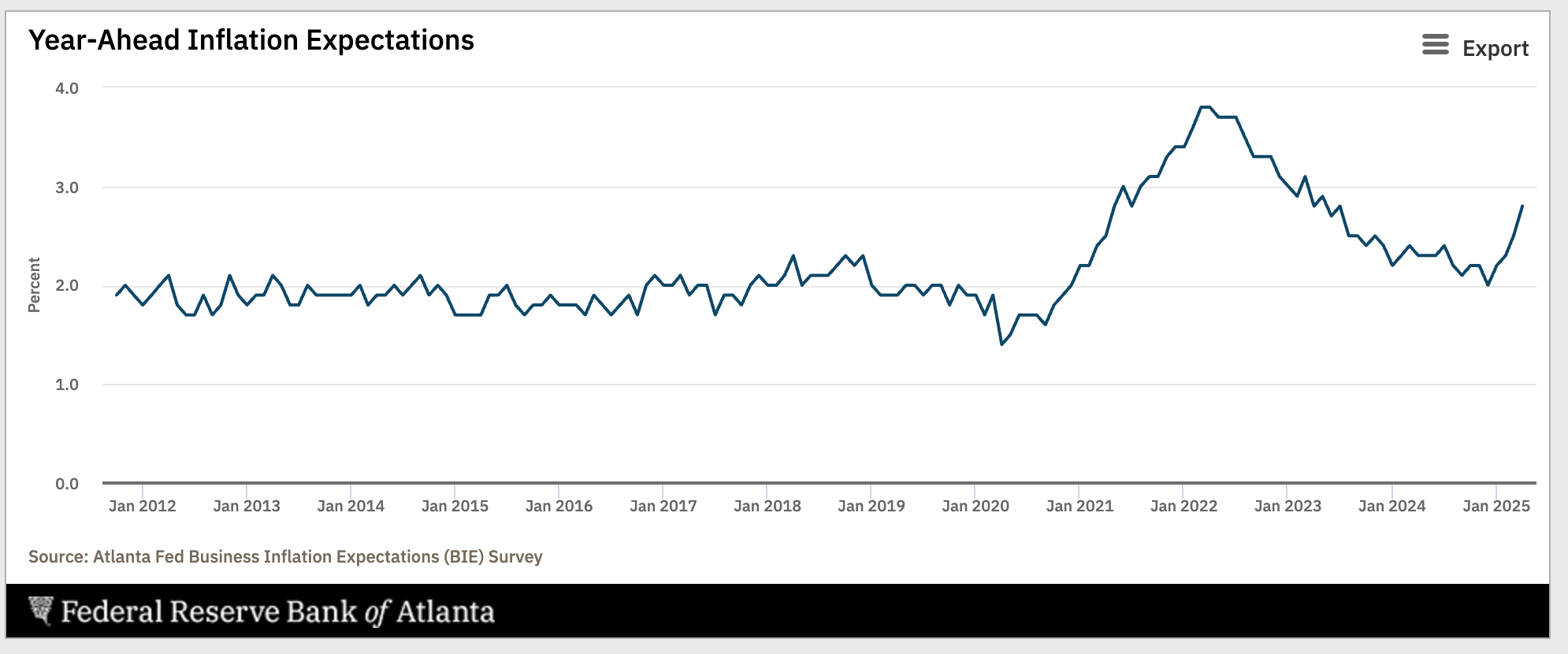
So what will Trump do if, as seems likely, Monday’s report on consumer prices shows the first signs of accelerating inflation? Even more important, what will he do when the cutoff of imports from China really hits consumers? There’s no chance that he will admit that he was wrong. There’s a very good chance that he and his minions will soon begin trying to corrupt the economic data.
So should we celebrate the trade deal that will be announced today? No. It won’t solve any of the problems Trump has created. It will, if anything, offer Trump the temporary illusion of success, encouraging him to create even more problems.
Whatever
Tags
Who is online
199 visitors
He hasn't yet declared victory in the trade war with China, but he's getting closer.....
If you'd like more precision on the UK "deal":
A Fake Trade "Deal": The Trump-Starmer U.S.-U.K. Near-Nothingburger, & the Shadow of the Chaos Monkey
A nearly hollow handshake cloaked in media spin…
by Brad DeLong
What we have here is less an economic accord than a theatrical stunt. It changes very little on the actual ground—some beef here, a tariff off ethanol there. The broader signal it sends is one of instability and caprice. With Trump, exporting to the U.S. becomes a risky gamble. The real cost to the U.S. flows from Trump’s blowing-up of all rational belief and trust in the stability of U.S. trade policy. Looking at Trump the chaos-monkey in broad perspective, American producers suffer a widespread loss in global market access, while British producers’ losses remain mostly confined to the U.S. This asymmetry makes the deal a serious strategic own goal for the United States, diluting its trade reliability while gaining little in return. For Trump, though, the deal serves its purpose: a video-ready spectacle for his base. For Starmer, it’s damage control—harm was done, but less than it could have been.
Robert Armstrong this AM:
Relative to the pre-Trump normal, the only steps to increase U.S. market access the U.K. has taken has been to pledge to remove its 19% tariff on U.S. ethanol imports, and allow tariff-free imports of hormone-free beef in the amount of 13,000 tons. All else is hot air: pledges to negotiate additional improvements in market access. Those are as close to nothingburgers as anything could be.
Relative to the pre-Trump normal, the U.K. has less access to the U.S. market than it had before.
Dwarfing this micro-“deal” is a far more important shift in the incentives for U.S.-U.K. trade.
Everyone in Britain now knows that any exports they make to the United States might be disrupted at any time for no reason other than that Donald Trump is a chaos monkey.
Everyone in Britain now knows that exports they make to other countries will not be disturbed.
Thus deciding to try to export to the United States carries huge risks, with associated costs.
And everyone in the U.S. knows that any exports they make to the U.K. might be disrupted at any time as the U.K. retaliates to tariffs and quotas imposed on its exports for no reason other than that Donald Trump is a chaos monkey.
And everyone in the U.S. knows that the same is true of any exports they make to any other country.
Thus, as a result of Trump, U.S. producers have on net suffered a major loss of market access not just to the U.K. but to every single country in the world. U.K. producers, however, have suffered on net a major loss of market access to the U.S., but their ability to export elsewhere remains the same. U.K. producers have lost a little with respect to their ability to fit into productive niches in the highly productive global division of labor. U.S. producers have lost a lot.
Thus taken as a whole—the process and the outcome—this Starmer-Trump fake trade “deal” is a substantial own goal for the United States. It is also a substantial own goal for Trump, at least if you see Trump as an advocate for U.S. exporters. It is, however a win for Trump considered as a videoclip-seeking attention hound.
Taken as a whole this Starmer-Trump fake trade “deal” is a harm-reduction exercise by Starmer that has been largely successful. Yes, harm remains. But it has been substantially reduced vis-à-vis Trump’s initial threats.
In addition to being a win for Trump as a video clip-seeking attention, the process and the outcome together make up a win for journalists who want to gain reputations for being friendly publicists for Trump. Even Robert Armstrong knuckles under, by making sure that the descriptive adjective “underwhelming” is in neither his headline nor his first sentence.