
Trump’s Smartphone Can’t Be Made in America for $499 by August

Category: Health, Science & Technology
Via: hallux • last year • 7 commentsBy: Wilson Rothman and Ben Raab - WSJ
 S E E D E D C O N T E N T

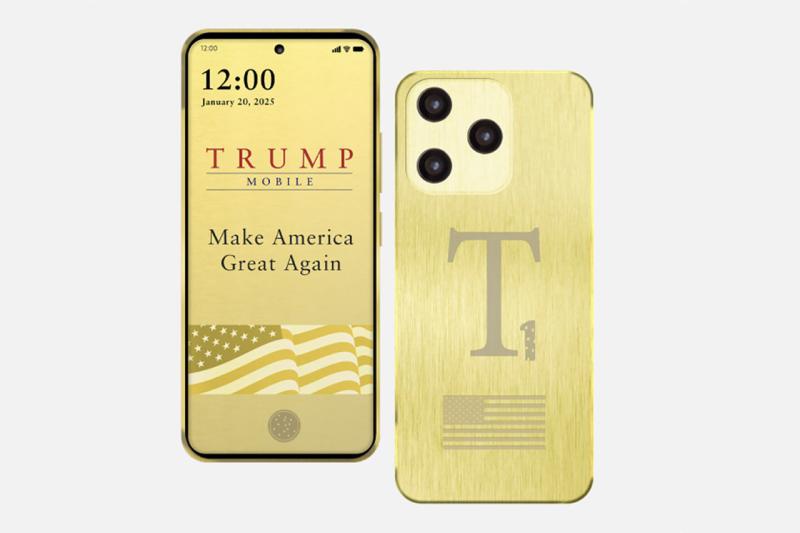
When the Trump Organization said it would launch a mobile-phone service , it also said it would sell a $499 T1 Phone beginning in August with some specs that beat the current top iPhone. A press release said the gold Android phone would be “proudly designed and built in the United States.”
The question is: how?
In April, when President Trump unveiled his sweeping tariffs, we investigated what it would take to make an iPhone in the U.S. Supply-chain experts agreed the U.S. would need years and many billions of dollars to establish the factories and skillsets needed to match China’s output. And even if it were possible, the labor and infrastructure costs would be astronomical, leading to phones whose build costs are many times as high as the iPhone’s.
A spokesman for the Trump Organization said in an email that “manufacturing for the new phone will be in Alabama, California and Florida.”
Despite the language in the press release, Eric Trump indicated that the first wave of phones wouldn’t be built here. “You can build these phones in the United States,” the Trump son told podcaster Benny Johnson on Monday morning on The Benny Show after holding up a gilded device that looked just like an Apple AAPL 0.97% increase; green up pointing triangle iPhone. “Eventually, all the phones can be built in the United States of America. We have to bring manufacturing back here.”
So it’s possible—even plausible—that these phones would initially come from China because, at that price point, only Chinese makers like Xiaomi and Oppo have hardware to match. Here’s what Trump Mobile is promising, and why it’s a tall order at $499:
Display: With a 6.8-inch display, the T1 would rival Apple’s $1,199-and-up iPhone 16 Pro Max in size. It might even match performance, with a bright AMOLED screen and fast 120Hz refresh rate. (There’s no mention of the T1’s screen resolution.) These screens are generally manufactured by Korean tech giants Samsung and LG .
Battery: While Apple doesn’t advertise its battery capacities, a teardown from iFixit revealed that the iPhone 16 Pro Max has a 4,676-mAh battery. The T1 phone shows a 5,000 mAh battery.
RAM: Apple doesn’t typically share RAM specs either, but teardowns show that the best iPhones have 8GB of RAM. The T1 is listed at 12GB of RAM.
Storage: Most iPhones start with 128GB of storage. Only the iPhone 16 Pro Max starts with 256GB, which matches the promoted T1 spec. But the T1 apparently goes further with an expandable-storage card slot. Apple has never had slots for expandable memory in its iPhones, though Android-based competitors have offered them, typically for MicroSD cards.
Camera: The T1 phone boasts a 50-megapixel camera, along with two others in the rear and a 16-megapixel selfie-camera on the front. Apple’s iPhone cameras currently max out at 48-megapixels, and are mainly sourced from Sony in Japan.
Headphone jack: The T1 is shown as having a 3.5mm headphone jack. Apple famously ditched that jack in 2017, sending some fans into mourning. (Apple offered adapters that allowed people to plug their old headphones into the Lightning port.)
Fingerprint sensor: The technology to hide a fingerprint sensor beneath the display has been around for a while, and Samsung has incorporated it in flagship devices going back to the Galaxy S10. Apple has never shipped this technology in an iPhone.
Processor: The T1 spec sheet doesn’t name the chip that will power the device. Most advanced chips for smartphones come from Taiwan and China, though there is some semiconductor manufacturing in the U.S.
“There’s absolutely no way you could make the screen, get that memory, camera, battery, everything” in the U.S., said Tinglong Dai, a professor of operations management and business analytics at Johns Hopkins University’s Carey Business School.
Dai estimated it would take “at least five years” for the U.S. to establish the infrastructure necessary to make “Made in USA” smartphones a real possibility.
He also played down the push to move smartphone manufacturing to the U.S. More immediately, the focus is on building technology such as semiconductors and medical devices, Dai said.
What does seem plausible: the wireless service itself. Carriers frequently sell service in bulk to “virtual” operators, as was the case with Ryan Reynolds’ Mint Mobile .
Tags
Who is online


137 visitors
.... and it comes with a 'freeish' Grift App!
You can now hold Big Brother in your hand
We already do.
cool, another undeniable identifier for the coming civil war ...
Funny, my old 8S Plus had fingerprint recognition. New 16 Pro is facial recognition. Unless I am missing something, that line is bullshit.
If they didn't ship it, how did it get there?
Osmosis
You knew he had to outdo the Obama phone, you knew it was coming.