
‘Queen of All Mayhem’ and ‘Belle Starr’: She Rode With the Outlaws


 S E E D E D C O N T E N T
On the night of Feb. 3, 1889, a woman riding sidesaddle in the rain through Indian Territory was shot off her mount by an assailant firing buckshot. Moments later a lighter load of turkey shot was fired point-blank at the victim’s head and neck. Thus passed from life the convicted horse thief, Confederate partisan and soon-to-be-legendary “she-tough” known as Belle Starr.
Having spent most of her 41 years in the company of bushwhackers, rustlers and robbers, Starr—born Myra Maybelle Shirley in 1848—already had a reputation as a splendid rider, a fine shot and an “expert at any manner of devilment,” as one newspaper put it. Posthumously, though, she became a sensation. Thanks to a lurid 1898 biography, Starr would come to rank in the annals of scurrilous derring-do alongside Jesse James, Calamity Jane and other notorious outlaw figures of the Wild West. Starr was a household name for decades. The gorgeous Gene Tierney played her in a 1941 biopic. After World War II, though, Starr faded from public consciousness.
Two biographies—one zesty and a tad daredevilish, the other more sedate and carefully sourced—tackle the life and times of this turbulent and enigmatic woman. Both books deal with much (but not all) of the same material. Both engage in necessary speculation. Both try to identify hard nuggets of truth amid mountains of glittering embellishment. Neither sees Belle Starr quite the same way.
In “Queen of All Mayhem: The Blood-Soaked Life and Mysterious Death of Belle Starr, the Most Dangerous Woman in the West,” Dane Huckelbridge relates the events of the woman’s life with whip-cracking energy and a sprawling exuberance for the messiness of the American experiment in the 19th century—that “chaotic jumble of peoples, clans, religions, and tribes, whirling and colliding in a New World crucible that seemed to scorch as many as it saved.” Mr. Huckelbridge, whose previous books include “No Beast So Fierce,” puts narrative oomph ahead of historical compunction, so it is often hard to pinpoint the provenance of his information. For the sake of a galloping tale, he adds color and flourish of his own and includes a number of entertaining anecdotes about Starr that may be too good to be true.
In “Belle Starr: The Truth Behind the Wild West Legend,” Michael Wallis gives his subject a calmer, more contemporary and more scholarly treatment that, by comparison to Mr. Hucklebridge’s book, borders on the prim. Mr. Wallis, the author of “Route 66” and “Billy the Kid,” sees trauma (rather than orneriness or adventure-seeking) shaping Starr’s character. He enlists historical analysts whose ideas fit the contemporary intellectual fashions for dismantling frontier myths, elevating the experiences of marginalized persons and deploring old-timey ideals of womanhood. Mr. Wallis makes a principled effort to sort fact from phoniness, and he seems to want to find the vulnerable real woman behind Starr’s feisty image. But in trying to tone down the legend and tame the wildcat, he robs Starr of agency.
He shows—both accounts do—that from girlhood, the future Belle Starr had a taste for fast horses, pretty pistols and bad boys. During the Civil War, she spied for her elder brother Bud, a Confederate saboteur, and it was said that she could “shoot a bumblebee off a thistle at thirty yards.” Later she married at least three men (all of them desperadoes) and shared her bed with at least two others. She disliked the company of women apart from that of her adored daughter, Pearl, who would grow up to be a prostitute.
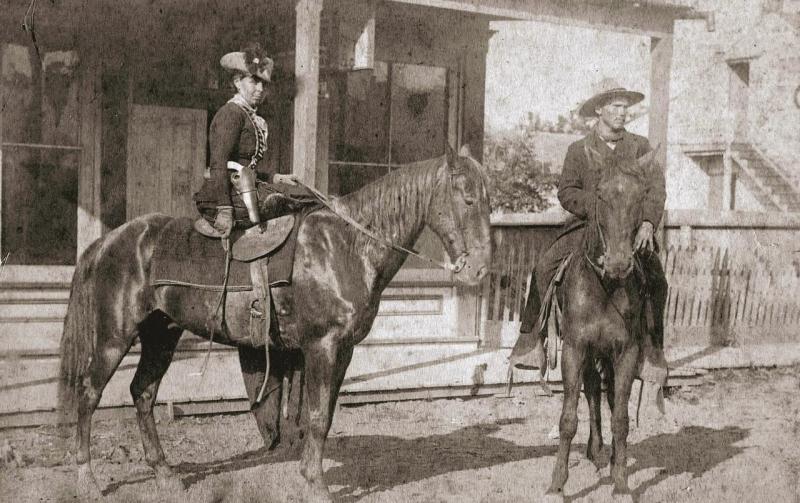
Starr cut a dashing figure in a black-velvet riding habit and broad-brimmed man’s hat trimmed with feathers. She excited the disapproval of censorious matrons. She was in and out of trouble with the law (accused, variously, of robbery, arson and horse-stealing). At the time of her death, she lived with a horse thief 15 years her junior. To Mr. Huckelbridge, all of this suggests that Starr was a spirited female with “outlaw tendencies.” Yet to Mr. Wallis, citing Glenda Riley, the feminist historian, Starr’s preference for scoundrels suggests that “eroded self-esteem convinced her that she had no place in the world, except as the companion of an unsuitable man.” Or perhaps—hear me out—her self-esteem was sufficiently robust that she felt entitled to choose the kind of man she liked.
The divergence of biographical attitude is seen most clearly in the authors’ differing appraisals of the infamous shakedown of a wealthy Creek rancher named Watt Grayson. In November 1873, three bandits tortured Grayson into telling them where he’d buried his gold. One of the bandits was Jim Reed, then our heroine’s philandering husband, who had told his wife about the scheme ahead of time. Legend holds that Starr herself—who in those days still went by Myra—dressed in men’s attire and joined in the robbery, a juicy factoid that the historical record does not support.
Mr. Wallis seems almost angry that Starr should be inculpated for the Grayson heist. “By far the most outrageous of all the falsehoods” involving the case, he writes, is that Starr “took an active role in the crime.” She was elsewhere during the robbery, he says, and “worried about the fate of her husband,” though according to her own later testimony she was close enough nearby in the woods to come when the ruffians summoned her, and she was there to watch the next day as they divvied up the loot.
Mr. Huckelbridge, by contrast, has no difficulty in seeing Starr up to her neck in the grim escapade. “Let there be no mistake about it,” he writes. “She was there when they planned the heist, she stood guard outside the ranch while they executed the robbery, she sat with them while they counted the money, and when it came time to flee, she would do that as well.”
OK, but who shot Belle Starr? That is the great question. The possibilities are tantalizing. Maybe the villain was Edgar Watson, an itinerant sharecropper with a hot temper, a criminal past and a grievance against Starr. Watson was arrested for Starr’s murder but soon discharged for insufficient evidence; afterward he moved to Florida and, it is believed, murdered again. Maybe Starr’s son, Eddie, was fed up with being bossed and beaten by his mother and wanted her dead. Maybe Starr’s then-husband, Jim July, shot her to get sole control of their homestead, located on Cherokee land. Or maybe, Mr. Huckelbridge hypothesizes, the homicide had its origins in tribal politics connected to Starr’s involvement in the Grayson heist. Only the assassin knew then, and no one knows now. But wow—what a story.
Tags
Who is online
74 visitors
Belle got so famous a State Park in Oklahoma was named after her.
good girls go to heaven, bad girls go everywhere ...
I've been a lot of places...
I bet ...
Did they let you stay?
I was allowed to stay in Canada for about 10 days...but that's probably because I was passing thru
Surprised we didn't keep you.
I would have stayed if I could. British Columbia is probably the most beautiful place I've ever been
There used to be a local bar named for her near Winchester, VA
Permanently closed ... alas.