
Senate Narrowly Advances Trump’s Tax and Spending Megabill

Category: News & Politics
Via: vic-eldred • last year • 13 commentsBy: Story by Richard Rubin, Siobhan Hughes, Katy Stech Ferek

 S E E D E D C O N T E N T
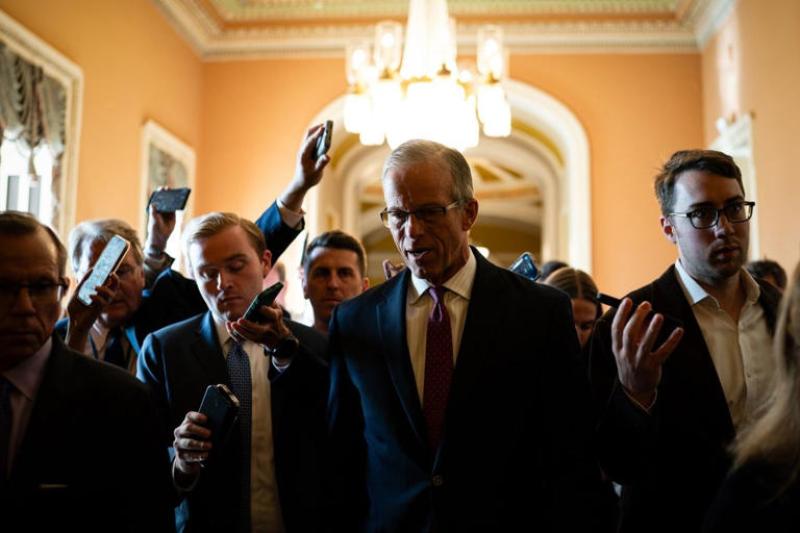
WASHINGTON—The GOP-controlled Senate voted late Saturday to advance President Trump’s tax-and-spending megabill despite two Republican defections, narrowly clearing one procedural hurdle and offering a stark preview of the difficulties party leaders face in passing the sprawling measure.
The initial vote on the One Big Beautiful Bill Act was 51-49, with most Republicans in favor and all Democrats opposed, putting the Senate potentially on track to pass the bill by Monday after a day of debate and amendments. GOP Sens. Rand Paul (R., Ky.) and Thom Tillis (R., N.C.) broke with their party to vote against advancing the bill. The revised text of the 940-page Senate bill was released late Friday night and is likely to keep changing.
Senators have been discussing the megabill for months, but the tense vote was the first real test of support. Republicans required more than three hours to wrangle all the votes to keep moving forward with the legislation, which carries the core of Trump’s agenda but also has provisions that irritate centrist and conservative GOP lawmakers.
Sen. Lisa Murkowski (R., Alaska), who has called for protecting clean-energy tax credits, negotiated on the Senate floor with Finance Committee Chairman Mike Crapo (R., Idaho) before voting yes. The final holdouts were Sens. Rick Scott of Florida, Mike Lee of Utah, Ron Johnson of Wisconsin and Cynthia Lummis of Wyoming, who want deeper spending cuts.
Johnson, who had earlier voted against advancing the bill, switched his vote and joined the others in voting “yes” at about 11 p.m. ET.
He said afterward that GOP leaders and Trump will back Scott’s proposal to cut off new enrollment for the Medicaid expansion that was part of Obamacare, where the federal government pays 90% of the cost of health insurance for some adults. The idea has drawn opposition from GOP moderates, however, and may not pass.
“We’re going to take one part of Obamacare that’s really done damage,” Johnson said.
The bill comprises permanent tax-cut extensions, new tax cuts, border and military spending along with spending reductions on Medicaid and nutrition assistance that represent Trump’s second-term priorities. Democrats oppose the bill, calling it a dangerous reduction of the social safety net combined with tax cuts for high-income households.
The Senate bill would reduce budget deficits by $508 billion—but only if you first assume that all the expiring tax cuts are extended permanently and have no cost, according to a Congressional Budget Office report late Saturday. On an apples-to-apples basis with the House bill, the Senate bill would likely increase deficits by about $3.3 trillion, up from $2.4 billion for the House version. That higher deficit figure is more than many House Republicans said they could stomach, raising further questions about the measure’s fate.
By 2034, the latest Senate bill would reduce the number of people with health insurance by 11.8 million, CBO said.
Republicans are using all the levers they have to build support, including policy changes and cajoling from Trump, who golfed with several senators early Saturday and met with others at the White House. Trump also criticized Paul and Tillis on Truth Social after their votes.
The latest version of the Senate bill offers a more generous deduction for state and local taxes—known as SALT—through 2029 than the previous Senate iteration. It gives states more time before lowering the ceiling on the so-called provider taxes used to enhance state Medicaid budgets and in turn attract federal matching funds.
The revised bill would also cut off tax credits for electric vehicles, solar and wind projects more quickly than the initial Senate version, in a blow to companies hoping their Republican senators could do more to shield them from an effort to roll back spending on EVs and renewable energy. It would impose a new excise tax related to the use of certain foreign components in renewable projects.
Paul opposed the bill because it increases the debt ceiling. Tillis said the Senate’s Medicaid cuts go too far, and the latest clean-energy changes also moved the bill away from his preferences.
Sen. Josh Hawley (R., Mo.) said he backed the bill despite opposing a Medicaid-funding formula change in it. He said his state would get increased Medicaid funding for the next few years due to a $25 billion special rural hospital fund designed to mitigate harmful effects from the bill and said he would fight in subsequent legislation to make sure that the postponed cuts don’t actually take effect.
Sen. Susan Collins (R., Maine) voted to move ahead with the measure, though she said she hasn’t decided on whether to support the final bill. Collins, who has expressed concerns about the Medicaid cuts, also floated letting the top income-tax rate revert to its pre-2017 level of 39.6% at some high income level.
Changes to SALT cap
In the new version of the Senate text, the state and local tax deduction cap would start at $40,000 for 2025, with phasing out starting after income reaches $500,000. Both amounts would climb slightly through 2029 and then the cap would go back to $10,000. The bill also would remove previously proposed limits on closely held businesses’ ability to avoid the cap with state-blessed workarounds, in a win for dentists, accountants, manufacturers and others.
The provision to hike taxes on colleges’ annual investment income has new language exempting schools with fewer than 3,000 students from an endowment tax. The exemption gives some relief to small colleges, which had been lobbying for changes.
The clean-energy changes respond to complaints from conservatives and Trump that Republicans didn’t quickly end tax incentives created or expanded by Democrats in the 2022 Inflation Reduction Act. Tax credits for new, used and commercial electric vehicles would all end Sept. 30, faster than under the House version or the prior Senate version.
Wind and solar projects would qualify for tax credits only if placed in service by the end of 2027. That is faster than the prior version that allowed projects to qualify based on their construction start date.
Hydrogen projects would get more time before expiration—something sought by Sen. Shelley Moore Capito (R., W.Va.). The bill would allow metallurgical coal suitable for use in steelmaking to be eligible for a critical minerals tax credit.
Elon Musk, the world’s richest person and former Trump adviser , said on X that the bill gives “handouts to industries of the past while severely damaging industries of the future.” Musk is the CEO of electric-car maker Tesla .
Lee said Saturday he would drop a provision that would sell off some public lands. Other Republicans were rallying against the idea and said they had enough votes to kill it.
Provider taxes change
On provider taxes, the rate that states charge hospitals would gradually decline to 3.5% from 6% currently in the states that expanded Medicaid under the 2010 Affordable Care Act. But the rate wouldn’t start declining until 2028, one year later than in the Senate’s prior version . For the 10 states that didn’t expand Medicaid, provider taxes would be frozen in place as of the date of enactment. The changes don’t apply to nursing homes or intermediate-care facilities.
The revised bill gives extra benefits to Alaskans, whose interests are being defended by Murkowski and fellow Alaska GOP Sen. Dan Sullivan.
Among the changes: a more generous tax deduction for Alaska Native whaling captains. It gives a more generous federal Medicaid matching rate to Alaska by factoring in the higher cost of living in both that state and Hawaii—the other noncontiguous state. It also gives Alaska some room to minimize cuts to federal food-nutrition programs.

Tags
Who is online
114 visitors
Debate will now begin on the spending bill – and that could take hours as New York Democratic Sen. Chuck Schumer has promised to have the nearly 1,000-page measure read before a final vote on passing it can happen.
I think that every bill should be read in its entirety before any votes are contemplated.
Most of the congressional clowns (on both sides of the aisle) have little if any clear understanding of the specific content and consequences of many of the bills they vote. That is how so much "I'll scratch your "back" money gets into the bills and budgets that congress passes.
I think they should require full attendance in the chamber for the reading of bills and that the reading should start from the beginning if a member is outside the chamber for more than a few minutes to go to the bathroom.
I was a bit hopeful when McCarthy was the speaker as he wanted to go back to the individual appropriation bills and he wanted to give 3 days time for members to read the bills. Unfortunately we all know how that ended up.
When the lunatics (MAGA) are allowed to run the asylum (HOR) then the only possible results are lunacy and chaos
It appears the Senate is holding the influences of the TEA Party (Freedom Caucus) in check. That's the only way to keep the MAGA movement alive post-Trump. What legislator in their right mind would agree to willy-nilly sale of public lands? That TEA Party folly would significantly hurt the country. (We know this to be true from the history of giving up government ownership of helium management. The quick-buck fuckers fucked over everyone; that's their only talent.)
This will also be the last gasp for the phony fiscal conservatives. What the Big Beautiful Bill proves is that the deficit and debt cannot be fixed with spending cuts alone. The neocon/neoliberal contingent have been cheating workers, savers, and honest businessmen for 40 years. That's why 97% of the national debt has been created since Saint Ronald of Reagan was inaugurated. Them there Republicans didn't have any cattle or hats. It's time to turn the page on Republican stupidity that has damaged the country almost to the point of no return. Your going to have to raise taxes, boys. At this point it's fiscally irresponsible not to.
What the Big Beautiful Bill proves is that the deficit and debt cannot be fixed with spending cuts alone.
The BBB (at least one of those B's should be for Bullshit) actually raises the national debt by trillions, reduces critical services for many in need and continues to focus the MAGA on serving the rich at the expense of the poor
The first time trump was in office, he raised the debt by more in 4 years than Obama did in 8. Repubes couldn't care less about the debt.
Repubes couldn't care less about the debt.
MAGA's believe in helping themselves at the expense of others
Let me guess, that's a good thing? LOL!!!
When Republicans achieve throwing millions off of healthcare it affects ALL healthcare everywhere.
When those without healthcare get sick, they go to the Emergency Room for care.
The whole premise of ACA (Obamacare) was to get more working people, the working poor on lower cost healthcare plans to reduce the strain on Emergency Rooms being used as primary care for the poor.
If Republicans have become so hateful against a successful plan the aided millions of Americans just as an act of political revenge against Obama it is going to backfire in spectacular fashion.
Medicaid is funded with state and federal funds but cutting federal funding is kicking red states into the worst situation possible.
If Republicans think this won't affect the wealthy they are truly sadly mistaken.
There are no "wealthy" folks only Emergency rooms.
They are saying that there should be a work requirement for young able-bodied people.
The whole premise of ACA (Obamacare) was to get more working people, the working poor on lower cost healthcare plans to reduce the strain on Emergency Rooms being used as primary care for the poor.
And it has been the main budget buster ever since.
If Republicans have become so hateful against a successful plan the aided millions of Americans just as an act of political revenge against Obama it is going to backfire in spectacular fashion.
It is not successful. It is bankrupting Medicare & Medicaid.
Medicaid is funded with state and federal funds but cutting federal funding is kicking red states into the worst situation possible.
States have abused the system.
It raises the debt limit by $5 Trillion. That’s not analysis or opinion. It’s literally in the bill.
Tacos
It raises the debt limit by $5 Trillion
You need to drop the word "limit" - it will raise the debt by $5 Trillion and the new debt limit limit will likely be reached at or shortly after the time he leaves office