
╌>

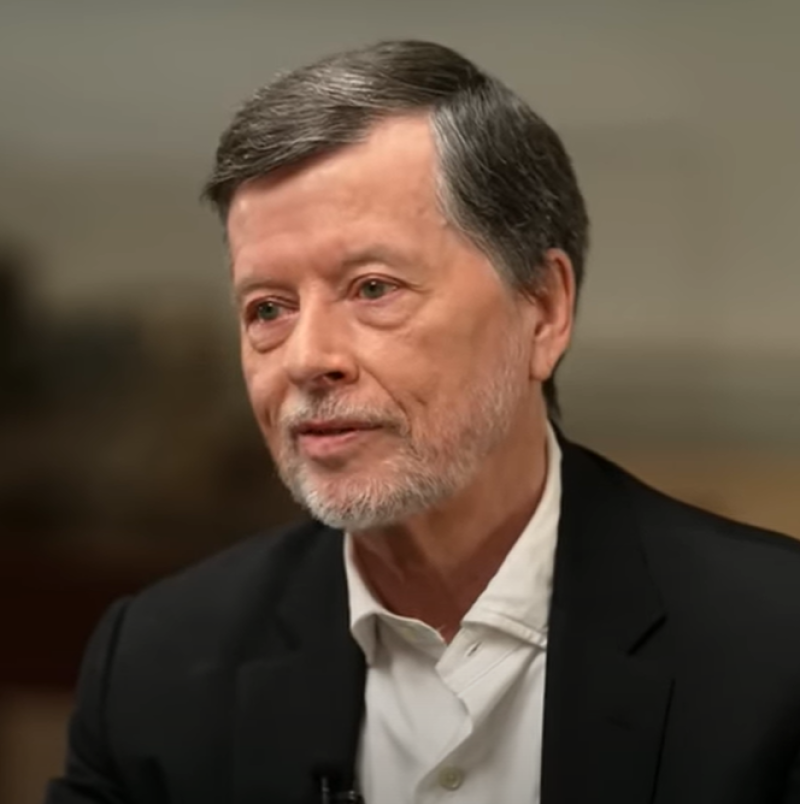
Full interview: Ken Burns on "Face the Nation"

  

Category:  News & Politics

Via:  thomas  •  last year  •  4 comments

By:   CBS News

Full interview: Ken Burns on "Face the Nation"

In order to form the government, they had to reach back through the middle ages, through the dark ages, back to antiquity to bring up these ideas like virtue and temperance and moderation and all of the things that all of them were looking for. I mean, the amazing thing is we're here at Thomas Jefferson's house, but we don't have a country without his words, but also we don't have a country without George Washington.

 And yet we know about all of these men. They're deeply flawed in in many important ways. And I think today in our binary culture, you know, where everything's a one or a zero or it's a red state or a blue state, it's my way or the highway, we've forgotten that it's possible to tolerate, as we do among with the people we love, their strengths and their weaknesses.

So heroism is not perfection, right? The Greeks told us that heroism was a negotiation within someone. Sometimes a war between somebody's great strengths and their great flaws. Like Achilles had his heel and his hubris to go along with his great strengths. And so I think that if we can take a historical view that permits us to see a Jefferson and a Washington in in these very complicated u understanding of them then it's possible to then breathe, to have some room to understand who we are now, who we were then, and where we might be which is of course the most important thing. All the anxiety about this present moment is really not so much about the present moment but about will we survive. Where will we be? And and you can go back to this moment and be completely inspirited by possibility. Is it necessary to understand the flaws of the founders so that they become more real and therefore their lessons are more accessible? I think so.

S E E D E D   C O N T E N T



Red Box Rules

Be polite. Be Nice. Anything you say can and will be used against you. 

Any commentary deemed by the originator of this seed to be offensive or demeaning is subject to moderation, deletion and, quite possibly, removal of the perpetrators birthday.



Tags

jrDiscussion - desc
[]
 
Thomas
Professor Guide
1  seeder  Thomas    last year
… I think it doesn't take as much effort as we think it does to reinvest in those things that we share in common. 

What is a citizen's obligation? Now, a citizen's obligation now is the same as it's ever been. And that's the most important thing. There's a wonderful phrase a little bit later from the famous words where Jefferson says, "All experience has shown that mankind are more disposed to suffer while evils are sufferable." Meaning, we all kind of have gravitated to be under authoritarian rule. You know, the trains run on time or we get at least this. But we're going to require of you to be a citizen something more. It's got to be active. The pursuit of happiness is not the acquisition of things in a marketplace of objects, but lifelong learning in a marketplace of ideas. 

That's what the founders said: To be virtuous, to live a virtuous life, to continually educate yourself is what was required to sustain this republic. And I think that's what we've gotten away from. Everything is sort of all individualized.


Thomas
Professor Guide
2  seeder  Thomas    last year

And of course there is the defense of PBS

Interviewer: Make the case for PBS.

Burns: It is the Declaration of Independence applied to the communications world. It's a bottom-up. It's the largest network in the country. There's 330 stations. It mostly serves, and this is where the elimination of funding for the Corporation for Public Broadcasting is so shortsighted, it mainly serves rural areas in which the PBS signal may be the only signal they get. They also have not only our good children's and prime time stuff. They have classroom of the air, continuing education, homeland security, crop reports, weather, emergency information that we're going to take away. This seems foolhardy and seems misguided mainly because there is a perception among a handful of people that this is somehow a uh a blue or a left-wing thing when this is the place that for 32 years gave William F. Buckley a show, right? I mean, it's and it's that show is, by the way, is still going on and moderated by a conservative. So, I just think that maybe we're throwing the baby out with the bathwater. 

And I couldn't do, let me personalize it, and I didn't want to, John. 

I couldn't do any of the films I've done without them being on PBS. I could go into a streaming service or a premium cable tomorrow and get every one of the millions of dollars it took to do this in one pitch, but they wouldn't give me 10 years. They want it in a year or a year and a half and that's a… I can't do that. Same with Vietnam, same with the Civil War, same with jazz, same with the national park, same with, you know, the Roosevelts. All of those country music, all of those have taken time to incubate. And that has been under the system that has one foot tentatively in the marketplace and the other proudly out. Kind of like the national parks are the Declaration of Independence applied to the landscape. These are really good American institutions that represent everybody from the bottom up, which is what it's always about.


Thomas
Professor Guide
3  seeder  Thomas    last year
So even within the United States, I was learning constantly. Maybe 20,000 Black people fought in the Revolution—probably 15,000 for the British, who had cynically offered them their freedom. Not freedom of Loyalists, right? And how you're going to tell, I don't know.

But they are—and then 5,000 fought valiantly for the Patriot cause. Very, very complicated. And you can never say a categorical "them" about anybody. And that's all we do.

Look, I have made films about the U.S. for all of my professional life. But I've also made films simultaneously about us. All of the intimacy of that—all the majesty and complexity and contradiction and controversy of the U.S. And the thing I've learned, if I've learned anything, is that there's only us. There's no them.

And we're constantly being told there's a them. There's no them. And that's what this document, produced by the man who sat in this room, you know—heard his troubled secretary, Meriwether Lewis, say, "You know what 15 million got you? It got you this. And by the way, there's no Northwest Passage. But look what you have here."

And you've got, you know, the Lewis and Cl—this is, this is, this is where, you know, he learns the whole thing. If there is only us and no them, it is also a strain in American history: "Look at them. Go get them." That's right. It's the simplest thing. It's the authoritarian's playbook. That's what you always do. You make an enemy and you say, "You know, your problem is that there's that thing happening."

But there's really not that. All of the religious traditions remind us that—or try to remind us that—and we want to forget it. There's something simplistic about allowing ourselves to be convinced that there is a them.

You know, we've—in our own political documents—enshrined the sanctity of the individual. The religious doctrines have been doing that for centuries. And so the idea of making distinctions—you know, I remember I gave a speech at Brandeis, a commencement speech, talking about the Middle East, and I said:

"These three great religions, all with claim to the same holy ground, have turned it into a shameful graveyard. God does not distinguish between the dead."


Thomas
Professor Guide
4  seeder  Thomas    last year

Wow. All y'all missed a good conversation.


Who is online

CB


78 visitors
