
Did Someone Neglect to Tell the President Which Direction People Wanted Prices to Move?


The extent to which the Trump administration is raising prices that are at the heart of the affordability crisis is remarkable

It looks like Trump has accepted that he's a lame duck. Whether he cannot run again, or his health gets too bad to rule, he seems to have accepted that it's NOW OR NEVER!!
So... he is flaunting his corruption and his disdain for human rights and the rule of law. He is flaunting his status as mad-king.
This may finally disturb his groveling followers, but he doesn't care now. Après moi, le déluge!
 S E E D E D C O N T E N T
Between the tariffs, deportations, and the budget, the Trump administration seems to be attacking the problem that prices are too low. I’ll start with a bunch of graphical evidence re the tariffs, and move to other policy areas—the budget and deportations—that are starting to look equally problematic in this regard.
Tariffs
The place to start here is the fact that tariff revenues are, employing the technical economic term, through the freakin’ roof, proving that exporters are clearly not “eating” the full tax. Pre-trade war, tariff revs were ~$7bn/month. Now, they’re $28bn, a 4x rise. The U.S. importers can, for a time, eat some of this tax, but not the whole thing and not for too long. This tax has to come out somewhere along the chain wherein consumers are the last link.
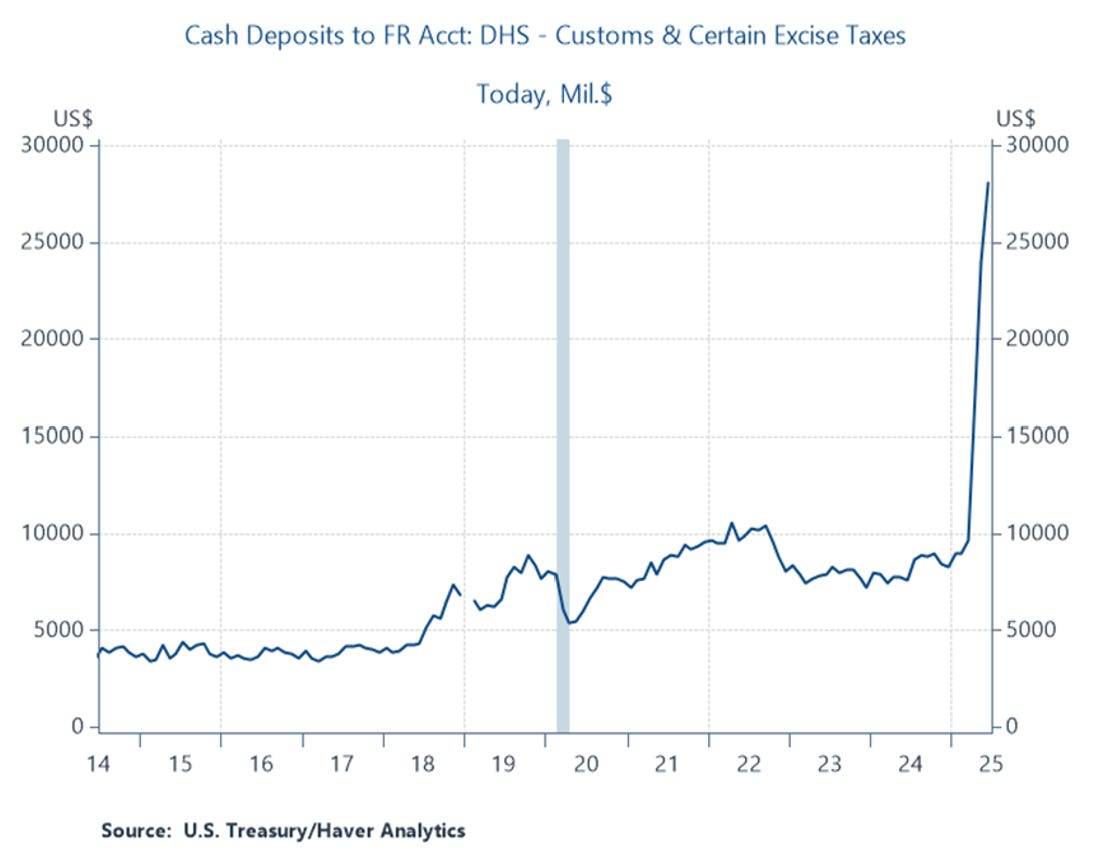
The rest is all about passthrough of the above dollars. This week’s CPI was revealing in that regard, but one month’s data isn’t enough to conclude much. You need to look at trends and trend-breaks, as follows:
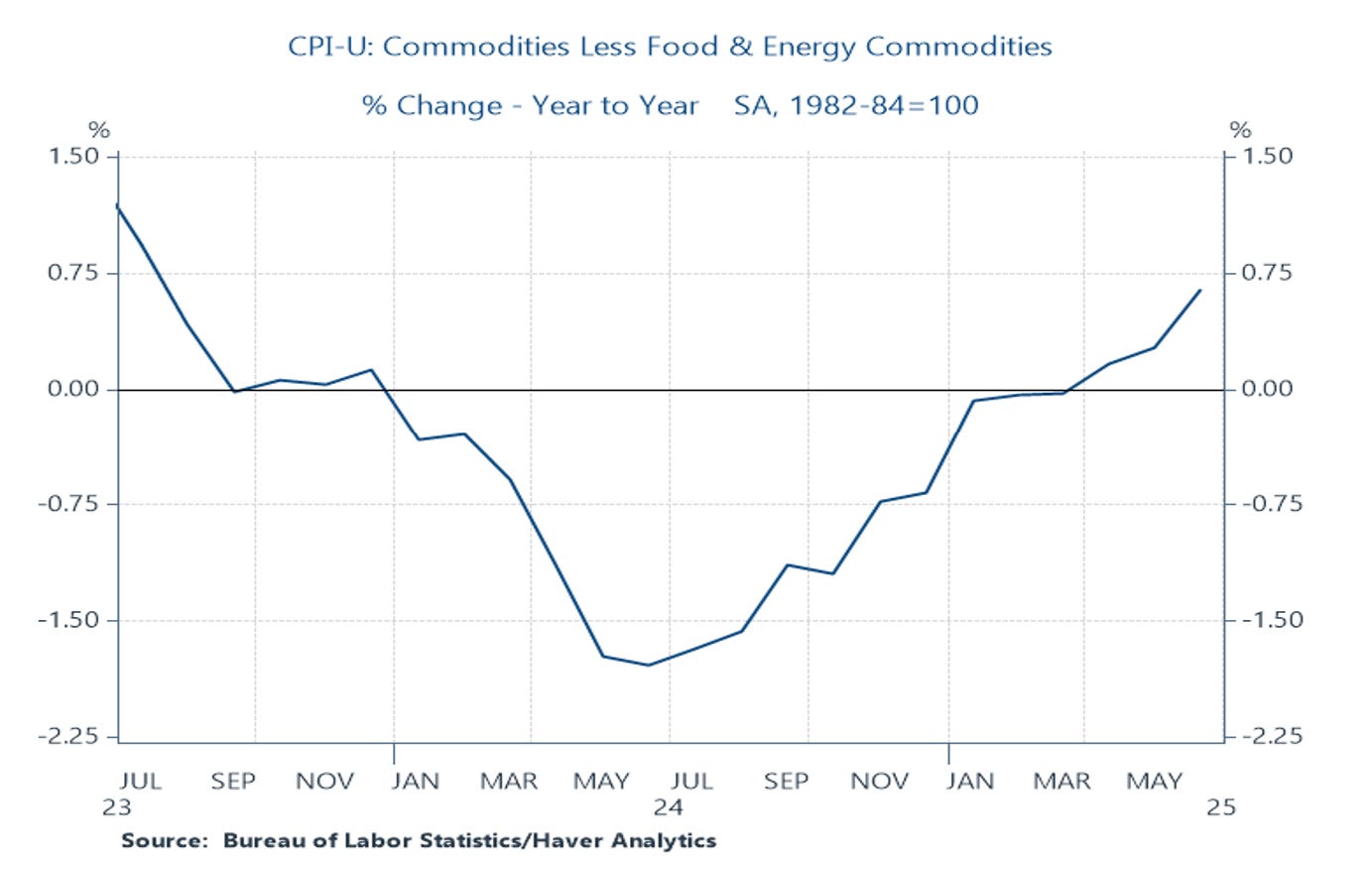
The first place to look under the hood for tariff-induced inflation effects would be goods as they include imports and imported parts (their weight in the overall CPI is about 19%). Last year, as the above figure shows, goods de flation contributed to CPI dis inflation (slower inflation), though less so as the year progressed. This year, they’re contributing to higher inflation.
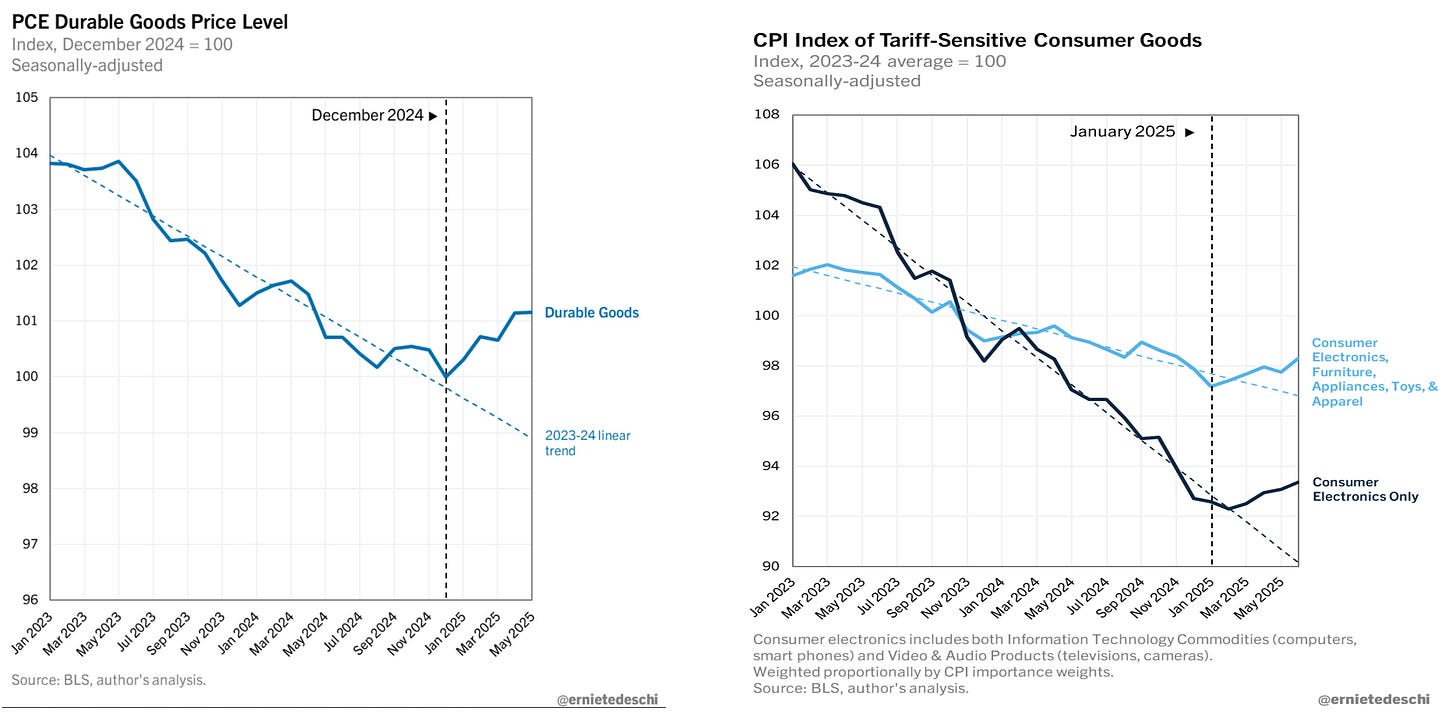
To assess the role of the tariffs, we need to keep digging, assisted by these Ernie Tedeschi slides, both of which show trend breaks this year in the prices of tariff-relevant products.
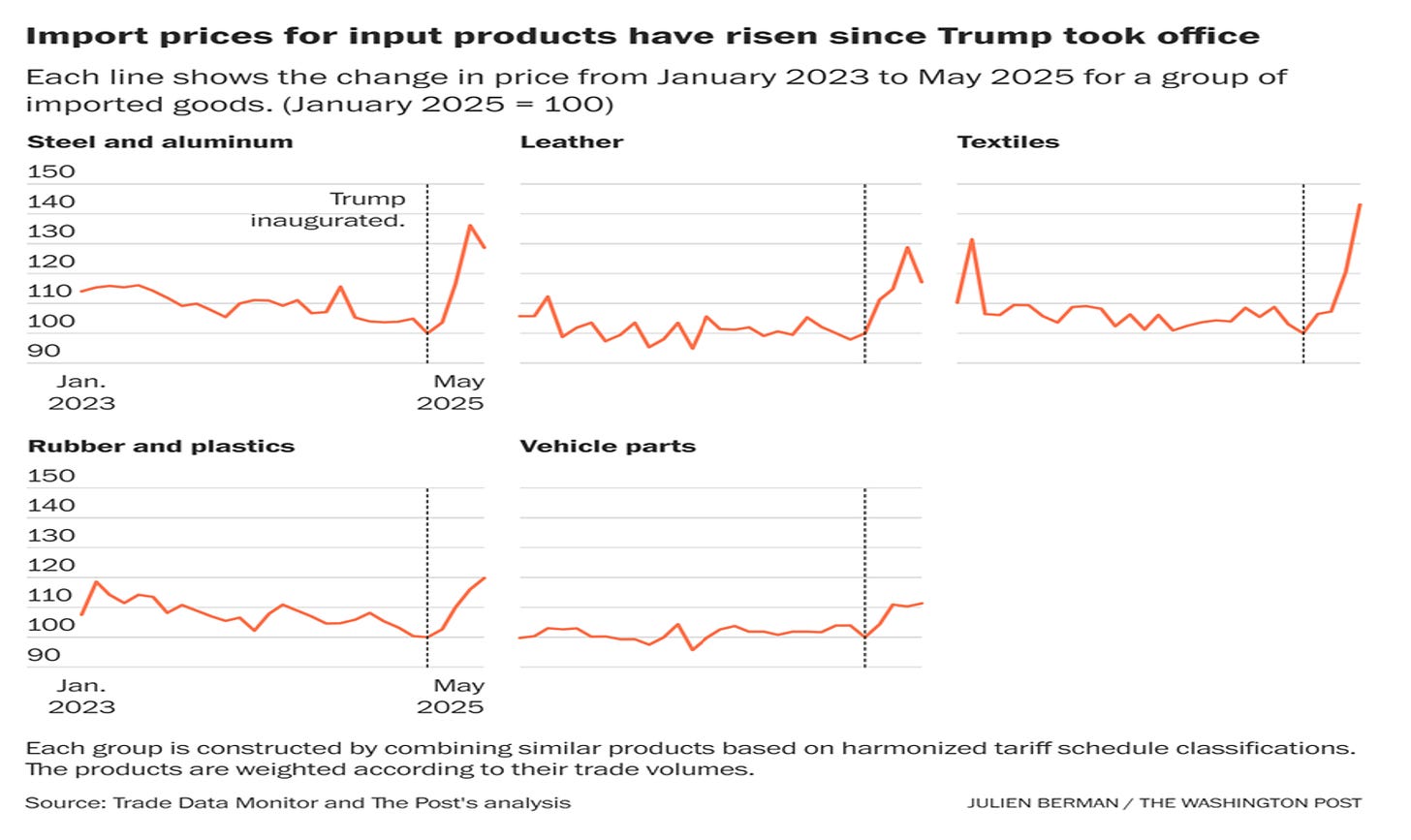
This slide from a WaPo editorial I recently cited goes another level down, showing similar trend-breaks in import prices of tariffed goods that are inputs into domestic manufacturing.
Next, we have the very helpful granular data work by Cavallo et al, who collect proprietary data from large, U.S. retailers with country-of-origin identifiers at the product level. They find that imported goods prices have gone from below domestic prices to above, with jumps around tariff dates (click through their paper for more evidence; note the price movements of Chinese imports).
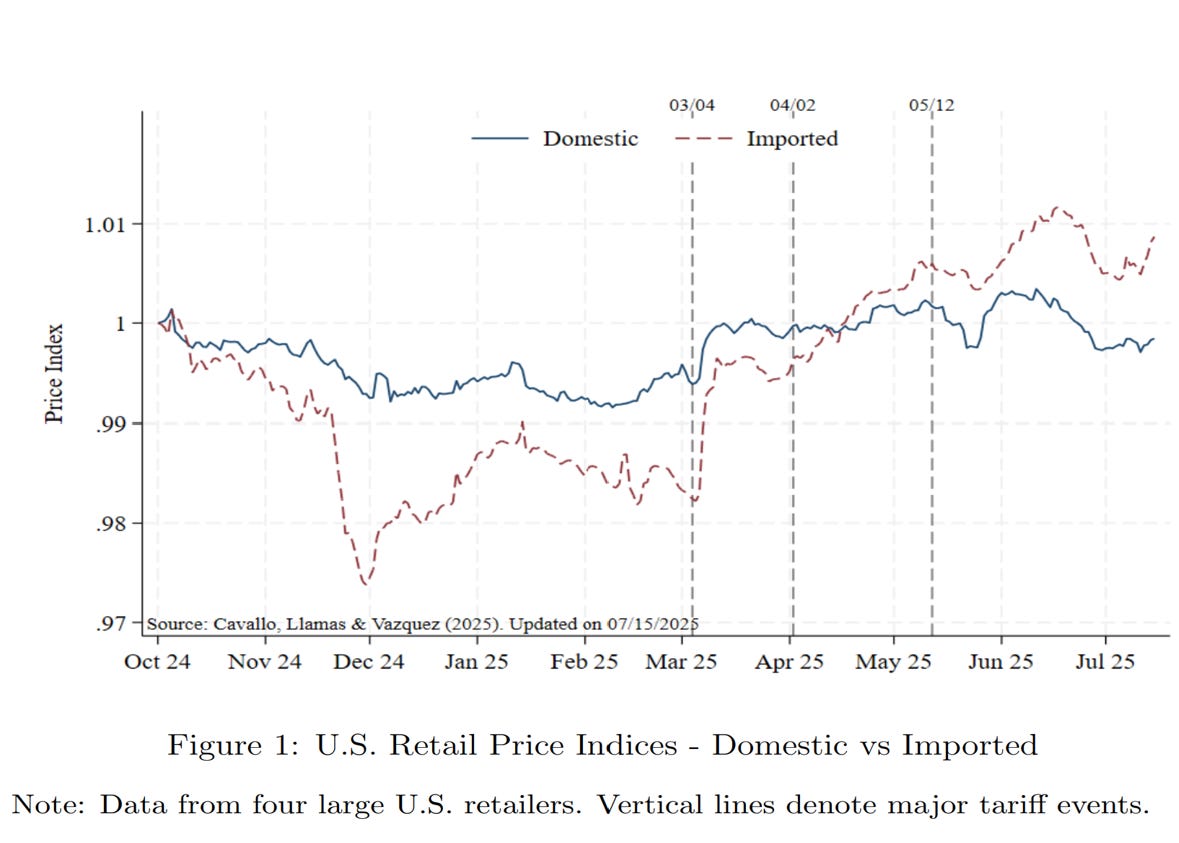
My conclusion at this point is that while some prices, as shown, seem clearly nudged up by the tariffs, the overall price index is not spiking. However, we now enough have evidence at to “issue an indictment.” The question is where does this go from here? In this regard, the tariff revenue slide is striking. As readers know, my prior is that as some of the buffers that were heretofore blocking passthrough (inventory buildups, higher profit margins) start to fade, more price passthrough to consumers will be forthcoming.
One area to watch closely, also linked intimately to affordability concerns, is imported groceries. There’s some early price-pressure evidence there too which I’ll feature in forthcoming posts.
The Big, Ugly Budget Appears to be Getting Into the Price-Hike Businesses, in a Key Sector
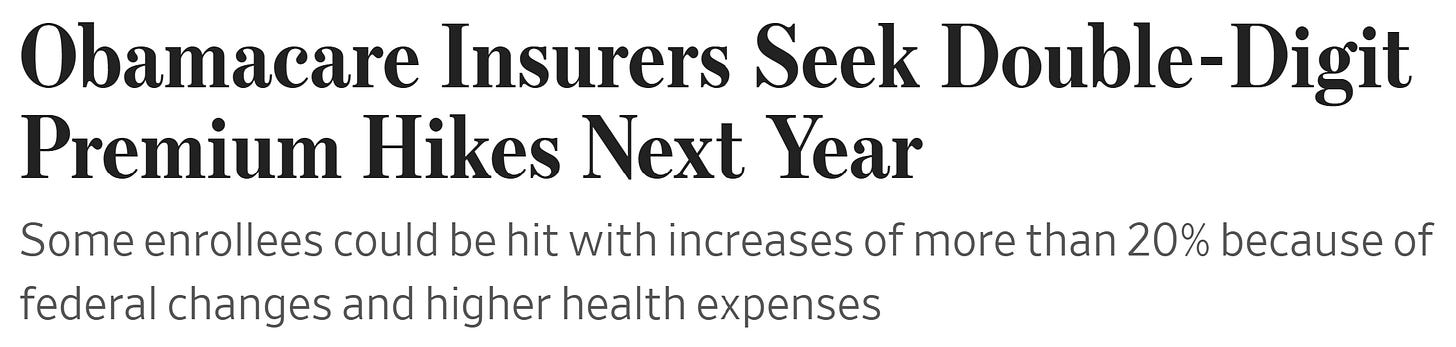
Trump’s wrong-way affordability assault is by no means limited to tariffs. Here’s a WSJ headline from yesterday :
My bold:
“The companies say the big increases are needed because of higher healthcare costs and changing federal policy, including cuts to subsidies that help consumers pay for plans .”
CBS News offers a helpful reminder of the magnitudes impacted by these cost increases:
Most of the 24 million people in Affordable Care Act health plans face a potential one-two punch next year — double-digit premium increases along with a sharp drop in the federal subsidies that most consumers depend on to buy the coverage, also known as Obamacare.
This is coming soon, by the way, as the ACA tax credit disappear next year. And remember, those subsidy cuts were legislated to help partially offset the budgetary costs—trillion is lost revenues—caused by tax cuts for the wealthiest households.
It’s clear why lower subsides raise out-of-pocket costs, but why should they raise premiums? My SIEPR colleague Neale Mahoney will have more to say on that shortly and I’ll link to his explanation here (the video at the CBS link is good on this too, getting into the adverse selection problem).
Deportation and Prices: The Part of the Sentence Stephen Miller Willfully Ignores
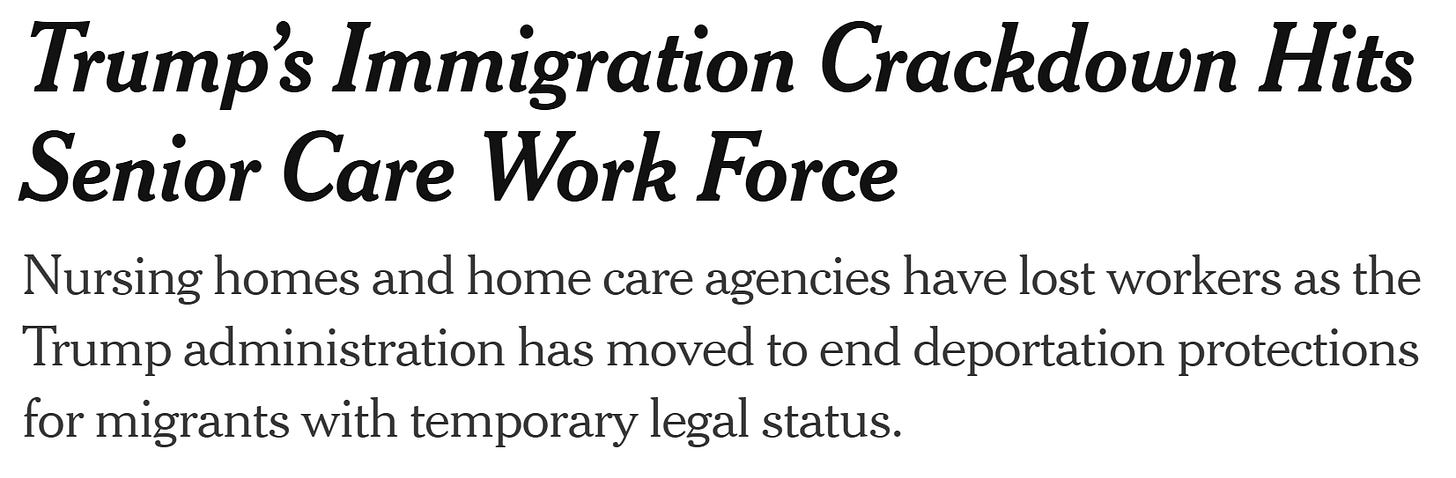
Here’s an NYT headline about another critically important sector that’s starting to face Trumpian-policy-induced price pressures:
Again, my bold:
…the long-term care industry already faces persistent challenges in recruiting workers. Providers say the reduction in staff could threaten the quality of services they are able to offer to the nation’s senior population. Some said they would have to raise wages to attract more workers to fill positions, and they were set to pass on cost increases to people receiving care.
I once heard Trump’s xenophobe-in-chief Stephen Miller go through the economics of his agenda. It amounts to the first part of the last sentence in the quote above: reduce labor supply by deporting immigrants and you’ll raise the price of labor—wages—for native-born workers.
That’s true but very incomplete. As I’ve noted before, it ignores the pro-growth effects of immigration through both increased labor supply and the increased demand for goods and services by immigrants themselves.
But in this context, it’s the last part of the sentence that matters. Higher wages don’t just come out of profits. They can also get passed through to prices and the nature of senior care—labor intensive without a lot labor-saving technology options—makes that a likely outcome. 1
Summing up, when it comes to affordability, the Trump administration is pushing remarkably hard in the wrong direction. Given the economic, and even more so for these guys, the political salience of the affordability crisis, this seems like not just terrible economics but terrible politics.
Thus, I conclude as follows: any opponent of this administration who can’t craft the above into a compelling argument as to why this regime must go needs to look for a new line of work.
I can hear some critics say “why do you never say that when you’re advocating for higher minimum wages?” But I do. I always say higher min wages are absorbed by the three p’s: prices, profits, productivity. In senior care, as noted, productivity gains don’t look like much of an option, though reduced margins could also be an absorption source here, though I wouldn’t count on it.
Whatever
Tags
Who is online
117 visitors
Yeah... sorry, folks.... More fucking NUMBERS!! How BORING!
Besides, MAGA_True_Believers©, like their beloved Master, don't need facts. Like HIM, they go with their gut feelings.
Bernstein speaks a language that MAGA_True_Believers© do not understand - that they do not want to understand.
This, this right here, is a disturbing truth, and has certainly been not just one, wasted by the "innocence", on occasion, wasted exclusively on our youth
When Trump and Lutnick and the other billionaire mouthpieces go out on tour touting "lower prices" what they mean is lower prices for the millionaire/billionaire class. Not lower prices for the American people.
They go home and laugh it up at the scam they pulled over on working class Americans.